



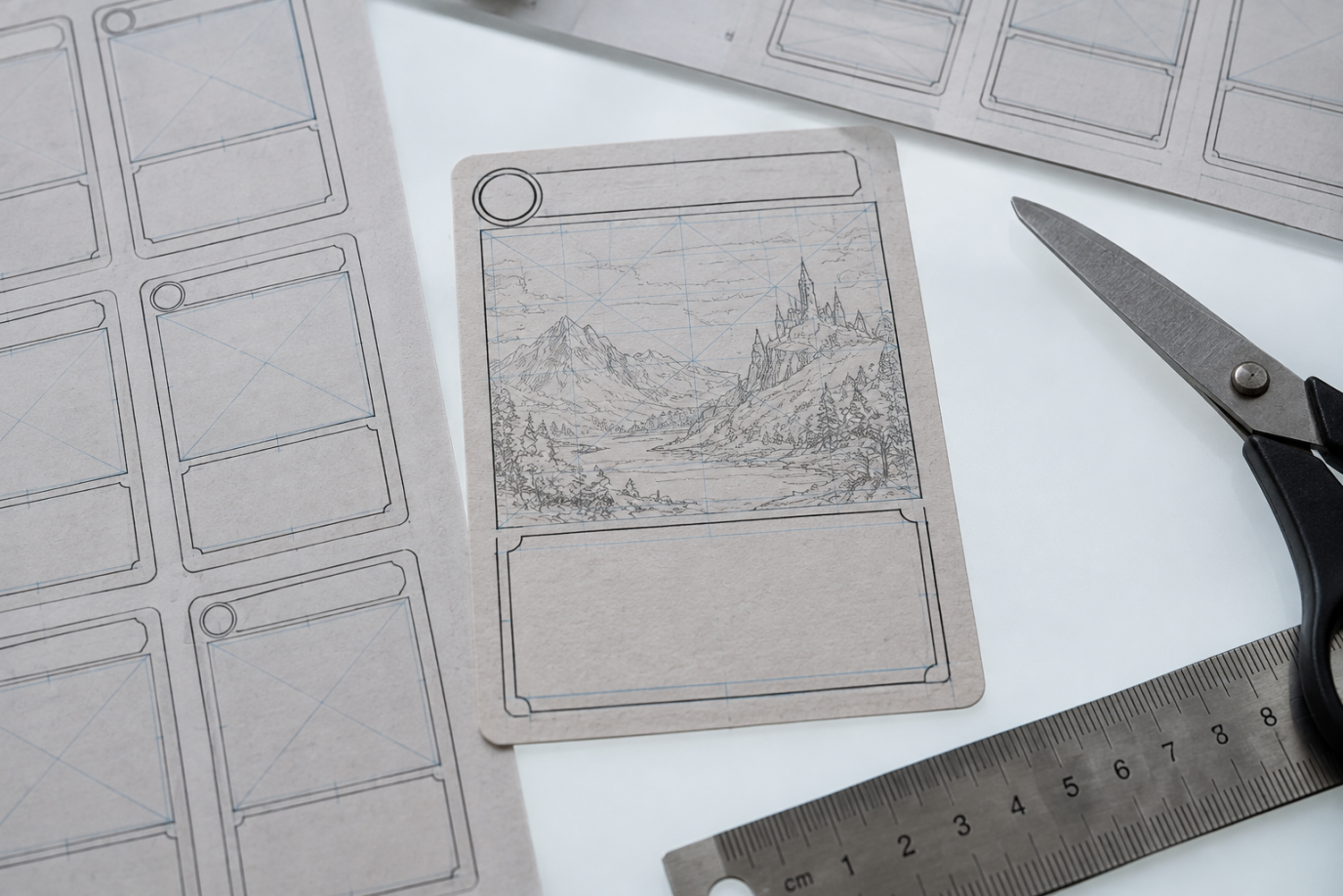
Designing a trading card game isn't the same job as designing one great illustration, or even one cohesive deck. A TCG has to work as a system, dozens or hundreds of cards that all read clearly mid-match and still feel like they belong to the same game. Hand someone fifty cards and they should be able to tell it's one game, not fifty unrelated ideas glued together.
Here's how that process actually plays out once you've got a concept you're ready to build..
Card Layout Comes Before Art
Every strong TCG runs on one layout, applied to every card no matter what it does. Where the name sits. Where cost and stat icons go. How much room the rules text gets. Where flavor text lives if you're using it. All of that gets decided before a single custom TCG cards gets illustrated.
This matters more here than in almost any other card format, because players are scanning cards fast, mid-game, under pressure to make a decision. If cost icons drift depending on the card, or rules boxes change size from card to card, people notice — maybe not consciously, but their read speed drops, and a game that's slow to parse at the table gets abandoned faster than a game that's just hard to master.
Design for Function, Not Visual Appeal Alone
It's easy to get pulled into making every card as visually dramatic as possible, especially if art is your strongest skill. But a TCG card isn't just meant to look good. It has to communicate every piece of mechanical information instantly, even to someone playing for the first time.
A few habits worth keeping in mind:
Icon-first thinking
Anything a player needs mid-game, like cost, type, or rarity, should be instantly recognizable from the icon alone. They shouldn't have to read the text to figure it out.
Consistent text hierarchy
The name, type line, and rules text should appear in the same relative size and weight across every card. A player should know exactly where to look before they've even focused on the words.
Contrast over decoration
Rules text sitting on top of busy artwork needs a background panel or box with enough contrast to stay legible. Sometimes that means sacrificing a bit of visual flair, and that trade-off is almost always worth it.
Build a Fair and Interesting Rarity Structure
Rarity tends to be the part new designers get most excited about, but it's doing real mechanical work: it shapes deckbuilding, it shapes how a pack feels to open, and it shapes whether the game has any long-term legs.
A structure that holds up usually breaks into a few clear tiers. Commons carry most decks. Uncommons add the strategic texture. Rares should feel exciting to pull, but not required to win. The failure mode to avoid is a rare so powerful that a match is basically decided by who happened to pull it — that turns rarity into a source of frustration instead of excitement for anyone who didn't get lucky in a pack.
Playtest for Balance, Not Just Fun
A TCG needs a different kind of playtesting than a standard card game, because the goal is making sure two players with any two reasonable decks can have a competitive match.
That means testing extreme deck builds on purpose, not just the ones you expect people to build. Designers who only playtest with decks that seem sensible tend to get blindsided later, once real players start experimenting.
It also helps to track win rates across different card combinations while playtesting, and make adjustments before anything goes to print.
Art Direction Should Serve the Whole Set
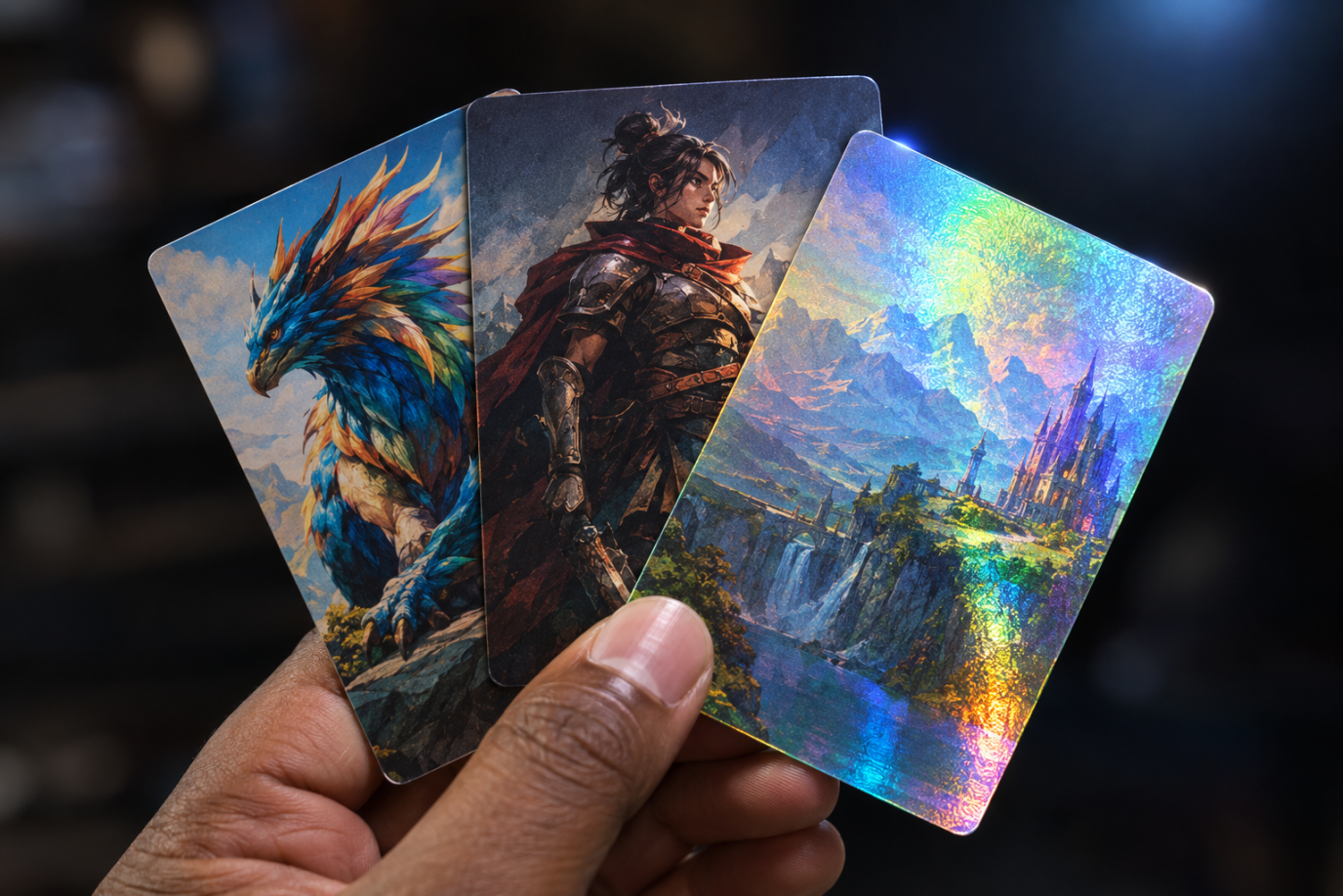
Once gameplay and structure are settled, art direction comes next. That means setting a color language tied to specific card types or factions, so players can recognize a card's alignment on sight, a fire-aligned card versus a water-aligned one, for example.
It also means briefing artists on what each card actually does, or keeping that in mind if you're illustrating it yourself. An aggressive attack card might call for a high-energy pose, while a defensive card reads better grounded and steady.
These choices affect how the game plays before a reader has even gotten to the text.
Consider Production Choices
Cards in a real deck get shuffled, sleeved, and handled constantly. They need to survive that, not just look good the first time someone pulls one out of a pack. Stock weight, corner rounding, and finish all affect how the set holds up over months of actual play, not just how it photographs on day one.
Bringing a Card Deck Together
A finished TCG set needs a locked structure, a fair rarity system, tested balance, art direction that reinforces the gameplay, and high-quality printing. None of these work well in isolation.
A beautifully designed card with confusing text will frustrate players, and a balanced card that looks generic won't generate any excitement.
Getting all of it right is what turns an idea into a deck that players actually want to keep coming back to.