



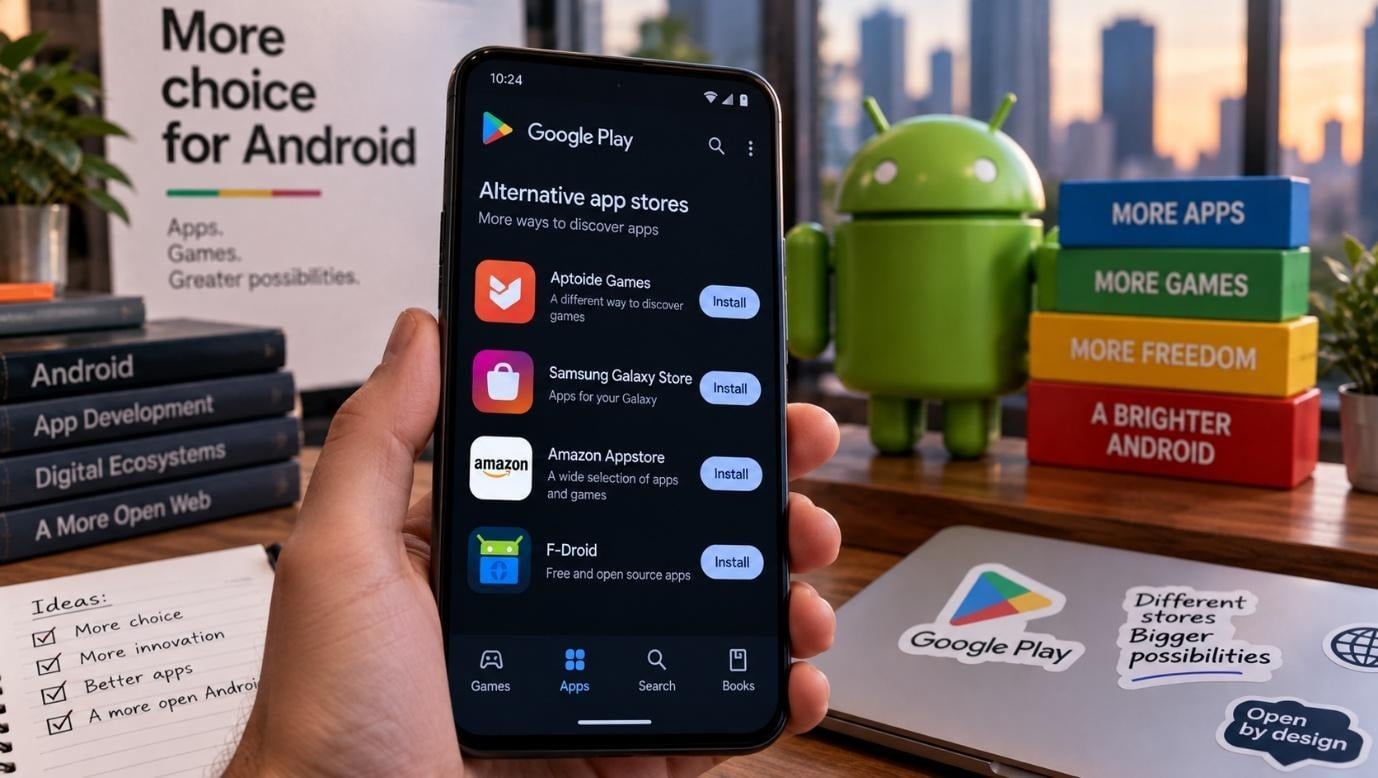
Android has always been more open to alternative software distribution than tightly controlled mobile platforms, but most US users still rely on Google Play for everyday downloads. That dynamic shifted in August when Google began allowing approved third-party app stores to be distributed through the Play Store itself.
Aptoide becomes the first rival store inside Google Play
9to5Google reported that Google Play had begun distributing third-party Android app stores in the United States, with Aptoide Games as the first visible participant. That lets users install a competing store through Google Play instead of first downloading an APK from the open web.
For Android enthusiasts, the most interesting part is how normal the installation flow can become. Sideloading has always been possible, but it asks the user to leave the main store, download a package and approve installation from another source. Discovering a rival store inside Google Play removes several of those steps. That does not make every alternative marketplace trustworthy, but it makes competition in app distribution much more visible to ordinary users.
More choice also creates more responsibility
Opening the Play Store to rival marketplaces does not mean Google is taking responsibility for everything they distribute. Google says third-party stores have their own security and privacy practices, and that downloads, payments and updates for apps obtained from those stores are managed by the third party.
Developers will still have to decide whether another store is worth supporting. A second marketplace can offer new discovery opportunities, yet it also creates another release channel to maintain. Update schedules, billing, ratings, customer support and promotional assets may differ between stores. Smaller studios, in particular, will need to judge whether the extra reach justifies the ongoing operational work, rather than treating every new distribution option as automatically beneficial.
Games can now arrive through more than one route
The change broadens the ways Android users can access digital entertainment. Some games arrive through Google Play, some through alternative stores and others are accessed directly in a browser. An online Plinko game online is an example of the browser route, which does not depend on a conventional app store listing. For Android users, the bigger trend is that “where an app or game lives” is becoming less predictable than it was when one storefront dominated discovery.
Payments could become one of the clearest differentiators. An alternative store can manage transactions under its own commercial model, but that also means users have to understand who is handling a purchase and where to request support or a refund. Google explicitly separates its responsibility from transactions completed through third-party stores, so clear checkout branding will be important to avoid confusion under the new model.
Regional rules and user behaviour will shape adoption
There is also a regional dimension. The current programme is tied to the US market and exists within a broader legal and competitive debate around mobile platforms. Android distribution rules already vary by jurisdiction, so developers cannot assume that a store strategy that works in one country will work everywhere. Global app teams may end up managing a patchwork of distribution options due to local regulations and platform policies.
The programme's success will ultimately depend on user behaviour. If people install rival stores but continue searching only on Google Play, the competitive effect could be modest. If specialised marketplaces build strong catalogues and recognisable identities, Android could develop a more plural retail layer. Either way, the change turns an abstract argument about platform openness into something users can now see directly on their phones.
Google still draws a line around responsibility
Google’s Play Console guidance says participating third-party stores must target US users, be registered organisations, operate as legitimate marketplaces and maintain the necessary developer authorisations. Those requirements show that opening distribution to rival stores is not the same as removing platform-level rules.
The practical impact will depend on how many rival stores join the programme and whether users can actually find them. Discovery friction remains a major factor: an alternative marketplace can only compete if people know it exists and trust it enough to install it.
For developers, the shift creates another distribution decision alongside direct Play Store publishing, web apps and sideloading. For users, it introduces more choice but also more responsibility to understand who manages payments, updates and security. Android’s openness is becoming more visible inside the Play Store itself, and that may prove more consequential than any single new app listing.