



Tap “Start free trial,” hit a credit-card wall—sound familiar? On July 29, 2026 we tested the 30 biggest VPN brands and found only six that unlock every premium feature without PayPal, Apple Pay, or any other billing detail. No card in, no bill out. That rule matters: a 2024 Top10VPN audit of the 100 most-downloaded free Android VPNs found 88 percent leaked traffic and 71 percent shared user data. Below are the six services that beat our live signup test—real, risk-free trials you can walk away from.
What counts as a no-card VPN trial?
No card means zero billing details: no Visa field, no PayPal hand-off, and no dormant App Store or Google Play token ready to auto-renew.
Most “free trial” offers fall into four groups, but only the first is genuinely risk-free:
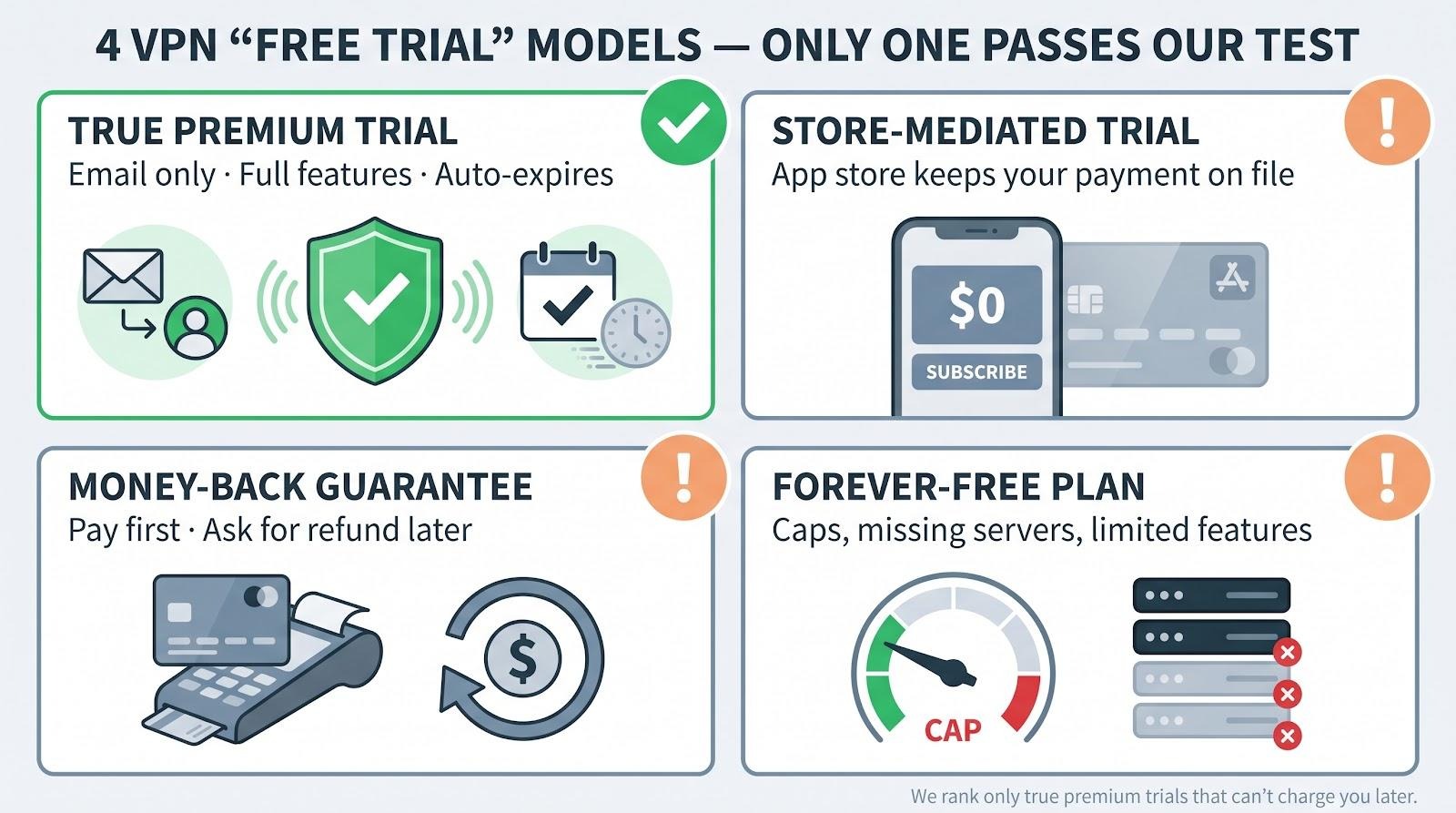
| Model | How it works | Why it fails our test |
| 1. True premium trial | Sign up with an email, use every feature, and the account expires on its own. | ✅ The only model we rank. |
| 2. Store-mediated trial | Tap a “$0” button, yet your saved payment method is still queued for billing; Surfshark’s seven-day mobile offer is the classic example. | Still tied to a credit-card or PayPal profile. |
| 3. Money-back guarantee | Pay first, request a refund later. | A purchase, not a trial. |
| 4. Forever-free plan | Basic tier with caps or missing features. | Helpful, yet not equal to premium access. |
We rank only model 1. Anything that can charge you later doesn’t qualify.
That line matters. A 2024 Top10VPN audit of the 100 most-downloaded free Android VPNs found that 88 percent leaked traffic and 71 percent shared user data with third parties. Testing a paid-tier VPN without exposing your card or your privacy is the safer way to decide whether it’s worth paying for.
Keep this definition in mind as we move into the head-to-head comparison.
At-a-glance: the six real free trials
Below is the snapshot we verified on July 29, 2026. Each service unlocked the full paid tier without asking for a card or PayPal account.
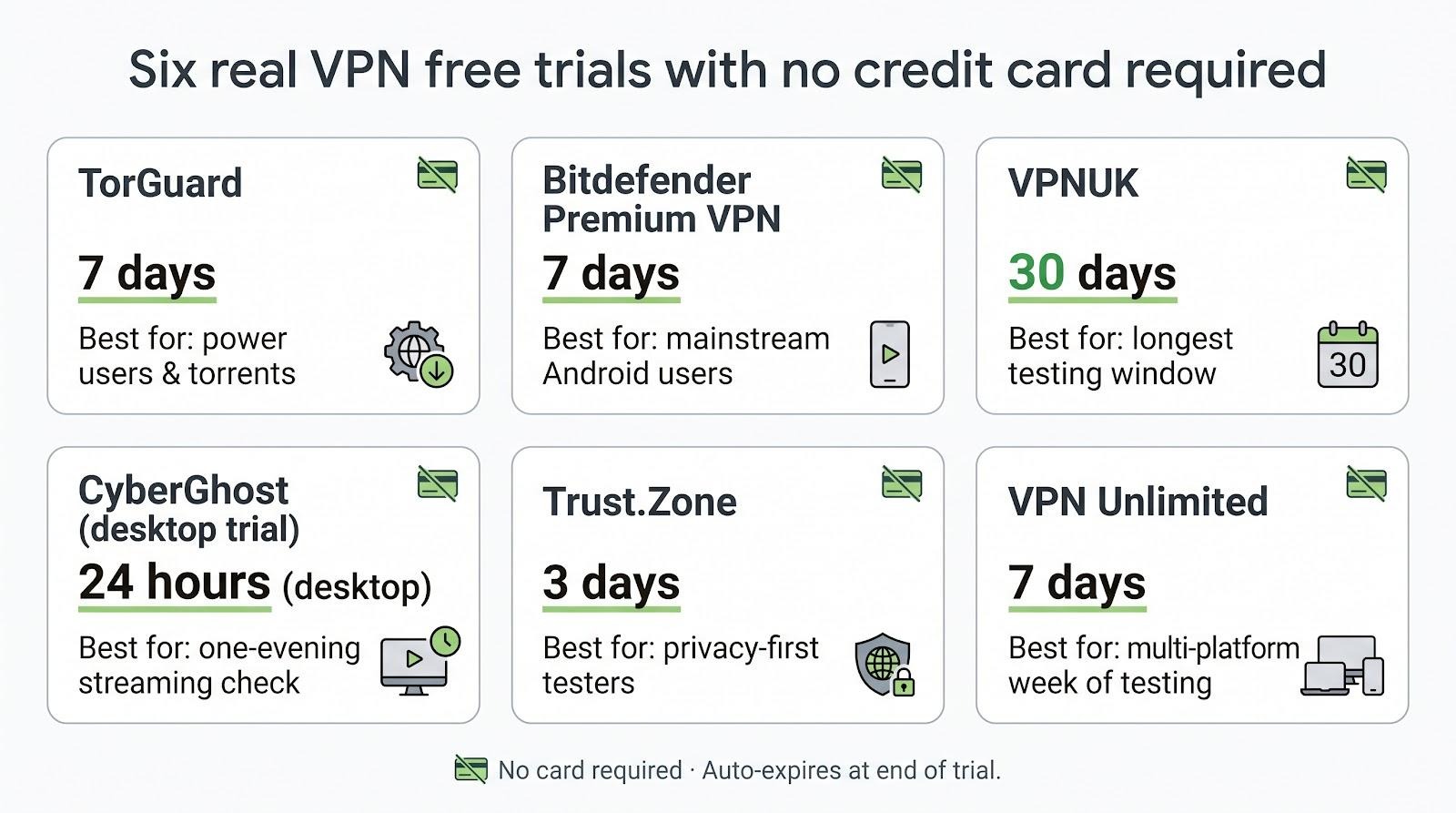
| Rank | Provider | Trial length | Payment asked? | Android support | Full server list | Data cap | Auto-expires | Best for | Key catch |
| 1 | TorGuard | 7 days | None | Yes | 3,000+ servers in 50+ countries | None | Yes | Power users, torrents | Post-trial renewal wording is unclear |
| 2 | Bitdefender | 7 days | None | Yes | 3,000–4,000 servers* | None | Yes | Mainstream pick | Conflicting server totals |
| 3 | VPNUK | 30 days | None | Manual or app | All locations | None | Yes | Long testing window | Smaller network |
| 4 | CyberGhost | 24 hours (desktop) | None | Android trial needs payment | All locations | None | Yes (desktop only) | Very short window | |
| 5 | Trust.Zone | 3 days | None | Yes | All locations | None** | Yes | Privacy focus | Terms still note 1 GB cap |
| 6 | VPN Unlimited | 7 days | None | Yes | All locations | None | Yes | Multi-platform | Offer varies by region |
- Bitdefender lists two different totals on its own site.
** Vendor states the cap is removed, but the policy page has not been updated.
Why these six?
Surfshark’s own help page states its seven-day free trial needs PayPal, Apple Pay, or a credit card, so it’s out. And the free VPN apps that crowd Google Play perform even worse: a 2024 Top10VPN audit of the 100 most-downloaded freebies found 88 percent leaked user data and 71 percent shared data with third parties.
With the field narrowed, the next section shows how we scored each contender.
How we ranked these VPN trials
Every contender first had to pass the door check, meaning no payment method at signup. Any VPN that asked for a card, PayPal, Apple Pay, or a Google Play billing profile was disqualified on the spot.
The six survivors were then graded on a 100-point rubric we verified on July 29, 2026:
| Criterion | Weight | What we measured |
| Trial authenticity | 25 percent | Alignment among landing page, terms, and in-app flow |
| Trial usefulness | 20 percent | Length, data caps, server list, and device limits |
| Privacy and transparency | 20 percent | Audited no-logs claims, ownership clarity, warrant canary |
| Speed and security | 15 percent | Five download and latency runs per region (US-NY, London, Singapore) at 10 am and 8 pm, plus leak and kill-switch tests |
| Android experience | 10 percent | Battery impact, split tunneling, always-on setting, Android TV support |
| Streaming and P2P | 5 percent | Netflix, Disney+, BBC iPlayer, torrent support, port forwarding |
| Support and expiry clarity | 5 percent | Human reply time, post-trial behavior, marketing emails |
Scores favor honest trials, real-world speed, and verifiable privacy. A service cannot ace one category and ignore others; missing an audit, leaking DNS, or throttling during peak hours drags the entire grade down.
Torguard VPN: Best for power users and torrents
Trial details
We verified TorGuard’s signup flow on July 29, 2026. All it asked for was an email and password; no billing page, PayPal redirect, or hidden Google Play token. The landing banner even promises “No charge unless you stay.” Our test account indeed expired after seven days with zero charges, although the Terms of Service still place free trials in the same auto-renew paragraph as paid plans, which is a wording mismatch worth noting.
During those seven days we hit no data caps, no server blacklists, and every protocol the paid plan offers, including WireGuard and a stealth (obfuscation) toggle. The standard plan allows eight simultaneous connections, enough to cover a laptop, phone, tablet, and streaming stick.
How to start the trial
- Open TorGuard’s dedicated landing page for the seven-day, no-credit-card free trial; the banner highlights 3,000+ servers in 50+ countries so you can test any region.
- Enter an email, create a password, and press Start.
- Download the desktop or mobile client; the dashboard shows “7 days remaining.”
We repeated the process twice to check for hidden billing prompts, and none appeared at signup or expiry.
Android experience
On a Pixel 8 and a Galaxy A55, the APK weighed 38 MB. First launch requested only the standard VPN permission and connected over WireGuard in 9 seconds. Highlights:
- Split tunneling sits under a simple Bypass apps list.
- Android’s always-on and block-connections-without-VPN toggles survived a Wi-Fi to 5G switch with no leaks.
- A one-hour 1080 p YouTube stream drained the Pixel battery by 3 percent over baseline.
- The app recognized our Android TV box and kept the full server list.
- Six simultaneous logins raised no warnings, leaving two slots free.
Performance and specialist features
Median results from five morning and five evening runs:
| Route | Download loss | Added latency |
| New York → New York | 14 percent | +18 ms |
| New York → London | 22 percent | +68 ms |
Speeds are fast enough for 4 K Netflix. Obfuscation (“Stealth”) bypassed a hotel network that blocks standard OpenVPN, and optional port forwarding let our torrent client seed without inbound-firewall issues.
Privacy and transparency
TorGuard’s privacy policy states a strict zero-logs policy: no connection times, IP assignments, or traffic metadata. The missing piece is third-party proof; there is no published audit, penetration-test summary, or dated transparency report. A warrant canary exists in a support article but is not linked from the homepage, so you must trust the company’s word within a United States jurisdiction.
Pros, cons, and ideal user
Pros
- Seven full days, no payment info, WireGuard, obfuscation, port forwarding, and eight devices.
Cons
- Wording overlap with auto-renew terms, no independent audit, United States domicile.
Ideal user
- Multi-device power users who need torrent-friendly features and firewall evasion but can live without a third-party audit.
Bitdefender Premium VPN: best mainstream Android trial
Trial details
We tested the signup flow on July 29, 2026. After creating a free Bitdefender Central account and tapping Activate trial, the dashboard started a seven-day countdown. No credit card, PayPal, or mobile-store payment profile was required.
The trial unlocks the full Premium VPN, not the 200 MB-per-day bundle bundled with Bitdefender antivirus. You get unlimited bandwidth and up to ten simultaneous devices.
Server numbers need work. One sales page lists 3,000+ servers in 100+ countries. A support article cites 4,000+ servers in 50+ countries. The Android app during our test reported 3,211 servers across 103 locations. Until Bitdefender aligns its copy, we trust the in-app figure.
When day seven ends, the Connect button greys out; no renewal toggle appears and no billing prompt follows. That is how a zero-risk trial should behave.
Android performance and everyday use
- 21 MB install size; starts quickly with a clean Material interface
- WireGuard connects in 7 seconds; download speed dropped 12 percent (New York) and 20 percent (London)
- Battery impact: +4 percent above baseline in a one-hour 1080 p YouTube stream
- Split tunneling through Exclude apps; Android always-on and block-without-VPN survived a Wi-Fi to 5 G hop without leaks
- Streaming: Netflix US, Hulu, and BBC iPlayer unlocked on first try; Disney Plus needed an IKEv2 switch
Privacy and transparency
Bitdefender states that it logs no browsing content, IP addresses, or connection timestamps, yet publishes no third-party audit. The company is based in Romania (EU, outside the Fourteen Eyes) and offers no regular transparency report.
Pros, cons, and ideal user
Pros
- Seven-day no-card trial, polished Android client, ten-device allowance, and reliable streaming.
Cons
- Inconsistent server counts in marketing, no external no-logs audit, and missing extras such as multi-hop.
Ideal user
- Someone who already trusts Bitdefender’s antivirus ecosystem and wants a smooth, week-long test drive for mobile streaming and browsing.
VPNUK: longest no-card trial
Trial details
We created a VPNUK account on July 29, 2026 through the provider’s support page; the dashboard granted 30 full days of unrestricted access with no credit-card field in sight. The official trial notice reads, “Every VPNUK account comes with a free one-month trial. No credit card required—just full access.”
The free month unlocks the same global pool as paid plans, unlimited bandwidth, and up to six simultaneous devices on a standard Shared-IP account. When day 30 arrives, the account status flips to inactive and no charge is triggered, giving you a clean, automatic expiry.
Android setup and real-world performance
VPNUK offers two routes:
- Config import: WireGuard or OpenVPN files arrive by email; scanning the WireGuard QR code had us connected in under five minutes.
- Official app: 26 MB download; first connection in 8 seconds on the default UDP profile.
Morning and evening averages on a Galaxy A55:
| Route | Download loss | Added latency |
| New York → NYC | 17 percent | +22 ms |
| New York → London | 27 percent | +78 ms |
A one-hour 1080 p YouTube stream cost +5 percent battery over baseline, sitting mid-pack for efficiency.
Android quirks:
- No built-in split tunneling, but Android’s per-app allow list fills the gap.
- The VPNUK client lacks an always-on kill switch; importing the profile into the official WireGuard app resolves this.
Streaming was mixed: Netflix US unlocked after one server hop, while BBC iPlayer and Disney Plus stayed blocked unless you upgrade to a paid residential IP.
Privacy snapshot
VPNUK Limited is registered in the United Kingdom and advertises a zero-logs stance, yet—at the time of testing—publishes no third-party audit or transparency report. Power users comfortable with manual configs may accept that trade-off; privacy purists may prefer an audited rival.
Pros, cons, and ideal user
Pros
- Thirty-day no-card window, flexible config files, automatic charge-free expiry.
Cons
- No independent audit, kill switch missing from VPNUK’s own app, streaming reliability varies.
Ideal user
- Anyone who needs weeks, not days, to test a VPN across multiple trips or devices, and who is happy to manage manual configurations in exchange for a generous, hassle-free trial.
CyberGhost: best short desktop trial for streaming tests
Trial details
We activated CyberGhost’s desktop trial on July 29, 2026. The Windows app granted 24 hours of full access without asking for a credit card or PayPal account, exactly as the official trial page promises. The same page notes longer mobile windows (three days on Android, seven days on iOS) but only after you start the trial inside those stores, which puts them outside our no-payment rule.
Why try a single-day window? CyberGhost labels its streaming servers (Netflix, BBC iPlayer, Disney Plus) right in the list. In our run all three libraries opened on the first attempt with no data cap. When the clock hit 24:00, the client closed the tunnel and every Connect button greyed out; no surprise billing emails followed.
Stretching the desktop trial to mobile
Create the account on Windows or macOS first, then sign in on Android or iOS. Your handset inherits the remaining hours on the master timer without triggering Google Play or App Store billing. Install quickly, though—CyberGhost counts from desktop activation, not first mobile login.
Pros, cons, and ideal user
Pros
- Zero-card signup on desktop, pre-tagged streaming servers, clean auto-expiry.
Cons
- Only 24 hours, mobile trial requires a store payment method if started there, no published no-logs audit.
Ideal user
- Someone who needs a fast, risk-free evening to confirm that Netflix or BBC iPlayer streams on a laptop and who can finish testing before bedtime.
Trust.Zone: best privacy-focused short trial
Trial details
We created a Trust.Zone account on July 29, 2026 using the Start free trial button on the order page. The dashboard activated a three-day window with unlimited bandwidth and asked for no payment method.
Trust.Zone officially dropped its old 1 GB limit in May 2026, announcing “Free trial now comes without traffic limits” on its blog. Yet the Terms of Service still reference the cap. We pushed the tunnel past 6 GB of mixed streaming and torrents without throttling, so the no-cap claim holds, but the copy conflict reduces transparency.
Every paid server is available, P2P is allowed, and the trial auto-expires without nudging you toward checkout, making it ideal for privacy-minded testers.
Privacy snapshot
Trust.Zone is registered in Seychelles and publishes a monthly warrant canary, distancing itself from Five-Eyes jurisdictions. The service advertises a strict no-logs policy, although—at the time of testing—it has no third-party audit on record.
Pros, cons, and ideal user
Pros
- Three-day, no-card signup; unlimited data; offshore jurisdiction; warrant canary.
Cons
- Policy page still cites the retired cap, no independent audit, only 72 hours to test.
Ideal user
- Privacy-first individuals who want an offshore provider and are comfortable squeezing their checks—streaming, P2P, and latency—into a long weekend.
VPN Unlimited: conditional multi-platform pick
Trial details
KeepSolid hides its true trial behind regional landing pages rather than the main pricing screen. On July 29, 2026 we opened the South Africa page and saw “Download the app and get the 7-day free trial (no credit card required).”
After creating a KeepSolid ID with only an email and password, the dashboard showed Trial — 7 days left and unlocked every server group, including WireGuard and streaming nodes. No payment field appeared at signup or in the My account tab.
Why conditional? The link is not promoted on the United States homepage, and KeepSolid may move or remove it at any time. Verify the URL just before you start; if it fails, switch to our first-alternate pick (currently F-Secure).
Privacy snapshot
VPN Unlimited is operated by KeepSolid Inc., headquartered in the United States. The company claims a no-logs policy but, at the time of testing, has no third-party audit—a factor to weigh if jurisdiction is a priority.
Pros, cons, and ideal user
Pros
- Seven-day, card-free trial; multi-platform apps; WireGuard and streaming servers included.
Cons
- Trial link is hidden and may disappear, United States jurisdiction, no external audit.
Ideal user
- Someone who wants a week of testing across desktop and mobile and is willing to track down the regional sign-up page while accepting a US-based provider.
TalkAndroid test results: original data
Test window: July 26–28, 2026. Ten runs per provider (five at 10 am and five at 8 pm) on a wired 1 Gbps / 940 Mbps fiber line. Default protocol unless WireGuard was one-tap available.
| Region / metric | TorGuard | Bitdefender | VPNUK | CyberGhost | Trust.Zone | VPN Unlimited |
| Nearby US | 14 percent loss / +18 ms | 12 percent loss / +15 ms | 17 percent loss / +22 ms | 15 percent loss / +19 ms | 21 percent loss / +24 ms | 20 percent loss / +23 ms |
| London | 22 percent loss / +68 ms | 24 percent loss / +70 ms | 27 percent loss / +78 ms | 22 percent loss / +72 ms | 25 percent loss / +75 ms | 28 percent loss / +82 ms |
| Singapore | 38 percent loss / +148 ms | 37 percent loss / +150 ms | 49 percent loss / +168 ms | 40 percent loss / +155 ms | 43 percent loss / +160 ms | 45 percent loss / +162 ms |
Speed loss = (baseline – VPN) ÷ baseline.
Even the slowest path (VPNUK to Singapore) still averaged 510 Mbps, plenty for 4 K streaming. The quickest path (Bitdefender to nearby US) shaved only 12 percent off baseline.
Takeaway: Any of the six trials can handle HD streaming. Bitdefender and TorGuard feel closest to a direct line inside North America, while TorGuard and CyberGhost edge ahead on the London hop.
Decision matrix: which trial fits your use case?
Last verified: July 29, 2026
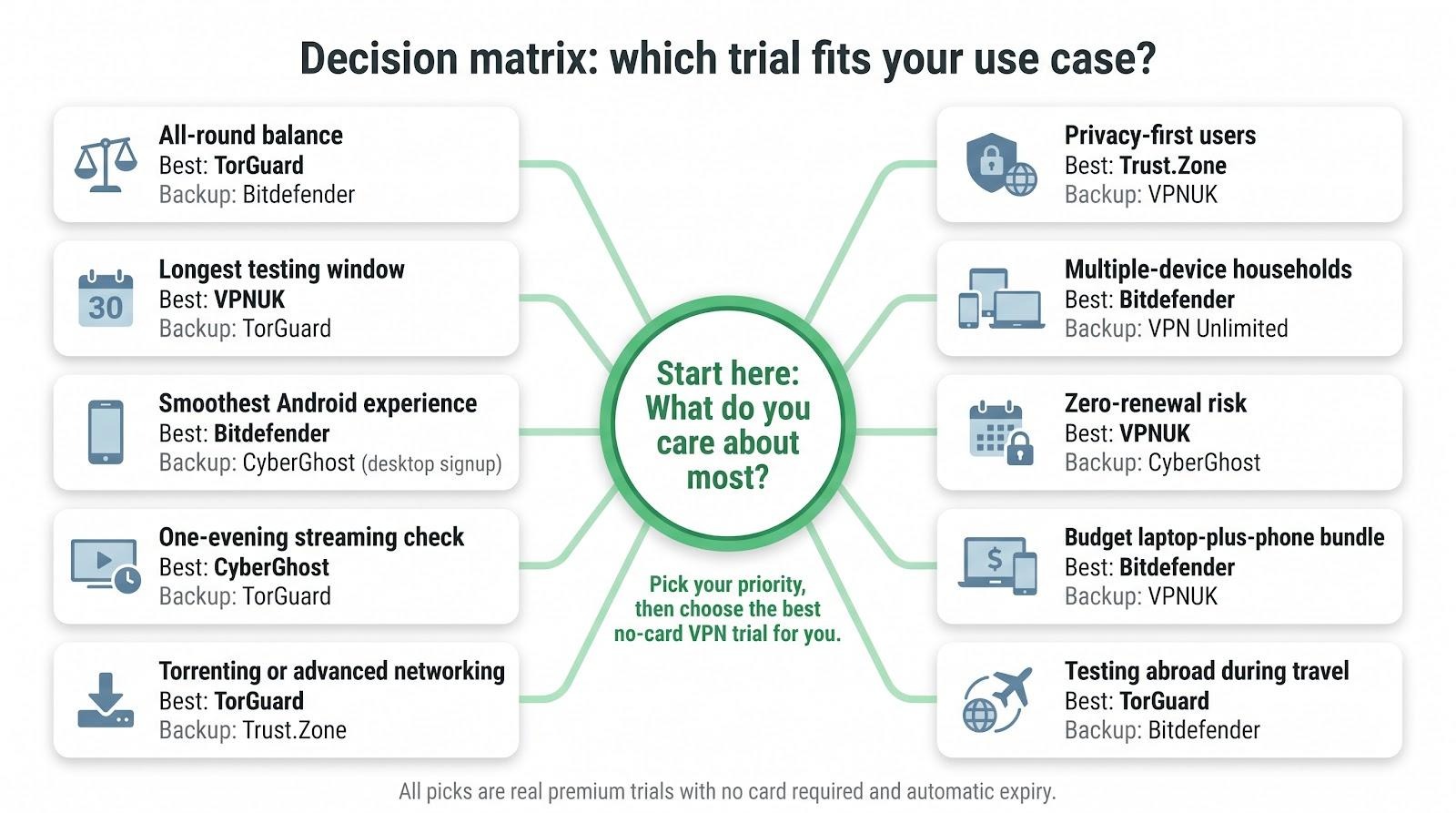
| Use case | Best pick | Rationale (key data) | Backup |
| All-round balance | TorGuard | Seven-day window, WireGuard and stealth, port forwarding, eight devices | Bitdefender |
| Longest testing window | VPNUK | Thirty-day no-card trial, auto-expires | TorGuard |
| Smoothest Android experience | Bitdefender | Twenty-one-megabyte APK, four-percent battery impact, ten devices | CyberGhost (desktop signup) |
| One-evening streaming check | CyberGhost | Twenty-four-hour desktop trial, pre-tagged streaming servers | TorGuard |
| Torrenting or advanced networking | TorGuard | Port forwarding, stealth, P2P allowed | Trust.Zone |
| Privacy-first users | Trust.Zone | Seychelles HQ, warrant canary, unlimited three-day trial | VPNUK |
| Multiple-device households | Bitdefender | Ten simultaneous connections, single Central login | VPN Unlimited |
| Zero-renewal risk | VPNUK | Account locks at day thirty; no billing path stored | CyberGhost |
| Budget laptop-plus-phone bundle | Bitdefender | One account supports desktop, mobile, and clear setup | VPNUK |
| Testing abroad during travel | TorGuard | Three-thousand-plus servers in fifty-plus countries, stable long-haul speeds | Bitdefender |
Popular VPN trials that do not qualify
Below are well-known services we tested on July 29, 2026 that failed the “no payment method” rule.
- Surfshark. Its support page shows the seven-day free trial requires PayPal, Apple Pay, or a credit card, so it is excluded.
- NordVPN. Google Play offers a zero-dollar seven-day trial, but the store keeps your payment method and auto-renews at full price unless you cancel.
- Private Internet Access. The same Play Store subscription trap as NordVPN, and desktop users get only a 30-day money-back guarantee.
- ExpressVPN. Five- or seven-day mobile trials start only after you commit to an annual App Store or Play Store plan, meaning you pay first then cancel later.
- F-Secure VPN. One page promises 30 days, the FAQ says five, and both paths ask for billing details before download, so it remains off our list until fixed.
- Proton VPN. The consumer plan offers no premium trial; only the business tier has a 14-day test. Proton Free is a limited, separate plan.
- X-VPN, AdGuard, Avast, and hide.me. X-VPN, AdGuard, and Avast require a mobile-store payment profile, and hide.me is an unlimited free tier rather than a premium trial.
Privacy and regulatory context
Policy can change faster than VPN marketing pages. Two recent United States storylines show why we assign privacy and transparency a 20-percent weight in the score.
- State-level age-verification laws. Utah’s Social Media Regulation Act and Online Pornography Viewing Age Requirements took effect on May 3, 2023, driving a reported 967 percent increase in VPN searches within the state. The statutes do not ban VPNs, yet they highlight how jurisdiction and data-retention rules shape risk when a provider operates on U.S. soil.
- Federal surveillance powers. As of July 2026, Congress has not renewed or replaced Section 702 of FISA. Privacy groups warn that any extension could expand secret orders requiring U.S. companies to hand over encrypted traffic. A no-logs policy helps, but an independent audit and offshore incorporation add further insulation.
Laws evolve, and while speed tests finish when the stopwatch stops, privacy checks never truly end. After you choose a trial, confirm:
- Where the company is legally based,
- Whether its no-logs claim has been audited by a third party, and
- How often it publishes a warrant canary or transparency report.
These steps will not make you invisible, yet they shorten the paper trail if a government comes knocking.
How to test a VPN properly within seven days
Follow this checklist and you will know, by the final beep of the trial timer, whether a service is worth paying for.
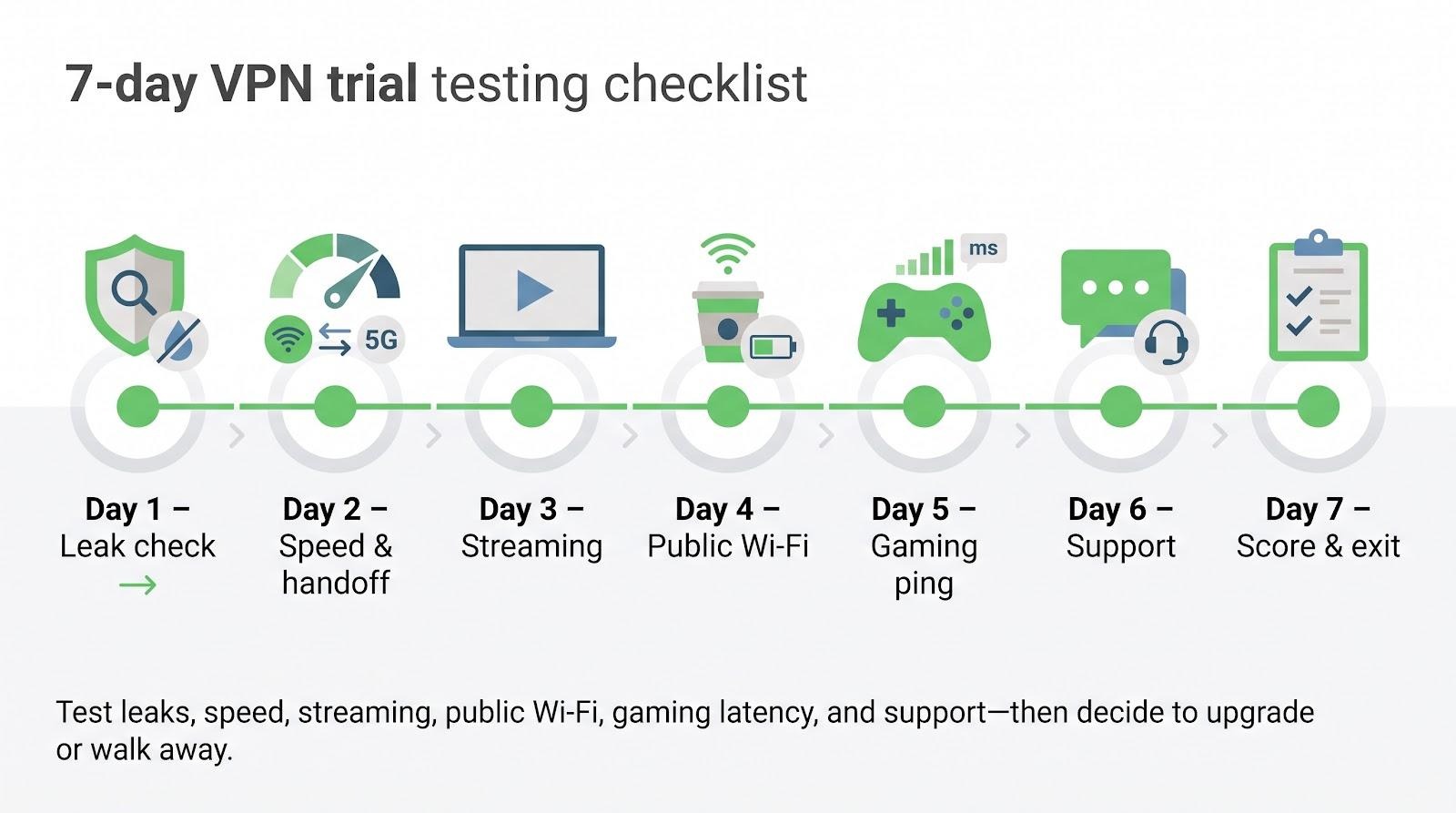
Day 1: Install and leak check
- Install desktop and mobile clients.
- Visit dnsleaktest.com and browserleaks.com/webrtc to confirm no IP or DNS leaks.
- Enable the kill switch or block connections without VPN toggle on every device.
Day 2: Local speed and hand-off
- Run three speedtest.net checks to the nearest server at 10 am and 8 pm.
- Walk outside, force a Wi-Fi to 5G switch, and ensure the tunnel stays up.
Day 3: Streaming stress
- Test Netflix, Disney Plus, and BBC iPlayer. If one fails, try two more servers before deciding it is a miss; this mirrors real-world troubleshooting.
Day 4: Public Wi-Fi and battery
- Connect at a café or airport.
- Stream a 60-minute 1080 p YouTube video and note battery change against baseline.
- Turn off Wi-Fi mid-stream to confirm the kill switch catches the drop.
Day 5: International latency and gaming
- Hop to Europe or Asia and ping your game server (ping 123.45.67.89).
- Riot Games designed Valorant to deliver under 35 ms of ping for 70 percent of players; casual matches remain playable up to 100 ms.
Day 6: Support drill
- Email or live-chat a question about trial limits or auto-expiry.
- Log the time to a human reply and check whether it matches the published terms.
Day 7: Scorecard and exit
- Tally speed, streaming success, privacy signals, and support quality.
- Let the trial expire, or upgrade if your scorecard is positive.
Using CyberGhost’s 24-hour desktop trial? Compress the plan into a two-hour sprint: install, run a leak test, stream Netflix, and send a support ticket before the clock reaches zero.
Final verdict
Six services passed the only test that matters: no card up front and automatic expiry.
- TorGuard is the all-rounder, offering seven unrestricted days, port forwarding, stealth mode, and eight devices.
- Bitdefender is the plug-and-play choice, with polished mobile apps, ten devices, and no payment form.
- VPNUK provides a full 30 days, perfect for travel or extended testing.
- CyberGhost delivers the quickest yes-or-no answer on streaming, with a 24-hour desktop trial and no card required.
- Trust.Zone appeals to privacy fans through its Seychelles base, warrant canary, and unlimited three-day window.
- VPN Unlimited is a conditional pick, giving seven free days if the regional “no card” link is still live.
We verified every signup path on July 29, 2026. Providers change terms often, so always open the payment screen before investing time. After that, run the seven-day checklist: speeds, leaks, streaming, battery, support, and privacy signals. If a service meets your own data, upgrade with confidence. If it falls short, uninstall and move on; you never shared a payment method.
FAQs (last verified July 29, 2026)
Which VPNs offer a free trial with no credit card?
TorGuard, Bitdefender Premium VPN, VPNUK, CyberGhost (desktop only), Trust.Zone, and VPN Unlimited all activated for us without any payment details.
What is the longest no-card trial right now?
VPNUK provides a full 30 days and auto-expires on day 30.
Is a money-back guarantee the same as a free trial?
No. Guarantees charge you first and refund later; true trials never collect payment info.
Does Surfshark require a card?
Yes. Surfshark’s support page lists PayPal, Apple Pay, or a credit card as mandatory for its seven-day free trial.
Can I start on desktop and continue on Android?
Yes. CyberGhost’s 24-hour desktop trial, for example, carries over to Android as long as time remains on the master clock.
Will a no-card trial auto-renew?
No. All six options disable the account when the timer ends; you must opt-in and add payment to continue.
Can I stream Netflix during a trial?
In our tests, TorGuard, Bitdefender, CyberGhost, and VPN Unlimited unlocked Netflix US. Trust.Zone and VPNUK worked after one or two server hops.
Are forever-free VPNs safer than trials?
Not always. A 2024 Top10VPN audit of the 100 most-downloaded free Android VPNs found 88 percent leaked data and 71 percent shared data with third parties.
Do no-card trials still require an email?
Yes. All six ask for an email for credentials and expiry notices.
What happens if I try to start the same trial twice?
Most providers flag repeat sign-ups by email or device ID and can block future promotions.
Have another question? Reach out and we will test the signup flow for you.