




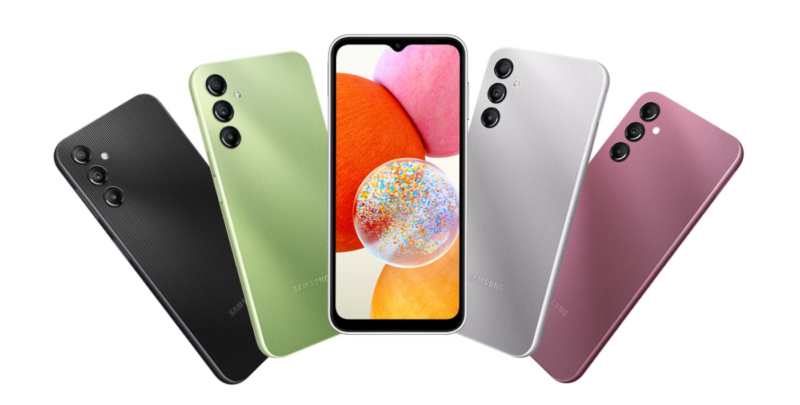
Depending on the variant you are targeting, actually yes. There is already enough merit to upgrade from the Galaxy A14 to the Galaxy A15, provided you are able to recoup the cost from the former. Especially if you purchased the A14 at launch. Then again, when it comes to daily driving, there is still a considerable price-to-actual-performance gap to consider.
Galaxy A14 vs Galaxy A15
| Galaxy A14 | Galaxy A15 | |
|---|---|---|
| Software | Android 13, One UI Core 5 | Android 14, One UI 6 |
| Processor | MediaTek Helio G80 (12nm) – Europe & Middle East Exynos 850 (8nm) – America & Asia | MediaTek Helio G99 (6nm) |
| Display | 6.6 inches PLS LCD, 60Hz, 1080 x 2408 pixels, 20:9 ratio, 400 ppi | 6.5 inches Super AMOLED, 90Hz, 1080 x 2340 pixels, 19.5:9 ratio, 396 ppi |
| Memory | 4GB, 6GB | 4GB, 6GB, 8GB |
| Storage | 64GB, 128GB | 128GB, 256GB |
| Rear Cameras | Triple: 50 MP, f/1.8 (wide), PDAF 5 MP, f/2.2 (ultrawide) 2 MP, f/2.4 (macro) | Triple: 50 MP, f/1.8 (wide), AF 5 MP, f/2.2 (ultrawide) 2 MP, f/2.4 (macro) |
| Front Camera | 13 MP, f/2.0 (wide) | 13 MP, f/2.0 (wide) |
| Sensors | Fingerprint (side-mounted), accelerometer, proximity, compass | Fingerprint (side-mounted), accelerometer, compass, Virtual proximity sensing |
| Connectivity | Wi-Fi 802.11 a/b/g/n/ac, Bluetooth 5.1/5.3, GPS, GALILEO, GLONASS, BDS, QZSS, NFC (market/region dependent), USB Type-C 2.0 | Wi-Fi 802.11 a/b/g/n/ac, Bluetooth 5.3, GPS, GALILEO, GLONASS, BDS, QZSS, NFC (market/region dependent), FM radio (market/region dependent), USB Type-C 2.0 |
| Dimensions | 167.7 x 78 x 9.1 mm | 160.1 x 76.8 x 8.4 mm |
| Weight | 201 g | 200 g |
| Battery | Li-Po 5000 mAh, 15W wired charging | 5000 mAh, 25W wired charging |
| Price | starts at $90 | starts at $160 |
Basic Purposes
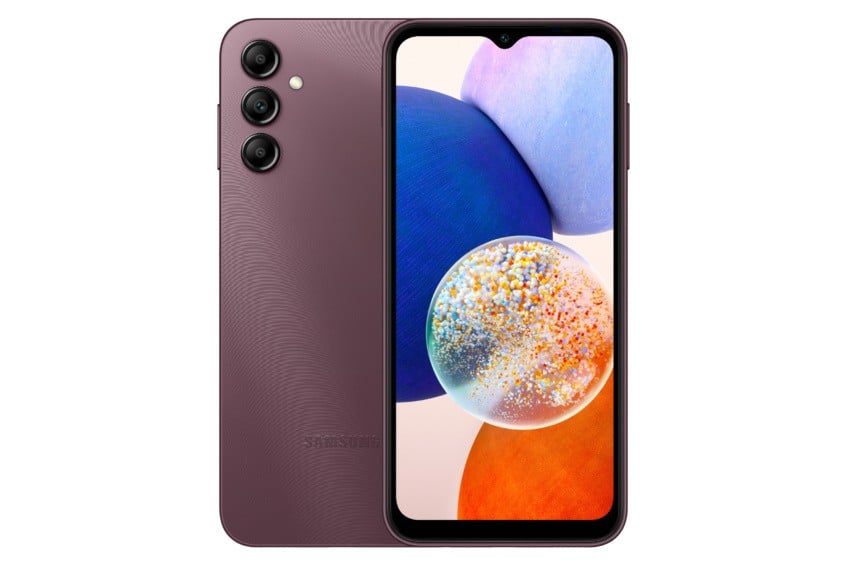
Let's face it, these types of basic upper entry-level and lower mid-range phones are never intended to be heavy workhorses of your daily life. If mainly used only as your daily driver for messages, a couple of multimedia apps here and there, and as your notification slave, then there is no technical difference between the A14 and A15. Even if there is a somewhat noticeable delay in performance for the G80, it is still more than enough for basic daily driving.
This is especially the case for the A14, since this particular model was the first time Samsung implemented the use of UFS 2.2 storage. Bumping up the storage technology to this level already puts it in the “snappy enough” category, essentially having almost 80% the speed of a SATA SSD.
The kicker, however, is that the differences are only negligible if we are talking about similar variants. This means that if you are using the lowest 4GB RAM 64GB storage A14 model, then that alone might already be enough of a reason to consider a small bump in “convenience” tiers. Especially since 4GB RAM is already feeling tighter and tighter for smartphones as 8GB becomes the baseline “snappy” standard.
Performance Potential

If you are using any apps that require heavy-duty performance, then the A15 simply loses instantly. In gaming, for example, many of the newer games require at least a Helio G96 to run smoothly at reasonable settings. You would be pressed hard to push the performance of the Helio G80 if you use game apps competitively.
Then there's the jump from PLS LCD to Super AMOLED. The A15 also wins this category, hands down. Especially when considering other differences between both screens. Well… having a 90Hz refresh rate isn't exactly superior. But it does help smoothen the overall feel of the A15 better than the A14.
Then again, in practice, it only ever becomes a true issue when refresh-rate-sensitive apps are involved (such as rhythm games). So we suppose ol' regular 60Hz would still be perfectly fine when browsing your favorite social media apps.
Operating System

Getting One Ui 6.1 out of the box certainly is a welcome advantage. But again, these are on the lower end of the product spectrum. It wouldn't really make much of a difference with a few QoL differences here and there when it comes to screen customization and UI adjustments. Unless, the OS itself is the key to optimizing the product's specification (of which the two are not).
Just be careful not to install any suspicious old apps on your yet-to-be-updated Galaxy A14.
Longevity

I mean… both were released in 2023. Purchase history-wise, you should ideally refrain from buying a new phone until a few years have passed. Especially since you purchased an A series Samsung Galaxy phone, which is targeted at very budget-oriented consumers.
Conclusion: Daily Driver or Bust
The price gap between the two hurls a wrench into our upgrade considerations. Since, even if accounting for the significant quality gap between a 4G 64GB Galaxy A14 and 6GB 128GB Galaxy A15, the former is still much, much cheaper. As such, if all you really do is very basic PC stuff, then doubling your purchase budget to jump to an A15 isn't going to be a wise choice.
Then again, if you are even anything a bit more than a casual user, then the perks of the A15 would become more than enough to consider the upgrade, even if technically the two products are just 10 months apart release-date-wise.


