



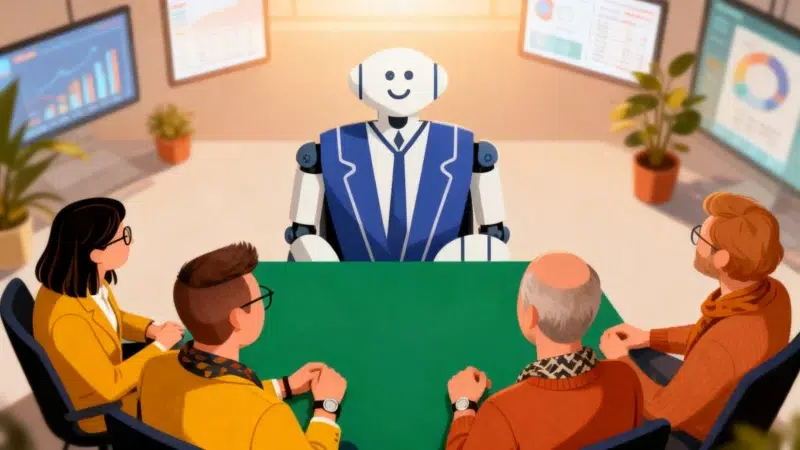
AI: From Administrative Assistant to Decision Authority
A shift is underway. Decisions once left to human judgment—with all its subjectivity—are now often influenced by algorithms. Some managers have begun relying on AI to help decide annual salary increases, handle disputes, or redefine team objectives.
Consider Timothée, 30, leading a seven-person audiovisual production team. In January 2026, his company tasked him with distributing a $3,250 raise pool (converted from €3,000) among his staff. In the past, he spent hours weighing projects, individual progress, and team relationships. This time, he turned the job over to an AI tool, entering data on goals achieved, tenure, skills, and shortcomings.
Within two hours, the process was complete. The tool even provided arguments to justify his decisions to the team.
“Honestly, it was a big relief,” he explained. “In a team, affinities naturally develop, and sometimes you’re softer on certain people—that’s just human. But decisions like these should be as neutral as possible. With this process, personal tensions and grudges no longer affect my choices. I don't feel guilty anymore.”
In another company, AI played a different role. In September 2025, Clara, 39, Director of Human Resources at a logistics group, faced a restructuring after poor results. She needed to merge two departments and reassign roles for about 15 employees. She gave their internal AI tool as much data as possible—job descriptions, performance scores, hard and soft skills.
Within seconds, the AI generated several possible scenarios, each with workload predictions. Clara was initially impressed—until she looked closer.
“The AI missed that some people couldn’t work directly together. It also didn’t know that one newly responsible team member was going through a hard time. These kinds of details don’t fit into data fields. And if I have to enter all of this myself, the tool is much less helpful.”
For Clara, AI is a useful resource, but nowhere near a replacement for human insight.
The Illusion of Bias-Free AI
Éric Gras, economist at Indeed, understands these frustrations.
“Many managers believe AI avoids bias because it’s based on factual data. Few ask who programmed the system or what criteria it uses. For example, in a sales team, not everyone has the same client portfolios or market expertise. AI can’t see those distinctions, nor does it account for geopolitical issues or sector uncertainty. That’s why it must be used with guidance. AI should save time—not make our decisions for us.”
Data on workplace AI adoption evolves rapidly. More than 80% of companies reportedly use AI to some extent. According to a July 2025 Indeed study, 31% had not yet established any guidelines. As a result, many employees and managers continued to use AI outside the company framework—on personal devices, with tools like ChatGPT, Claude, or Gemini—sometimes sharing sensitive internal information. And often, users may not realize these tools are mainly designed to generate a reply to satisfy the user, even when the outcome may be questionable.
The Paradox at the Heart of AI Management
Earlier optimism about AI in management focused on freeing up the manager—from tedious busywork to focus on supporting teams and building authentic connections. But the reality has not lived up to this promise.
“Sadly, productivity gains from AI are immediately pushed back into production rather than freeing up time for human interaction. Our cognitive workload is exploding, and people increasingly fend for themselves,”
notes Emmanuelle Loye, former LinkedIn executive and France Director of Staffbase, an internal communications platform.
Nearly a quarter of employers already report fewer informal interactions at work, largely attributed to AI. Even more concerning, 64% worry that AI could erode trust within teams—a figure that jumps to 74% among HR professionals, according to Indeed.
“When decisions stop coming from a manager’s experience and judgment and instead come from a machine, the manager’s role becomes less legitimate,”
says Éric Gras.
Loye goes further:
“The danger is managers may stop being decision-makers and simply become the messengers for decisions made elsewhere—a kind of ghost manager. The managerial role isn’t as attractive as it once was, especially for younger generations. If it no longer draws on a person’s expertise and judgment, why does it exist? The role might even disappear.”
What’s Next: The Ends and Limits of Machine Judgment
Concern about AI in management grows stronger with mental health already in decline. According to a January 2025 Qualisocial survey, one in four employees in France reported poor psychological health. Sick days increased by nearly 8% in one year and by 30% over the last decade. In this context, AI adds a new sort of chronic anxiety: the 2025 ADP People at Work study found only 11% believed AI would have a positive impact on their work, and over 30% of those feeling threatened by AI were looking to change jobs—even if it meant leaving a secure position.
It’s easy to forget just how much the manager, and especially front-line managers, can notice what data never reveals—such as mounting exhaustion, unspoken tensions, or subtle anxieties. The manager is also the buffer between top-level demands and workplace reality, adapting objectives when staff face the impossible. If you strip away this buffering role, you risk removing the final traces of humanity from workplaces and may close the door to meaningful fulfillment at work.
This leads to a crucial question: what does a manager look like who truly understands both the strengths and limits of AI? Not one who delegates every decision for comfort, nor someone who refuses technology outright, but a manager who recognizes that their irreplaceable value lies not in tasks like reporting or distributing raises, but in interpreting nuanced situations, taking calculated risks, and deploying emotional and situational intelligence. A leader who can use AI for analysis but still bring human judgment and creativity to the fore. Someone who orchestrates collective intelligence, where cooperation outshines competition and innovation emerges at the intersection of human insight and algorithmic power. Most importantly, a manager who still knows their role—and why it matters.