


It’s the classic EV cliffhanger: solid-state batteries have been promised for years as the innovation that would finally push electric cars past their limits. Now, real-world road tests and major factory deals suggest the revolution may at last be moving beyond the lab.
Solid-state buzz: Could it finally be real?
For years, automakers and experts have called solid-state batteries the “next big leap” for electric vehicles, but until recently they never made it out of the lab. This time, a trio—Stellantis, American startup Factorial Energy, and Korean battery producer SK On—have taken visible steps: road testing in a Dodge Charger Daytona has started, and an industrial partnership aims to use existing battery plants. Suddenly, progress feels more concrete.
Stellantis, Factorial & SK On: Testing and teaming up
On July 29, 2026, Factorial and SK On signed a Memorandum of Understanding (MoU) to study the possibility of mass-producing FEST solid-state batteries in existing lithium-ion battery factories. While solid-state tech looks promising on paper, scaling up production will be the real test. Stellantis, for its part, has already demonstrated early industrialization on the road.
Stellantis isn’t new to Factorial Energy. The automaker previously invested in the startup and has validated 77 amp-hour FEST solid-state cells. These boast an energy density of roughly 375 Wh/kg (watt-hours per kilogram)—translating into potentially longer driving range for any given weight—and have endured over 600 charge cycles in tests. According to Factorial, these cells can charge from 15% to more than 90% in about 18 minutes at room temperature, and they’re designed to work between -22°F and 113°F. That should be good enough for everyday use, as well as more extreme North American weather.
For drivers, this means the possibility of more range, much faster charging—particularly on highway trips—and greater safety, since the solid electrolyte is reportedly less flammable than conventional liquid electrolytes.
Testing on the Streets: Progress and hurdles
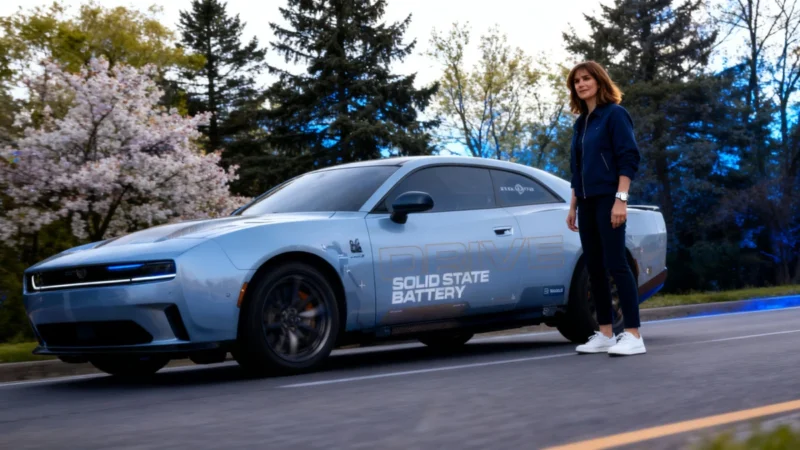
On June 11, 2026, Stellantis announced that a FEST battery pack had been installed in a development Dodge Charger Daytona and that real-world road tests had started in North America. A small demonstration fleet was planned to roll out in 2026 to put the new batteries through their paces: repeated charging, extreme temperatures, and real driving demands. For now, these vehicles are only for development and demonstration. There is no public date for mass-market deployment.
Factorial’s strategy is not to build its own dedicated solid-state gigafactories. Instead, it is designing FEST technology to be compatible with equipment already used to produce lithium-ion cells. SK On, which already operates a global network of battery factories, could make this a reality.
“A breakthrough in batteries only matters if it can be produced at scale,” said Siyu Huang, CEO of Factorial Energy. “That’s what makes this partnership with SK On so significant. Their factories are among the most advanced in the world, and their expertise will be crucial for integrating solid-state battery technology into global manufacturing.”
Simply put, if Stellantis’ progress combines with the ability to adapt existing SK On production lines, moving from prototype to mass production could be more feasible and less costly than starting from scratch. Still, significant hurdles remain, including industrial yields, material costs, and long-term reliability. Meanwhile, competitors like CATL, BYD, and Toyota are also making strides toward producing solid-state or semi-solid batteries at scale.
Large-scale rollout: Still a moving target
Many manufacturers are said to be aiming for around 2030 for wide commercial rollout of solid-state batteries, but Stellantis has made no firm commitments. With current road tests underway and existing factory infrastructure now part of the equation, the answer to “Are solid-state batteries finally becoming a reality?” is starting to look much more tangible.