

Google Cloud has launched Gemini for healthcare, an AI agent product for hospitals and health insurers. It pulls data from electronic health records, billing platforms and insurance systems and then carries out multi-step work such as summarizing medical records and reviewing prior authorization requests. The product is in preview now. It isn't something you'll download from the Play Store, but it puts Gemini into the systems that handle your medical records and insurance claims.
Google announced the product on November 10, 2026, in a post on The Keyword and a longer press release. The company says it built Gemini for healthcare to do more than look up information: it is meant to take action across systems that usually don't talk to each other, within set guardrails and with people overseeing the results.
Google's pitch centers on paperwork. It cites a study from The Harris Poll and Google Cloud finding that clinicians spend nearly 28 hours a week on documentation and administrative work. It also points to American Hospital Association estimates that administrative costs make up 25% to 35% of total US healthcare spending.
“The fundamental challenge in healthcare isn't a lack of information—it's the immense friction of making that data actionable across a highly regulated ecosystem,” said Thomas Kurian, CEO of Google Cloud.
What Gemini for healthcare does
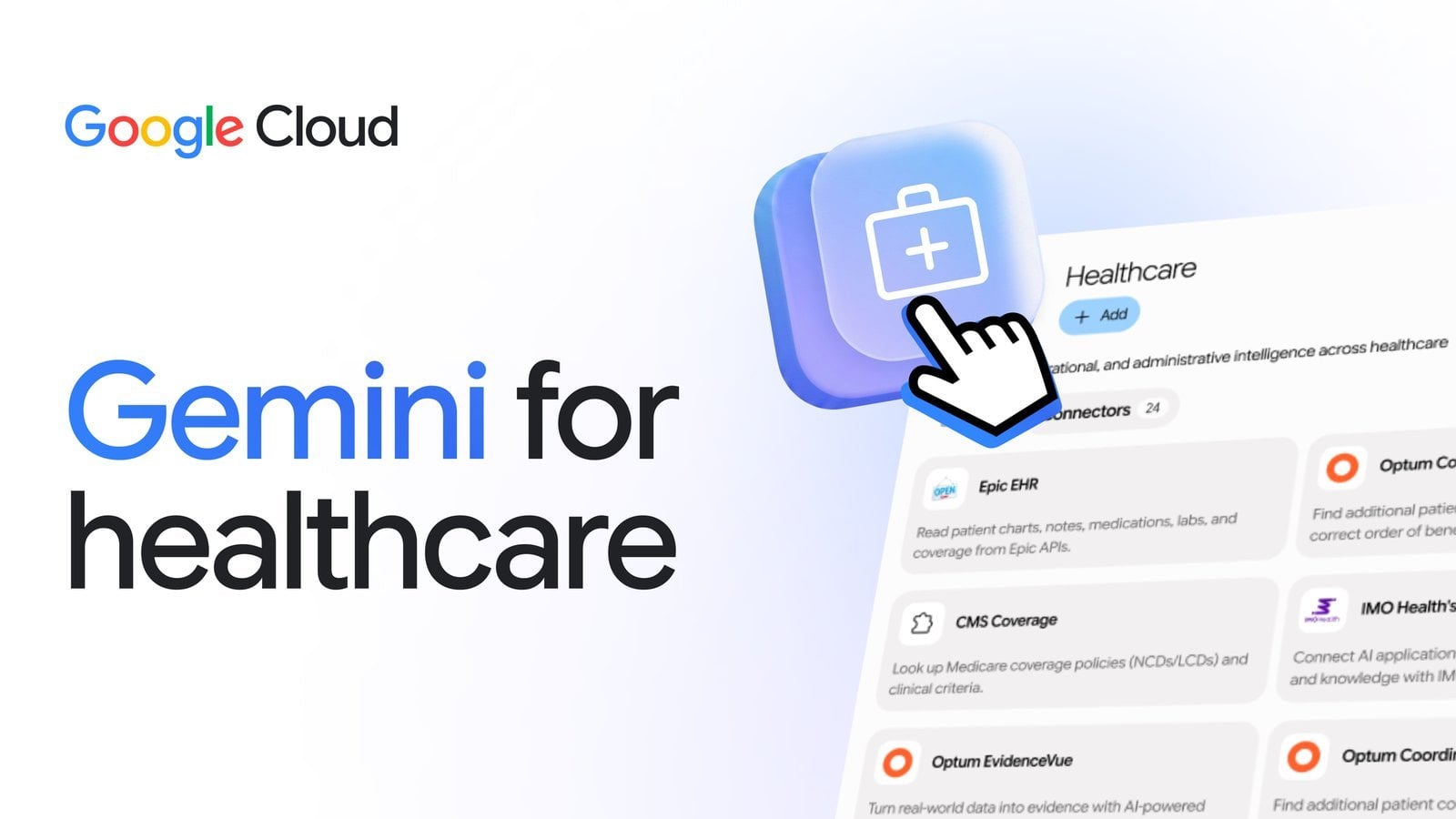
Gemini for healthcare runs on Google's general-purpose Gemini agent and adds healthcare-specific tools. According to the press release, its main pieces are:
- Specialized skills: ready-made, multi-step instructions for medical records synthesis, preparing for appointments, coverage and policy review, and payer benefit determination. Organizations can also build their own skills.
- EHR connectors: read-only links to Epic and Oracle Health records, so care teams can pull up conditions, medications and recent lab results without the AI writing anything back to the chart. Google says NextGen Healthcare support is due in the coming months.
- Billing and coverage lookups: access to CMS coverage data, the NPI Registry, RxNorm and ICD-10, plus partner integrations such as Waystar, Cognizant TriZetto, GoodRx for prescription pricing, and Infinitus for benefit verification.
- Medical references: American Society of Clinical Oncology guidelines, BMJ Digital Health decision-support content and Optum EvidenceVue, so clinicians can find and cite evidence.
- Model choice: customers can use models from Google, Anthropic and OpenAI. Routing sends routine admin work to cheaper, faster models and saves higher-reasoning models for complex clinical analysis.
It also connects to Google Workspace, Microsoft 365, ServiceNow and Salesforce's Health Cloud, and dozens of consulting firms have signed on to deploy it. One of them, AuxoAI, said in its own announcement that it will focus on insurer workflows like prior authorization and claims, and on provider work such as revenue cycle management.
Who is using it

The launch customers are Blue Cross Blue Shield of Massachusetts, Hartford HealthCare, HCA Healthcare, Highmark Health, Northwell Health, Optum and Stanford School of Medicine. ASCO is also contributing its Guidelines Assistant.
Most of the partner quotes describe exploring and testing the product rather than results, and Google hasn't published any figures on accuracy or time saved. Stanford gave the most concrete example: researchers can now query its clinical research database in plain English instead of writing SQL.
Northwell Health CEO John D'Angelo told Fortune that automating fights over insurance claim denials is “part of driving the affordability conversation the right way.” He also said Northwell operates on “a 1% margin business at best.”
Privacy, availability and pricing

Google says patient records, prompts and outputs stay inside each organization's dedicated environment on Google Cloud and that it doesn't use customer data to train its foundation models. The platform supports HIPAA compliance, keeps each organization's existing role-based access controls, and logs activity for audits. Answers include source citations so staff can check them against the chart.
As of November 10, 2026, Gemini for healthcare is in preview. It will be offered to Gemini Enterprise Standard and Gemini Enterprise Plus customers, either as per-user seat subscriptions or on pay-as-you-go pricing. Google hasn't announced prices or a date for general availability.
Gemini for healthcare follows Google Cloud's earlier industry versions for government services, financial services and legal. The next milestone to watch is the NextGen Healthcare integration, which Google says is coming in the next few months.
Sources: Google, Google Cloud (via PR Newswire), PR Newswire, Fortune