


What happens when a blogger calls out problems in China’s fast-growing EV industry? With battery temperatures heated—sometimes literally—the story of Cai Shen Dao, an automotive blogger in China, shows the risks of being too outspoken in a tightly controlled market.
Blogger Versus Giant: How the Dispute Began
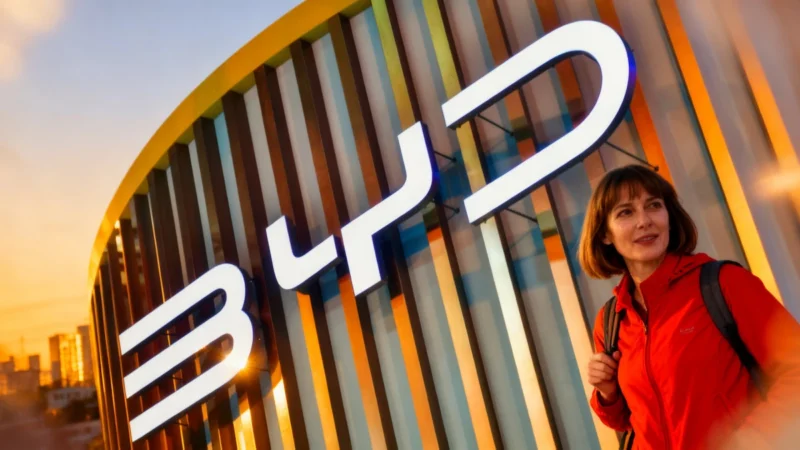
On July 30, 2026, automotive expert and blogger Cai Shen Dao announced on Weibo that he was the subject of a police complaint. According to Cai, BYD, one of China's leading electric vehicle makers, reported him to the Songjiang District police in Shanghai after he shared hundreds of pages of test data regarding BYD vehicles. As of now, neither Shanghai police nor BYD has confirmed any complaint or investigation.
The controversy began in May 2026. During a livestream, Cai filmed the fast-charging of a BYD Fangchengbao Tai 3, an SUV featuring BYD’s new Blade 2 battery. As viewers watched, the battery charged from 8% to 97% in real time.
Five temperature probes positioned on the surface of the battery cells recorded a peak of 76.42°C (about 169.6°F). Meanwhile, the battery management system read a lower value, about 71°C (159.8°F). Depending on where the probes were placed, differences reached as much as 6.5°C (11.7°F). Despite these high readings, there were no malfunctions or thermal runaway events recorded during the charging session.
Temperature Gaps and Ongoing Arguments
Why the difference? Cai’s probes measured the surface temperature at specific spots, while the battery management system used its own sensors placed elsewhere within the battery pack. Official Chinese recommendations for lithium iron phosphate battery cells set a maximum of around 65°C (149°F), with normal operation between 20°C–30°C (68°F–86°F). That the probes and BMS weren’t measuring the same parts of the battery became central to the dispute. Cai persisted, releasing another critical video on the quality of BYD’s Blade 2 batteries.
BYD has consistently backed its batteries. Sun Huajun, head of BYD's battery division, told Chinese media: “70 degrees was the cognitive limit of the past,” suggesting new batteries can safely exceed that temperature.
The Blade 2 battery launched on March 5, 2026, advertised to charge from 10% to 97% in nine minutes. BYD aimed to install 20,000 fast-charging stations across China by the end of 2026. However, after the dispute grew, the focus soon shifted from engineering arguments to censorship.
Censorship Follows Critique
In early July, the Cyberspace Administration of Shenzhen cut off Cai’s access to major social media platforms. He was barred from posting, commenting, or earning income on WeChat, Bilibili, Douyin, and Weibo. Officials cited “misleading test information” and “harm to a company’s reputation” as the justification. These measures took place as part of China’s Qinglang (“Clear and Bright”) campaign, which closely monitors and often censors online criticism of state-backed companies.
Despite these restrictions, Cai hired the Guolian Research Institute, a national-level battery research center, to independently repeat the temperature experiment. On July 15, 2026, Cai released a video showing the results.
Lab Results Confirm the Heat—But Is It Unsafe?
In the new video, the lab charged a Blade 2 battery from 7% to 97% in 8 minutes and 32 seconds, drawing a peak current of about 1,200 amps. The lab’s external probes measured surface cell temperatures at 78.5°C (173.3°F), while the vehicle’s own system showed 70.5°C (158.9°F). The approximately 8°C (14.4°F) difference appeared on cells exposed for laboratory testing, not packed inside a factory-sealed battery pack.
These results matched Cai’s earlier livestream: battery cell surfaces could exceed 78°C (172.4°F) during ultra-fast charging. At the same time, the car’s internal readings were also valid, supporting BYD’s argument that measurements depend on probe position. The lab did not comment on whether these temperatures were hazardous, and BYD stood by its statement about higher operating limits.
Accusations, Context, and an Unresolved Dispute
On July 31, 2026, Cai posted purported screenshots showing that on May 5, the day before his original battery livestream, someone identifying as a BYD intermediary reached out about a possible business arrangement. The authenticity of this contact remains unconfirmed.
This was not Cai and BYD's only conflict. Back in May, Cai apologized on video after losing an unrelated appeal against the company. Nevertheless, he continued public testing of the Blade 2 pack. Meanwhile, BYD has filed about $1,000,000.00 in claims against multiple Chinese bloggers, according to published figures.
No official decisions or public legal statements have been made about this latest dispute. Shanghai police have not provided updates, and the courts have not ruled on the current complaint. Although Cai’s Chinese social accounts remain restricted, his videos still circulate outside of mainland China.