



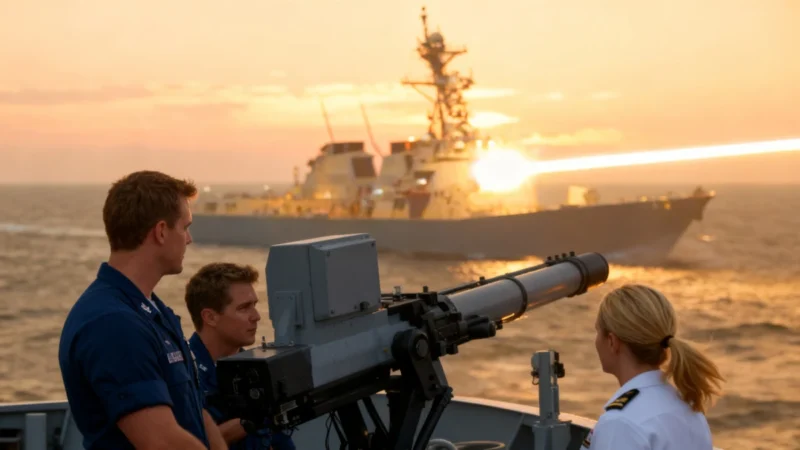
Laser Fire at Sea
During a demonstration confirmed by Lockheed Martin’s CEO Jim Taiclet, the USS Preble, an Arleigh Burke-class destroyer, successfully destroyed four drones at sea using a new directed-energy weapon known as HELIOS. This marks a milestone for counter-drone technology as these unmanned aerial vehicles continue to pose a growing threat to naval forces worldwide. Taiclet stated, “We have successfully used a ship-based laser system—Lockheed Martin’s HELIOS—to down combat drones,” highlighting that the system neutralized four targets and helped conserve traditional anti-aircraft missiles for higher-priority threats.
HELIOS: More Than Just a Laser
HELIOS, or High-Energy Laser with Integrated Optical Dazzler and Surveillance, also designated Mk 5 Mod 0, is a 60-kilowatt (roughly 80-horsepower) directed-energy weapon. It’s designed to destroy or disable drones and small boats, and can also act as a blinding device targeting enemy sensors. Since 2022, the USS Preble has been the only Navy vessel equipped with this system. Some other destroyers have received lower-powered ODIN dazzling lasers, while other experimental high-energy lasers have appeared on different ships.
This demonstration was significant as it marked the first time the Navy confirmed HELIOS engaging multiple aerial targets in real conditions.
Big Promises—but Big Questions Remain
The test reflects the Navy’s push to make directed-energy weapons an essential layer of close-range defense against threats like drones. According to reports, Navy leadership has previously argued that lasers should be the preferred defense for crews facing unmanned aerial attacks.
Recent operations in and near the Red Sea have exposed how swarms of drones, especially when combined with cruise and ballistic missiles, can overwhelm conventional defenses. Lasers offer a key theoretical advantage: their ability to fire repeatedly, so long as the ship can supply enough electrical power and cooling.
There’s also an economic angle. While a single RIM-116 Rolling Airframe Missile on a Navy ship costs about $1,000,000.00, once installed, a laser can engage targets at a far lower per-shot cost, though the upfront investment is substantial.
The Tough Reality: Technical Obstacles
Despite its promise, the HELIOS demonstration raises several unresolved issues. It’s unclear how quickly the system can shift between targets or how much time it takes to neutralize each drone. Lasers currently can only engage one target at a time. Their effectiveness diminishes with distance and can be impaired by weather, smoke, or dust. Operating in rough seas with salt spray and the heavy cooling demands of the system further complicate its use.
Unless improvements address these hurdles, the expansion of laser defense technology across the fleet may remain limited, despite the system’s evident efficiency.
In short, while the Navy’s laser weapon made a strong showing in its historic test, it remains to be seen whether it can meet the challenges posed by unpredictable real-world combat conditions.