



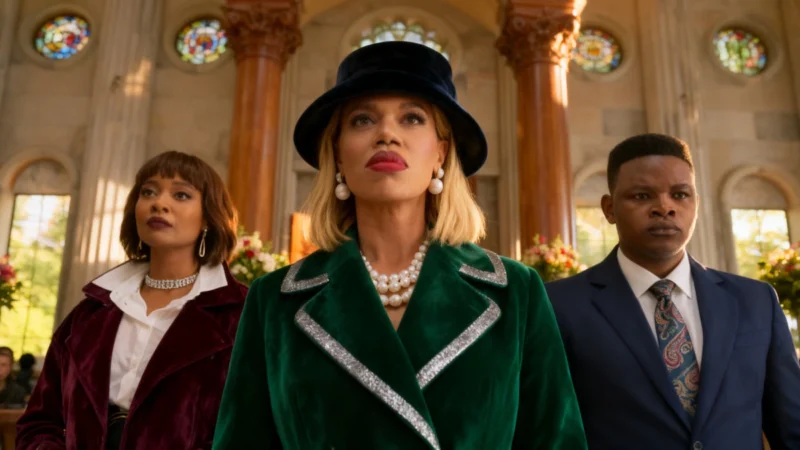
From Johannesburg to Global Fame
The phenomenon began in Johannesburg, South Africa, where The Polygamist, a Zulu-language telenovela, exploded onto Netflix and became a national talking point. After its 2026 premiere, the story of a cheating husband juggling a double life drew over 23 million views in its first month, making the Netflix top ten in 62 countries—including the United States—and nabbing the number one spot in nearly two dozen. From Romania to Hong Kong, viewers found themselves hooked by the drama unfolding around the Gomora family.
At the show’s core is matriarch Joyce Gomora, intent on keeping up appearances as her businessman husband, Jonasi, secretly sets up house with another woman. Across 22 explosive episodes, expect plenty of fierce confrontations, houses on fire, strong language, and steamy scenes—all with enough plot twists to leave your head spinning.
All That Glitters: Challenging Stereotypes
The series’ glamorous look at African wealth turned heads across continents. One viewer compared the drama’s opulence to other global hits:
“Crazy rich Africans, I thought Crazy Rich Asians was something, but crazy rich Africans is a whole other level. Good grief! What?!”
Zimbabwean author Sue Nyathi, whose book inspired the show, says this depiction is exactly what surprises international audiences. In her words:
“It also showcases a different kind of African lifestyle that viewers are not familiar with, you know, the rich African…because oftentimes in media, we have one lens in which Africans are viewed.
It’s always the poor struggling Africans. And this is not to dismiss the poverty in Africa. No, but it’s also saying that there is also a society of Africans that are very, you know, affluent, well off.”
Nyathi believes the show resonates because it offers something universal—the chance for viewers to see themselves, regardless of where they’re watching.
“It’s a series that holds up a mirror to society and people see themselves in one form or the other. And so because it resonates deeply, that’s what makes it popular.”
The chaos may revolve around polygamy, but at its heart, the theme of infidelity hits home everywhere. Nyathi reflects:
“As much as Jonas is a polygamist, he’s also a cheating husband. Infidelity, things of infidelity permeate the story. And I think that’s a problem that is universal, you know.”
She adds,
“You have a married couple, then you have the mistress or the paramour, the side chick, whatever you want to call it. And that story is familiar for a lot of people.”
Behind the Scenes: Real-Life Inspiration
Nyathi’s novel didn’t catch fire immediately in bookstores, but after the Netflix adaptation, the book quickly soared in popularity across South Africa. Even fans who rarely read have flocked to signings to snap up a copy, swept up by the show’s massive success.
Nyathi drew inspiration from a shift she observed among African men—from traditionally open polygamy to secret second families that often impact women negatively. In her book, women’s voices are front and center:
“So in the book, the story is told from the women’s POV (point of view). The man never speaks…Because we’ve heard men speak all our lives. And men will always justify why they want to have more than one wife.”
For context, South African tradition allows polygamy under customary law, but civil marriage law does not. In the traditional model, all wives know about each other—a practice still observed by the Zulu royal family. The current King Misuzulu kaZwelithini, for example, has three wives and was recently embroiled in a public scandal after a leaked video showed him berating Queen Nomzamo Myeni and ordering her to leave the royal household, alleging infidelity.
These dynamics aren’t unfamiliar to the show’s producers, Gugu Zuma-Ncube and Thuli Zuma, daughters of South Africa’s most high-profile polygamist—former President Jacob Zuma, who has four wives. Zuma-Ncube reflects on growing up in this environment:
“My father is a polygamist. He had several wives…it’s definitely formed part of my experience. It’s formed a big chunk of my childhood, just understanding the dynamics, being frustrated sometimes by a lot of it, but also trying to appreciate it for what it is and for the choices that people make.”
Both producers say they’re still reeling from the show’s international breakout:
“We were completely surprised by, completely blown away, still kind of pinching ourselves at the moment, as to how well it’s done abroad. I think the attention that it’s gotten, the welcome and reception that it’s gotten, I think will help the entire industry and will benefit all African storytellers.”
Local Flavor Goes Global
For global viewers, The Polygamist offers a dubbed version voiced by South Africans that keeps some of the rich vernacular. International audiences will pick up on terms like “haibo!” (meaning “wow!”) and discover South Africa’s beloved weekend ritual of “braaiing” (barbecuing), which connects people from Cape Town to Limpopo.
Zuma-Ncube still encourages fans to try the original Zulu audio with subtitles, noting,
“I was watching a creator from (South) Korea who was saying she was learning how to speak Zulu watching the show, which was really, really interesting.”
The show’s impact even stretches beyond entertainment. In rural Limpopo, a government department used the show’s buzz for a campaign against gender-based violence, warning:
“The Polygamist shows fiction, Gender-based Violence and Femicide shows consequences. Break the cycle.”
If you’re looking to spice up your streaming list, immerse yourself in some fiery South African drama, and maybe pick up a Zulu phrase or two, The Polygamist is ready for your watchlist.