



Let’s be honest, if ERP infrastructure SAP environments go down, it’s not just “an IT issue.” It’s finance stuck mid-cycle, procurement frozen, shipments delayed, and leadership asking uncomfortable questions.
This is very much evident in a manufacturing setup where a two-hour ERP slowdown during quarter-end caused invoice processing delays that took days to recover from.
Not because systems failed entirely, but because the infrastructure underneath wasn’t designed for consistent performance.
That’s the real story here. SAP and ERP platforms don’t fail loudly. Sometimes they just… slow down. And that’s enough to hurt business.
Why ERP Infrastructure SAP Matters More Than You Think
At a glance, it’s easy to assume ERP infrastructure SAP decisions are mostly about hosting, on-prem vs cloud, that sort of thing.
But the reality is much different than that. Infrastructure choices directly influence:
- How fast transactions are processed
- Whether users face lag during peak hours
- How quickly can you recover from outages
- Honestly, how well your team sleeps at night
Why is ERP infrastructure SAP critical for business continuity, and how does Sangfor support it?
ERP infrastructure SAP directly impacts transaction speed, system availability, and operational continuity. Sangfor HCI strengthens this by delivering consistent performance, built-in redundancy, and simplified infrastructure management, reducing the risk of slowdowns or outages during critical business cycles.
What Makes SAP and ERP Workloads So Demanding?
Here’s the thing: ERP isn’t just another application. It’s an ecosystem.
You’ve got databases handling massive transactions, integrations with CRM systems, reporting engines crunching numbers, and hundreds (sometimes thousands) of concurrent users. Now imagine all that happening at month-end or during a sales spike.
That’s when the cracks show.
In regions like India and across APAC, there’s another layer:
- Data residency regulations
- Multi-branch connectivity challenges
- Latency issues across distributed locations
This makes ERP infrastructure SAP planning not just technical, but strategic and region-specific.
Infrastructure Options: What Actually Works?
Let’s break this down without overcomplicating things.
1. On-Premises Infrastructure
On-premises still makes sense for a lot of organizations. If you have strict compliance requirements, legacy application dependencies, or you just need very low and predictable latency, keeping everything in your own data center gives you full control.
The trade-off is real, though. You’re buying hardware that depreciates, managing refresh cycles, and scaling manually when the business grows.
| Benefits | Challenge |
| Strict compliance requirementsLegacy SAP versionsLow latency, especially for local users | High upfront costsScaling takes time (and budget approvals)Hardware refresh cycles can be painful |
Many teams are still running aging hardware simply because the upgrade path felt too disruptive.
2. Private Cloud
Private cloud is where many mid-to-large enterprises are landing right now. You get virtualization flexibility and better resource utilization without giving up governance. Recovery planning becomes easier, too. It’s a strong choice for modernizing ERP infrastructure SAP environments.
| Benefits | Challenge |
| Better resource optimizationEasier disaster recovery designImproved operational agility | Needs strong internal expertiseGovernance becomes critical |
Still, for many enterprises, this hits a sweet spot.
3. Public Cloud
Public Cloud is not a bad fit for ERP, but it needs careful planning. Elastic scaling and fast provisioning are genuine advantages, especially for organizations modernizing quickly or running global operations.
The problems usually show up later, in cost predictability, workload tuning, and data residency constraints that weren't fully thought through during planning.
| Benefits | Challenge |
| Rapid deploymentsGlobal user accessTesting and development environments | Costs can spiral without governanceSAP workloads need tuning (they’re not cloud-native by default)Data residency concerns, especially in regulated sectors |
Many companies move everything to the cloud, and then quietly bring critical workloads back.
4. Hybrid Cloud
Hybrid Cloud is the realistic path for most enterprises right now. You keep sensitive or compliance-bound workloads closer to home, while taking advantage of cloud agility where it makes sense.
A hybrid cloud is the most practical model for many enterprises, because it balances compliance and agility while simultaneously supporting evolving ERP infrastructure SAP strategies. It's more complex to architect, but it lets you modernize in phases without betting everything on one model. Solutions like Sangfor Hybrid Cloud enable businesses to unify on-premises and cloud environments through a single, integrated platform.
| Benefits | Challenge |
| FlexibilityBetter business continuityGradual modernization | Architecture complexity |
But honestly, if planned well, a hybrid gives you the best of both worlds.
Which infrastructure model works best for ERP infrastructure SAP environments?
Hybrid cloud is often the most effective model for ERP infrastructure SAP environments, balancing compliance, scalability, and performance. Sangfor HCI supports this approach by enabling seamless integration across on-premises and cloud environments, simplifying management while maintaining control over sensitive workloads.
What You Should Actually Be Measuring
Performance matters, obviously. Database responsiveness, transaction throughput, and concurrent user handling all need to be tested against your real workloads, not vendor benchmarks.
But availability is just as important. You need to define your recovery time objective and recovery point objective clearly, then build your infrastructure around those targets. Testing failover regularly is something a lot of teams say they’ll do and then don’t. That’s a risk you can’t afford with SAP.
Scalability deserves more attention than it usually gets. Your SAP environment today isn’t your SAP environment three years from now. Planning for growth before you hit the ceiling is far cheaper than doing an emergency migration later.
Security is where things often fall short. SAP and ERP systems are high-value targets that hold financial records, employee data, critical business information, etc. Instead of layering separate tools, modern ERP infrastructure SAP environments benefit from platforms where security is built directly into the infrastructure. This comprises integrated threat visibility and intelligent monitoring that continuously adapt to system behavior.
The advantages are reduced complexity, faster response, and a more resilient foundation that doesn't rely on disconnected security layers.
A Simple Decision Framework
If you’re evaluating options, here’s a practical way to approach it:
- Classify workloads by importance
- Map compliance and data residency needs
- Benchmark performance requirements
- Estimate 3-year TCO (not just year one)
- Validate security, including AI-driven capabilities
- Choose a model that supports future growth
Simple? Yes. Easy? Not always.
Sangfor Perspective: Keep It Simple, Keep It Resilient
From where we stand, the biggest challenge isn’t technology, it’s complexity. Too many tools, too many layers, and fragmented systems continue to slow down ERP infrastructure SAP performance.
The goal should be straightforward:
- Reliable performance
- Strong security
- Easy management
With solutions like Sangfor HCI and Sangfor’s integrated security stack, businesses can unify these elements into a single, streamlined platform. Therefore, it becomes easier to reduce operational burden while improving visibility and control across the entire environment.
As one of the leading VMware Competitors, Sangfor’s efficiencies are more than simple marketing statements you see on advertisements and spec sheets.
Date: Jun 1, 2026
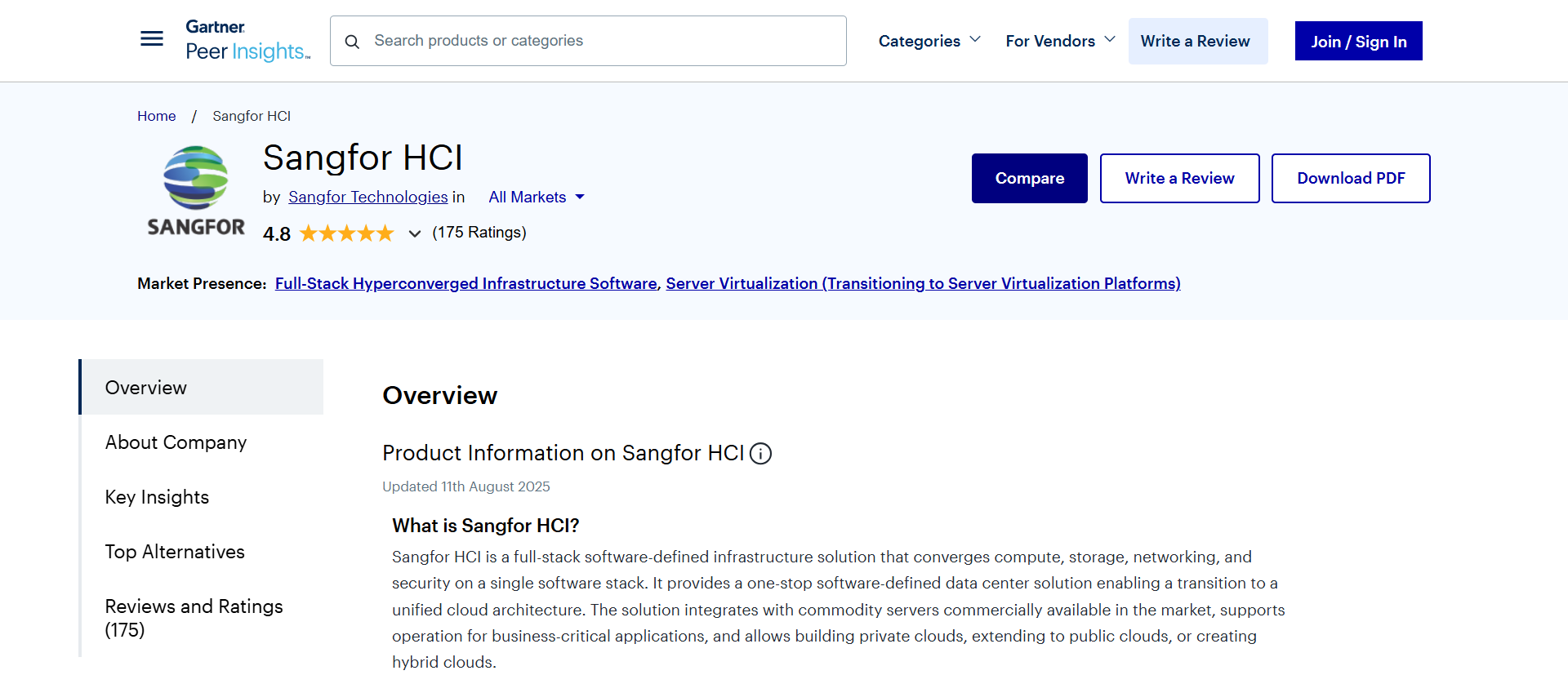
Most users who moved away from VMware or other more costly and complex IT infrastructures switched to Sangfor HCI. They are happy with the migration and overall service along with Sangfor’s support, as evident on peer review platforms like Gartner and G2. Users are rating Sangfor 4.8 out of 5 on Gartner and 4.7 out of 5 on G2.
Manufacturers like AmWire modernized legacy ERP systems using Sangfor HCI and Managed Cloud Services, ensuring seamless migration, reduced infrastructure costs, and improved scalability, without disrupting operations. Learn more from this video.
At the end of the day, ERP systems shouldn’t be something you constantly worry about. They should just work, securely, efficiently, and without complexity getting in the way. That’s what Sangfor strongly underscores.
A Simple Way to Frame the Decision
The best and simplest way to frame your decision starts with classifying your workloads according to criticality. Next, map out the data residency requirements, benchmark performance and failover needs against your business SLAs, and estimate your total cost of ownership across three years.
Modern infrastructure platforms are increasingly designed with built-in intelligence that can automatically adapt to workload behavior, user patterns, and system performance.
Truth be told, the right ERP infrastructure isn’t about picking the most advanced option. It’s about picking the one that keeps your business running reliably, secures what matters most, and doesn’t become a problem to manage in three years.