



What would actually happen if you found yourself floating in outer space without a space suit? Spoiler: It’s a fate much worse than simply gasping for air, unlike what you might see in the movies. The truth is even more dramatic—and deadly—than most sci-fi films suggest. Here’s the hard science behind why astronauts can’t just step outside the International Space Station (ISS) in casual clothes, no matter how brave they are.
The High-Stakes Outfit: Why Astronauts Suit Up from Head to Toe
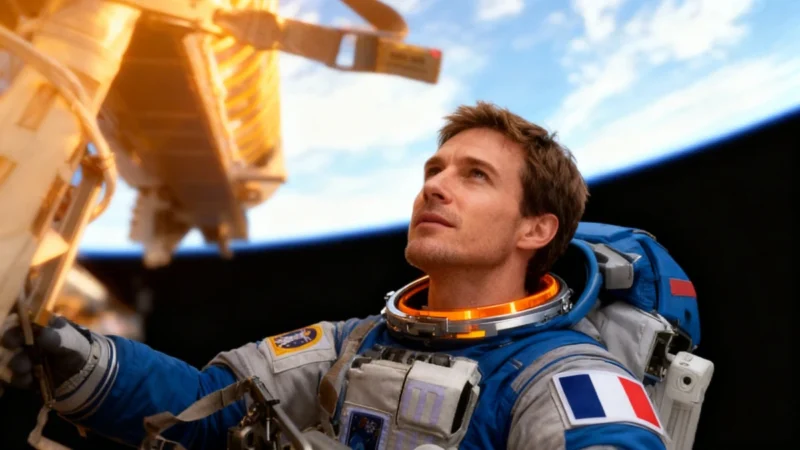
French astronaut Thomas Pesquet performed three spacewalks during a recent stay aboard the ISS. This sparked a question from a Sciences et Avenir reader: Why do astronauts need all that elaborate equipment for spacewalks? As Romuald Amougou asked:
“Without a protective suit, what would actually happen to us out in space?”
Thanks for your questions—they’re important!
For every extravehicular activity (EVA), astronauts don protective suits that are bulky and precisely fitted. Why go to all that trouble? The answer: space is deeply hostile to the human body.
The First Step into the Void: A Near-Disaster in 1965
On March 18, 1965, during the Soviet Voskhod 2 mission, the first spacewalk in history took place. Cosmonaut Alexei Leonov exited the airlock in a “flexible” suit, tethered to his spacecraft by a short cable. Seeing space firsthand, he later described:
“What struck me most was the silence. It was an impressive silence unlike anything on Earth, so deep and heavy I started hearing the sound of my own body […]. The sky was pitch black but sparkled with sunlight… The Earth seemed small, blue, clear, so moving, so alone.”
But that flexible suit almost cost Leonov his life. It expanded quickly in the vacuum of space due to the drop in pressure, so much that he could not move. He lost mobility, bumped into the ship repeatedly, and his hands and feet shifted inside the inflated suit. He couldn’t fit back in the airlock at first—the opening was too small. Leonov decided to risk depressurizing his suit slightly, letting out just enough air so he could shrink the suit and force his way through the hatch, head first. The whole outing lasted 12 minutes and 9 seconds, during which he narrowly avoided tragedy. It was the first direct human encounter with the forces of outer space.
The Deadly Threats of Space: Vacuum and Weightlessness
So what’s really out there? First, there’s no atmosphere and no gravity you can feel. Astronauts in the ISS experience weightlessness thanks to the station’s fast orbit around Earth, which effectively cancels out gravity’s pull and gives that familiar floating sensation. Movements can be much harder, as every action in microgravity is more complex than it looks on Earth.
The real killer, though, is depressurization. Space is a near-perfect vacuum. There’s no air or oxygen; only occasional cosmic rays from the sun and even farther away. Sound doesn’t travel because it needs air to propagate. That means space is absolutely silent.
Here’s where it gets dangerous for the human body. Our bodily fluids are in balance at atmospheric pressure and around 98.6°F (37°C). If suddenly exposed to vacuum, the boiling point of these fluids falls below your own body temperature. Your blood and tissues could start to boil almost instantly—a process known as ebullism. This is fatal within seconds. That’s why spacesuits maintain a survivable pressure, typically at least 0.3 bar (about 4.4 psi).
Unprotected, your body would also freeze or heat up by radiation, depending on where the sun hits you. Temperatures swing from -238°F (-150°C) in shadow to 302°F (150°C) in direct sunlight—a jaw-dropping 540°F (300°C) difference across your body. The suit is absolutely essential. It supplies air, keeps temperatures safe, and blocks harmful sunlight and cosmic radiation.
Other Hazards: Cosmic Radiation and the Unexpected
Beyond extreme temperatures and pressure, astronauts also face cosmic radiation—streams of high-energy particles from solar flares or deeper space, mostly protons but sometimes helium nuclei and heavier atoms. These are highly radioactive and still not fully understood in terms of long-term risk. They may damage nerves or DNA. Another key reason why spacesuits are designed with radiation shielding.
Even the best suits can’t stop every problem. In 2013, astronaut Luca Parmitano’s helmet filled with water due to a cooling system leak, forcing an emergency return. Astronauts train for such emergencies, always prepared for a rapid escape through the ISS airlock if the unexpected happens.


Why is an article on space suits on a site about Android? This has nothing to do with Android & makes one question the validity of any claims made by those who have no accreditation in the field of Space Science & Astrobiology.
Get a life