


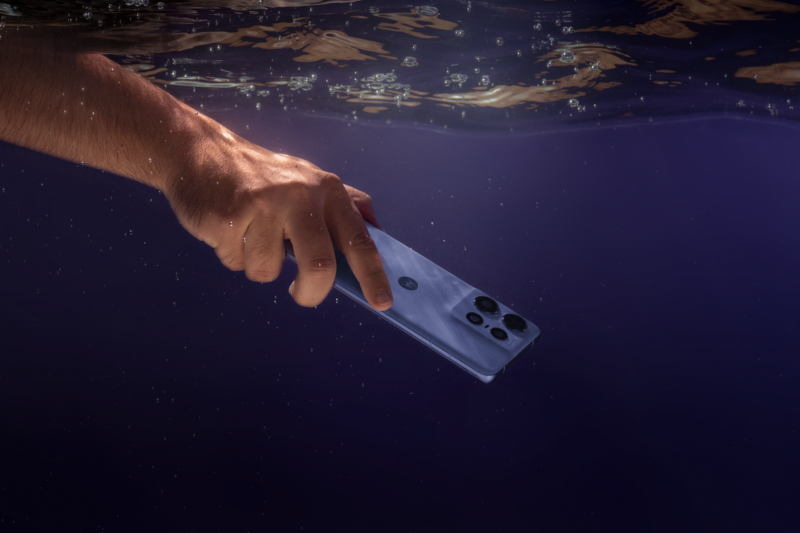
It was back in 2013 that Sony released the Xperia Z. This device was notable for many reasons, but one of the things it brought to the table which was quite novel at the time was water resistance. Yep, the Sony Xperia Z had IP57 certification, making it the first flagship device to boast of that.
Over a year from then, it is now expected that a flagship smartphone should have an IP rating, and if it doesn't, that's held as a major demerit on its part. You might just know that “IP68” is good to see on the spec sheet, but it's a good idea to know exactly what these numbers mean, and I'm here to lead you through that.
Each Number In An IP Rating Indicates Something Different

When talking about an IP rating, the IP stands for Ingress Protection. Ingress isn't the most common word, but it refers to the entrance of something, so Ingress Protection is guarding against letting something into an object. In this case, the object could be a smartphone, earbuds, a smartwatch, a portable speaker, and so on. There are a lot of devices that can have an IP rating.
After “IP”, there are two numbers; for example, IP68. In this case, the 6 means something and so does the 8. The first number indicates the level of dust resistance, or protection against solid particles; while the second number indicates protection against liquid.
You might have seen a device with an “IPX7” rating. When there's an X instead of a number, it simply means that there's no data for that specific criteria. In other words, it simply was not tested.
The First Number: Solid Resistance

The first number in an IP rating refers to the size of solid particles that the device allows into it. You might also hear it referred to as dust resistance because a lot of the time, the aim is to prevent the entry of particles as small as dust or sand.
This tends to be neglected a little, so you'll commonly see devices with IPX4, IPX5, IPX7, etc. ratings. This tends to apply to a lot of devices marketed primarily for their water resistance. Below is a table describing what each first digit means.
| Level | Description |
| X | No data available; not rated |
| 0 | No protection against solid object ingress |
| 1 | Protection against large surfaces of the body greater than 50 mm; no protection against deliberate contact |
| 2 | Protection against fingers or similar objects larger than 12.5 mm |
| 3 | Protection against tools, thick wires, etc. larger than 2.5 mm |
| 4 | Protection against small screws, large ants, most wires, etc larger than 1 mm |
| 5 | Some protection against dust, though only enough to prevent any interference with function |
| 6 | Complete protection against dust; dust-tight |
The Second Number: Liquid Resistance

More people are concerned about the water (or liquid) resistance of a device that they use, more so than the dust resistance. The liquid resistance rating goes higher numerically than dust does, all the way up to 9.
I've simplified the descriptions because considering the fact they are for certification, they can be rather technical. Anyway, keep an eye out for what the 8 in IP68 means, because that's the flagship standard in smartphones these days. Though Oppo has hit IP69 in a device that isn't rocking that “rugged” look.
| Level | Description |
| X | No data available; not rated |
| 0 | No protection against liquid ingress |
| 1 | Protection against vertically dripping water for 10 minutes |
| 2 | Protection against vertically dripping water when the device is tilted 15° in four directions, for 2.5 minutes for each tilt |
| 3 | Protection against spraying water at an angle of up to 60° for a minimum of 5 minutes |
| 4 | Protection against splashes of water from any direction for a minimum of 5 minutes |
| 5 | Protection against water jets (4.4 psi from 3 meters away) from any direction for at least 3 minutes |
| 6 | Protection against powerful water jets (15 psi from 3 meters away) from any direction for at least 3 minutes |
| 6K | Protection against powerful water jets with increased pressure (150 psi from 9.8 feet away) from any direction for at least 3 minutes |
| 7 | Protection against water immersion up to 1 meter depth for 30 minutes |
| 8 | Protection against water immersion up to 3 meters depth for a manufacturer-determined duration |
| 9 | Protection against high-pressure, high-temperature, close-range water jets (at least ~1160 psi from only as far as 0.15 meters with 80°C water) from four angles for 30 seconds from each |