



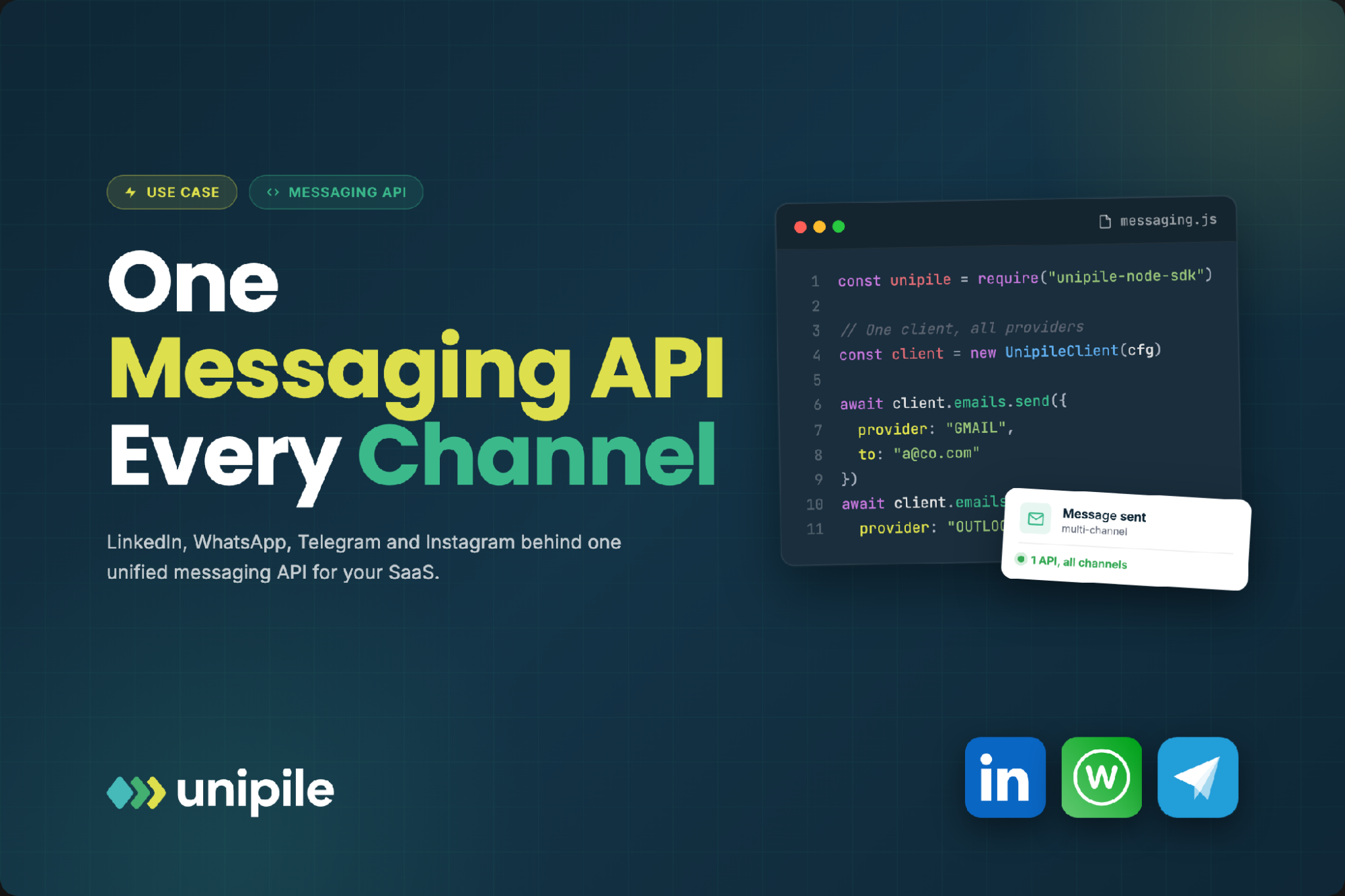
Your customers do not live in one inbox. Some reply on WhatsApp, some on LinkedIn, some on Instagram, and the same person often moves between them mid-conversation. For a product team, the naive answer is to integrate each platform one at a time, and the bill for that decision arrives six months later as a pile of half-maintained connectors. This article makes the case for a unified approach, sketches what the architecture looks like, and helps you decide honestly whether to build it yourself or buy it.
Introduction
There was a time when integrating one messaging channel was a competitive feature. Today customers assume you meet them wherever they already are, and “wherever” now means five or six platforms with incompatible APIs. A messaging API that speaks to all of them through a single interface has quietly become infrastructure rather than a nice-to-have. The interesting question is no longer whether to support multiple channels, but how to do it without your codebase turning into a museum of one-off integrations. This piece looks at why unification matters, how a multi-channel layer is actually structured, and where the build-versus-buy line falls.
The hidden cost of one integration at a time
The failure mode is predictable because each channel looks small in isolation. LinkedIn is one project. WhatsApp is another. Then Telegram, then Instagram, then Messenger. Each has its own authentication, its own message format, its own way of delivering inbound events, its own rate limits, and its own rules about what you are allowed to send and when. Individually, none of these is unreasonable. Collectively, they are five codebases that all do “send a message and receive a reply” slightly differently, each drifting as its platform ships changes, each needing its own monitoring and its own on-call knowledge. The cost is not the first integration; it is the compounding maintenance of the fifth, and the fact that adding a sixth means starting the cycle again.
What “unified” actually means
A unified messaging API sits between your application and all of those platforms and hides their differences behind one consistent model. Concretely, that unification shows up in a few places.
- A normalized message object. Whether a message came from WhatsApp or Instagram, your code reads the same shape: sender, conversation, body, attachments, timestamps. You stop writing per-platform parsers.
- One authentication and connection model. Instead of learning five consent and token flows, you connect an account through a single mechanism and the layer handles each platform's specifics underneath.
- One inbound mechanism. Rather than reconciling five different webhook and polling schemes, you receive events in one consistent stream and react to them in one place.
- A single sending interface. You call one send method and route by channel, instead of maintaining five client libraries with five different method signatures.
The value is not magic; it is that your team writes and maintains one integration surface while supporting many channels. A good reference for how this is framed as a product category is this overview of a messaging api built to cover several platforms at once.
The channels that matter and why they differ
The platforms usually bundled into a multi-channel messaging layer are LinkedIn, WhatsApp, Telegram, Instagram, and Messenger, and it helps to know why each is its own animal.
- LinkedIn is where professional conversations happen, which makes it valuable for B2B, but it is also the most sensitive on acceptable use. Anything you build here should act on behalf of the authenticated user, respecting the platform as an independent technical intermediary rather than a bulk automation tool.
- WhatsApp carries the highest engagement rates but the strictest structure: pre-approved templates for proactive messages, explicit opt-in, and a 24-hour window for free-form replies.
- Telegram is the most developer-friendly, with a straightforward bot model and generous limits, but its own credential and update mechanics.
- Instagram and Messenger, both under Meta, share family resemblances in their APIs while differing in the surfaces and audiences they reach.
A unified layer does not erase these differences, because the platforms' own rules still bind you. What it does is spare you from re-implementing the plumbing five times.
A note on responsible use
Consolidating channels makes it easier to send a lot of messages, which is exactly why it raises the responsibility bar. Each platform enforces its own rate limits, and a unified API passes those through rather than removing them. On LinkedIn in particular, cadence and volume remain a customer-side decision, and the sensible posture is to treat the platform's limits as hard constraints, act only on behalf of the authenticated user who connected their account, and remember that a tool like this is not affiliated with, endorsed by, or sponsored by the platforms it connects to. Building consent and pacing into the product from the start is not just polite; it is what keeps the accounts you rely on healthy.
Use cases that justify the effort
Three product patterns tend to drive multi-channel messaging, and each benefits differently.
Customer support. Support is the clearest win. Customers reach out on whichever app they already have open, and a unified layer lets your agents or bots answer from one queue instead of five disconnected inboxes. The person who asked on Instagram yesterday and WhatsApp today is one conversation, not two orphaned threads, which is the difference between coherent support and a customer repeating themselves.
Sales and engagement. Sales teams work where their prospects are, and for B2B that increasingly means LinkedIn alongside email. A unified messaging layer lets a CRM or sales tool surface those conversations in one place, so reps engage from a single workspace and the history is captured automatically rather than living in someone's personal app.
CRM and system of record. This is the quiet but strategic use case. When every message across every channel flows through one API, your CRM can hold a complete communication timeline for each contact. That completeness is what makes downstream features, analytics, routing, automation, actually reliable, because they are reading from one source of truth instead of stitching together partial exports.
The architecture at a glance
Under the hood, a multi-channel messaging system has a recognizable shape regardless of who builds it. Account connections authorize access to each channel. An inbound pipeline ingests events from every platform, normalizes them into the common message model, and hands them to your application. An outbound pipeline takes your send requests, applies per-channel rules and rate limiting, and dispatches them through the right platform. State management keeps conversations, contacts, and delivery status in sync between the platforms and your database. Whether you build this or adopt it, those four components exist, and the hard parts, normalization and state reconciliation, are the same either way.
Build versus buy, honestly
The real decision is whether to construct that architecture in-house or adopt a vendor, and the honest answer depends on how central messaging is to your product.
Building makes sense when messaging is your core differentiator, when you need capabilities beyond what a vendor exposes, or when you have the engineering depth to own five platform relationships and track their changes indefinitely. The trade is full control at the cost of continuous maintenance that never really ends, because the platforms keep shipping changes whether or not you have time for them.
Buying makes sense when messaging is important but not the thing that makes your product unique, which describes most CRMs, support tools, and sales platforms. Here a unified API lets a small team ship multi-channel support in weeks instead of quarters and, more importantly, stop re-doing the work every time a platform updates or a new channel gets requested. The cost is a per-account fee and a dependency on the vendor's coverage and reliability, which is why vendor selection deserves the same scrutiny as any core dependency.
A useful test is to ask what happens in a year. If your roadmap has you adding channels and your team is small, the maintenance curve of building in-house bends against you fast. If messaging is the product and you have people dedicated to it, owning the stack may be worth the weight.
Where to start
If you are early in this decision, resist the urge to integrate the first channel and figure out the rest later, because that first integration quietly sets the pattern the next four will fight against. Instead, sketch the normalized message model you want your application to see, list the channels your customers actually use rather than the ones that sound impressive, and only then decide whether to build that abstraction or adopt one. Multi-channel messaging is genuinely valuable, customers reward being met where they are, but the value comes from a coherent layer, not from a drawer full of separate connectors. Design for the unified model first, decide build versus buy with your one-year roadmap in view rather than today's single request, and the individual channels become implementation details rather than standalone projects that each demand their own maintenance.