



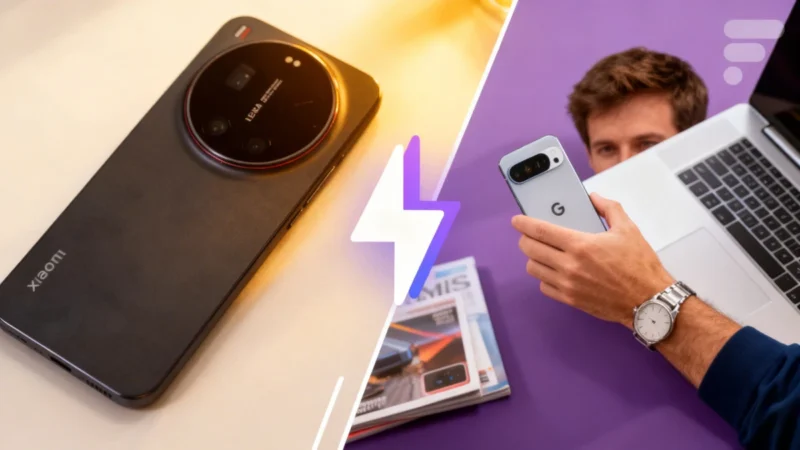
Ready for a heavyweight clash? The Xiaomi 17 Ultra has landed in stores, facing off against Google’s Pixel 10 Pro XL for the title of top smartphone. Both phones earned strong 9/10 reviews, but with pricing and feature gaps, which one really takes the crown? Here’s why many tech reviewers now say one of these devices outperforms the other in nearly every category.
Design and Build: Two Heavyweights, One Standout?
Aesthetics are subjective, but some reviewers prefer the style of the Google Pixel 10 Pro XL, calling it more elegant and symmetrical, with more appealing color options. Both are massive devices: the Xiaomi 17 Ultra sports a 6.9-inch display, and the Pixel 10 Pro XL comes in just shy at 6.8 inches. Neither is light—the Pixel weighs in at up to 8.2 ounces (232 grams), making it one of the heaviest mainstream phones.
What really differentiates them is their rear camera design. Xiaomi’s 17 Ultra comes with a huge circular camera module dominating the back, while the Pixel 10 Pro XL opts for a more subtle camera bar across the rear. For many, that more discreet look is preferable—but this is a matter of taste.
Both phones offer robust protection: Google uses Gorilla Glass Victus 2 and Xiaomi relies on its proprietary Shield Glass 3.0. They’re both certified water-resistant, but the Xiaomi 17 Ultra is rated at IP69 (top-tier dust and water protection) while the Pixel holds an IP68 rating.
Display: Brightness and Color
The screens on both flagships have impressed reviewers with their size, thin bezels (slightly thinner on the Xiaomi), and exceptional brightness. The Xiaomi 17 Ultra has set a new bar, reaching a peak brightness of over 3,500 nits—reportedly the brightest Android display tested to date. The Pixel 10 Pro XL is close behind, topping out around 3,000 nits. Both are easily readable in sunlight.
Color accuracy, though, tilts slightly toward Google out of the box: the Pixel 10 Pro XL delivers a more neutral profile, whereas the Xiaomi may require some tuning for the most natural balance. However, both fall short on full DCI-P3 color space coverage, especially given their premium pricing—something budget phones have sometimes done better.
Software, AI, and Performance
Both devices shipped with Android 16, but Xiaomi layers on its HyperOS 3.0 interface, significantly changing the user experience. One common frustration: Xiaomi continues to pre-load its handsets with numerous apps, making Google’s Pixel the less cluttered choice for those who prefer a minimal approach.
Google stands out on software support: buyers have had the promise of seven years of Android updates and security patches, plus timely access to new features via frequent “Pixel Drops.” Xiaomi, while offering impressive hardware at launch (~$1,630.00), provides five years of core software updates and an extra year for security patches—solid, but not quite the same longevity as Google’s commitment.
On AI features, Google has maintained its lead. The Gemini assistant is baked into Pixel devices everywhere, capable of increasingly autonomous in-app actions. Xiaomi’s focus with AI so far has mostly centered around text re-writing and photo editing, with fewer so-called “agentic” functions.
Raw processing power is one area where Xiaomi pulls ahead. The 17 Ultra uses the Snapdragon 8 Elite Gen 5, one of the fastest smartphone processors to date, handling demanding tasks and gaming effortlessly. While it can get warm and occasionally throttle, reviewers haven’t found any real-world workload that slows it down. By comparison, the Pixel 10 Pro XL’s Tensor G5 chip lags behind in graphic-intensive use, requiring users to accept lower settings for some games. For basic tasks, however, the Pixel remains perfectly fluid and capable.
Camera and Battery: The Xiaomi Advantage
Google has long been considered a leader in smartphone photography, but Xiaomi has closed the gap, especially since its collaboration with Leica. The 17 Ultra features a groundbreaking 200MP telephoto lens capable of optical zoom from 3.2x to 4.3x with no loss in quality. The Pixel 10 Pro XL, while improved, sticks to a more conventional hardware setup.
Pixel phones are outstanding point-and-shoot cameras, producing warmly lit shots with balanced exposure. However, they sometimes over-brighten shadows and smooth out highlights, resulting in flatter images. Xiaomi, by contrast, keeps stronger contrast and more distinct details, giving images a unique artistic feel. The ultra-wide cameras on both devices see a drop in quality compared to their main sensors, but still offer a wider perspective—here, the individual style of each manufacturer makes the biggest difference.
Google made strides this past year with its telephoto lens, but it doesn’t quite match the photographic versatility and precision of Xiaomi’s dual-focal module—even if it means accepting an extra-large camera bump. For those who prioritize photography, the 17 Ultra is hard to beat.
The story repeats on battery. Despite its XL moniker, the Pixel 10 Pro XL’s battery life has not improved over the regular Pixel 10 Pro, often requiring daily charging. The Xiaomi 17 Ultra, on the other hand, packs a 6,000 mAh battery, lasting over 19 hours in third-party testing. The Pixel lasted about 12.5 hours under similar testing—nearly a full day less for heavy users.
Charging speed amplifies the difference: Xiaomi’s included 100W charger fully powers the phone in just 43 minutes, compared to about 1 hour and 20 minutes for the Pixel. Both devices offer wireless charging, but only the Pixel 10 Pro XL supports Qi2 wireless charging.
So, in nearly every key metric—performance, display, photography, battery endurance—the Xiaomi 17 Ultra outshines the Pixel 10 Pro XL. Unless Google’s software support or the more affordable price tag (the Pixel now selling for about $540.00 less) is your primary concern, Xiaomi’s flagship clearly wins on features and power. For budget-conscious buyers, however, the Pixel 10 Pro XL remains a reliable choice with some advantages of its own.
If you want bite-sized tech news each morning, consider joining Frandroid’s official WhatsApp channel for daily updates.
The data you provide in this form is managed by Humanoid, publisher of Frandroid, as the data controller. Your data won’t be shared with third parties. Messages are sent only if you give consent, and you can unsubscribe via links in every email. For full privacy details or to exercise your rights regarding your data, see our dedicated request form.
This content is blocked because you have not accepted cookies or trackers. Provided by Disqus, you must accept usage to view, which may include sharing data for purposes like social media interaction, personalized ads, and analytics. Learn more on our site.