




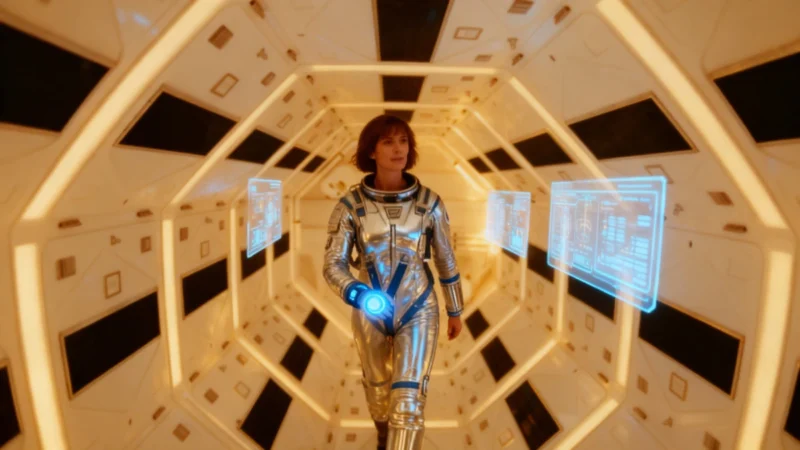
Ready for a trip through space, time, and the deepest recesses of the human mind? Sci-fi cinema has always dared to ask big questions—and sometimes, the answers arrive with laser swords, rampaging dinosaurs, or the menace of artificial intelligence. Here are 10 sci-fi movies that didn’t just entertain but fundamentally shaped the way we watch and imagine film. How many have you seen?
Metropolis (1927): The Blueprint for a Dystopian City
Starring: Brigitte Helm (The Star of Valencia, Adieu les beaux jours), Alfred Abel (Money, Dr. Mabuse, the Gambler), Gustav Fröhlich (Gloria, Clarissa), Rudolf Klein-Rogge (The Testament of Dr. Mabuse, Spies), and others.
As Metropolis reached its hundredth anniversary in 2026, the influence of Fritz Lang’s silent dystopian masterpiece remains striking. The film’s vision of a futuristic city split between wealthy industrialists living in luxury and exploited workers confined to hardship has inspired generations of filmmakers, including those behind Blade Runner and Star Wars. The arrival of a savior helps ease the tension between classes, and its social commentary feels as relevant today as ever.
Classic Monsters and Time Experiments: Godzilla and La Jetée
Godzilla (1954)
Starring: Takashi Shimura (Seven Samurai, Rashomon), Akihiko Hirata (The Mysterians, The Secret of the Telegian), Akira Takarada (Godzilla: Last War, King Kong Escapes), Momoko Kōchi (Prisoners of the Martians, Half Human: The Story of the Abominable Snowman), and others.
King Kong made his debut in 1933, but it’s Godzilla who still reigns as king of the monsters. With nearly forty films and series, this franchise is the oldest in cinema history. Godzilla, awakened by nuclear testing, has long represented Japan's postwar anxieties. In more recent films, the monster sometimes appears as a protector of Earth, although its destructive instincts never fade.
La Jetée (1962)
By: Chris Marker
This influential 28-minute French short established the cinematic language for time travel. Even decades later, La Jetée is frequently cited among the most important films ever made. Told almost entirely through black-and-white photographs, it follows a man in a post-apocalyptic world who, under scientific influence, revisits his past to try to rescue the future.
Stars, Mysteries, and Forbidden Zones
2001: A Space Odyssey (1968)
Starring: Keir Dullea (Fahrenheit 451, 2010: The Year We Make Contact), Gary Lockwood (Duo de choc, Zone interdite), Douglas Rain (Woody and the Robots, One Plus One), Daniel Richter (The Revolutionary), and others.
This Stanley Kubrick film is regarded by many critics as the greatest science fiction movie ever made, renowned both for its visual spectacle and its philosophical ideas. The story follows the discovery of a mysterious object beneath the moon’s surface and humanity's quest to understand its origins—helped by the advanced HAL 9000 computer. Even at the time of release, HAL suggested the chilling pitfalls of artificial intelligence in a position of power.
Star Wars (1977)
Starring: Mark Hamill (Marche ou crève, The Life of Chuck), Carrie Fisher (The Rise of Skywalker, When Harry Met Sally…), Harrison Ford (Blade Runner 2049, The Force Awakens), Alec Guinness (Murder by Death, The Bridge on the River Kwai), and others.
George Lucas’s saga about a young farm boy striving to save a captive princess practically reinvented cinema. Nearly fifty years later, the rich world of planets, robots, and creatures in Star Wars continues to spark the imagination of audiences worldwide. For many, ‘The Force' has become part of everyday vocabulary, embodying the timeless battle between good and evil.
Stalker (1979)
Starring: Aleksandr Kaydanovskiy (Confidences à un inconnu, Parajanov: The Last Spring), Alisa Freyndlich (Katia Ismaïlova, Rasputin), Anatoliy Solonitsyn (The Ascent, Solaris), Nikolay Grinko (The Mirror, Andrei Rublev), and others.
After leaving an indelible mark with Solaris, Russian director Andrei Tarkovsky went even deeper into the human soul with Stalker. The film follows a guide, the ‘Stalker', who leads a writer and a professor into ‘the Zone,' an area abandoned after a meteorite crash, rumored to be a place where desires come true. The exploration is psychological as much as it is physical.
Androids, Dinosaurs, and Digital Realities
Blade Runner (1982)
Starring: Harrison Ford (The Fugitive, Raiders of the Lost Ark), Rutger Hauer (Valerian and the City of a Thousand Planets, Confessions of a Dangerous Mind), Sean Young (Bone Tomahawk, Ace Ventura: Pet Detective), Daryl Hannah (Kill Bill: Vol. 1, Wall Street), and others.
Just three years after Alien, Ridley Scott unveiled Blade Runner, depicting a bleak, corporate-dominated future where androids are nearly indistinguishable from humans. Loosely based on Philip K. Dick’s novel, the film takes place in 2019, with policeman Rick Deckard hunting down the dangerous humanoid ‘replicants.'
Jurassic Park (1993)
Starring: Sam Neill (Thor: Love and Thunder, Hunt for the Wilderpeople), Laura Dern (Is This Thing On?, Marriage Story), Jeff Goldblum (Asteroid City, Jurassic World: Dominion), Richard Attenborough (Gandhi, The Great Escape), and others.
Steven Spielberg proved his grasp on sci-fi with classics like Close Encounters of the Third Kind, E.T., and Minority Report. But Jurassic Park truly set a milestone in visual effects, thanks in large part to software by Quebec programmer Daniel Langlois. The digital dinosaurs still impress and terrify audiences more than thirty years later, and the film remains both convincing and iconic.
The Matrix (1999)
Starring: Keanu Reeves (Good Fortune, John Wick), Carrie-Anne Moss (The Matrix Resurrections, The Song of the Elephant), Laurence Fishburne (The Amateur, Contagion), Hugo Weaving (The Royal Hotel, The Lord of the Rings: The Return of the King), and others.
At the turn of this century, the Wachowskis shook up science fiction with The Matrix, combining technical feats like time-bending slow-mo, striking visual style, and big metaphysical questions. Are our lives simulations sent straight into our heads? Young programmer Neo tries to break out of this controlled dystopia by supporting a rebellion.
Avatar (2009)
Starring: Sam Worthington (Avatar: Fire and Stone, Horizon: An American Saga — Chapter 1), Zoe Saldana (Emilia Pérez, Guardians of the Galaxy), Sigourney Weaver (My Salinger Year, Alien), Stephen Lang (Sisu: Path of Vengeance, Avatar: The Way of Water), and others.
James Cameron further cemented his sci-fi credentials after film landmarks like Aliens, the first two Terminator movies, and The Abyss. With Avatar, he introduced viewers to Pandora, a luminous exomoon inhabited by the blue-skinned Na’vi. This film, the most profitable in history, follows Jake Scully, a paraplegic soldier who, through his avatar, becomes a Na’vi and resists the relentless exploitation of Pandora’s resources by desperate humans facing an energy crisis on Earth.
Share Your Thoughts
Comments are moderated by the L’actualité team and will only be approved if they follow current netiquette rules. Please allow time for review and validation.


This is mostly a great list, though I don’t think Avatar really holds up to the others.