


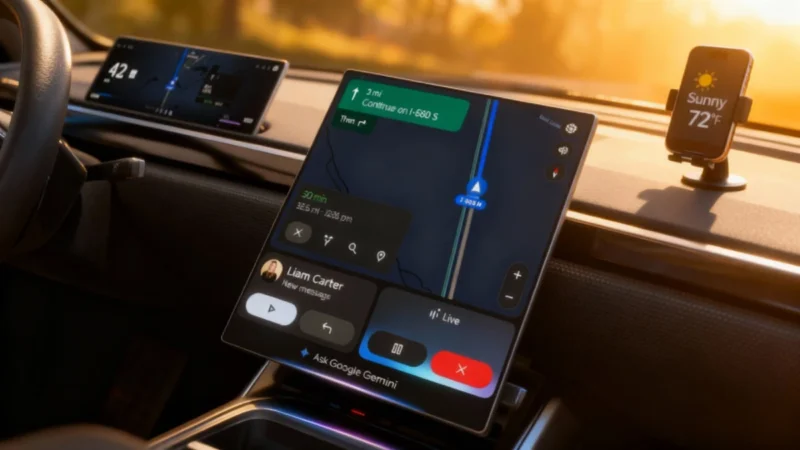
Have you ever uttered the classic “OK Google, navigate home” in your car, only to be met with a soul-crushing silence or, even worse, the robotic equivalent of a shoulder shrug: “Sorry, I didn't understand”? If that rings painfully true, you’re not alone, and no, you haven’t developed an accent overnight. Something bigger—and frankly quite baffling—is unfolding on the Android Auto front.
An Unmistakable Decline: Where Are Google Assistant’s Neurons?
Let’s call it what it is: Google Assistant seems to be losing its marbles. More and more Android Auto users are noticing that their trusty car companion is becoming slower and less reliable, often failing on simple, crucial commands. Frustrating? Certainly. But behind the growing agitation in the driver’s seat, there’s a serious issue at play. This is not just about minor tech annoyances—it’s a genuine safety concern on the road.
A Chaotic Transition: From Assistant to Gemini
So, what’s going on under the hood? According to Google’s own announcements, the company is gearing up to transition from Google Assistant to its shiny new generative AI, Gemini, at the end of 2025. Unfortunately, calling this transition “smooth” would be generous. The current phase is a muddled grey zone: the old Assistant is being quietly neglected, while the new Gemini isn’t ready for prime time just yet.
If you’ve ever felt like you’re being shuffled out of an old favorite only to stand outside the door of a not-yet-opened club, you’re not far off. Reports, including those from 9to5Google, confirm that Google has already started pulling resources away from the Assistant to double down on Gemini. On paper, that sounds ambitious. In practice? The result is a user experience (or lack thereof) that leaves many drivers in limbo.
Sound familiar? If you own a Nest speaker, you’ve watched this movie before. Google has a knack for pushing users toward its next big thing by making the old one, well, less appealing. The catch this time: for the overwhelming majority of European drivers, Gemini isn’t even available yet.
Danger Behind the Dashboard
Tech evolves. That’s not news. But here’s the rub: Google’s approach seems to ignore how its products are actually used. On your phone, if Gemini crashes, you just type in your search like it’s 2009 again. In the car, though, a failed voice command nudges you toward fiddling with the screen or reaching for buttons—and that takes your eyes off the road. So, this isn’t just about your playlist not loading. It’s a problem with real-world safety implications.
- When a voice assistant fails, the temptation is strong to manually intervene.
- Manual intervention while driving increases the risk of distractions.
- The gap between an abandoned old product and an unfinished new one leaves users exposed right now.
Gemini: Grand Promises, Slim Realities
There’s hope on the horizon, or at least that’s what the marketing folks at Google want you to believe. Gemini’s promise is enticing: natural language understanding, contextual responses, and the true intelligence we’ve been waiting for in our cars. The reality, at present, is a lot more vapor than ware.
Google itself has half-acknowledged that things aren’t running smoothly, making vague promises about future fixes. But the truth is, the number-one focus now is rolling out Gemini—a process Google says will stretch across all of 2026. In other words, expect the gap to linger longer than your patience might allow.
For drivers, the bottom line is both clear and infuriating: The transition between Google Assistant and Gemini is less of a smooth ride and more of a pothole-riddled detour. Until Gemini arrives in full force, the simplest hands-free requests risk being met with either confusion or complete silence. The only real option for now? Keep your eyes on the road, your hands on the wheel, and maybe, just maybe, practice saying “navigate home” in your very best robot voice—because it figures your tech might need all the help it can get.