


The Cyclops Who Got Away
After the initial rush, Variety published its “every performance in Christopher Nolan’s film” ranking. Of course, the headline exaggerates—there’s inevitably no space for background figures like “Third Trojan” or “Old Man at Coastal Village.” The piece covered most major and several of the minor roles, but it omitted one of The Odyssey’s boldest and most inventive characterizations: Bill Irwin’s Cyclops.
Polyphemus: Homer’s Monster, Nolan’s Enigma
The Cyclops episode is central to The Odyssey—referenced by Zeus in the opening lines and expansive enough for all of Book 9, which Emily Wilson translates as “A Pirate in a Shepherd’s Cave.” Pop culture tends to misremember Homer’s original. His Polyphemus is more complex than a mindless brute—he’s articulate, even somewhat reasonable, considering he’s a supernatural, man-eating giant. Yes, he traps Odysseus and his crew before literally tearing them apart two at a time. But he’s polite enough to pass around Odysseus’ wine by the fireside and takes a bleak liking to Odysseus, promising to eat him last.
Odysseus returns this fleeting courtesy with cunning and revenge, blinding Polyphemus with a heated wooden spear and escaping while blood from the ruined eye pours out. The wailing Cyclops appeals to his fellow giants (who, in Homer’s version, are something like neighbors, though they keep to themselves), but because Odysseus has introduced himself as “Noman” or “Nobody,” they take Polyphemus’s claim that “no man” harmed him as mere divine mischief. That could have closed the book—but Odysseus can’t resist boasting as his ship sails away:
If any mortal asks you how your eye was mutilated and made blind, say that Odysseus, the city-sacker, Laertes’ son, who lives in Ithaca, destroyed your sight.
That moment of pride costs him dearly. Polyphemus’s father is Poseidon, god of the sea, and Odysseus’ explicit self-disclosure gives Poseidon a target for his rage. In Homer, the poet lingers on the gory detail of the eye’s injury, underscoring the violence of Odysseus’s victory. While the narrative doesn’t exactly seek pity for Polyphemus—his appetite for human innards is gruesomely described—Poseidon’s yearslong vendetta against Odysseus doesn’t feel entirely unjustified.
Irwin’s Cyclops: Alien, Mournful, and Unforgettable
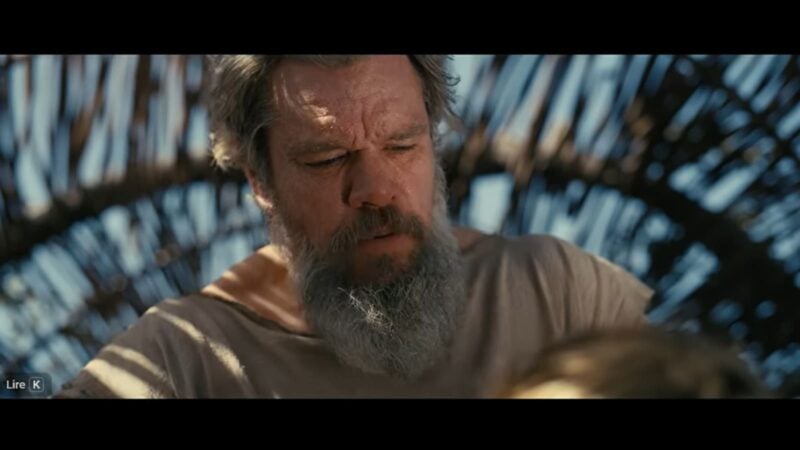
In Nolan’s film, Irwin plays the Cyclops as something far stranger than Homer’s talkative Polyphemus—a silent, inscrutable force. He never addresses Odysseus or his men, and when he finally cries out, his words are barely intelligible. (That kind of indecipherable dialogue is nothing new for a Nolan film.) This Cyclops is all brute instinct, calmly biting off heads as if snacking. Yet in Irwin's hands, he’s also lonely and pitiable, a hermit more at peace making cheese in solitude than fighting invaders. He seems gentle toward his sheep, at least.
Irwin, a Tony-winning stage veteran (Who’s Afraid of Virginia Woolf?, opposite Kathleen Turner), world-renowned for his performances in Samuel Beckett plays and beloved as Sesame Street’s Mr. Noodle, is not the obvious choice for a giant mythological ogre. But that offbeat casting—and Irwin’s artistry—make the Cyclops marvelously unique. He isn’t as imposing as Matt Damon’s Odysseus or as bloodthirsty as the Laestrygonians, but he is ancient, saggy, lumbering—and still powerful enough to tear a man to pieces.
Here, the Cyclops consumes Odysseus’ men not out of cruelty but out of instinct, barely registering their presence. When he first bites down, he recoils like a kid who’s just tasted vegetables. Humans seem so far beneath him, they barely count at all, much like ants to a person. When the Cyclops finally howls in pain, one of Odysseus’s men expresses surprise that the creature hadn’t spoken to them at all. “Do you talk to ants?” Odysseus replies.
The Hidden Craft of the Giant
Irwin’s Cyclops might be overlooked because he barely speaks or because the performance blurs boundaries. Since Irwin is not, in reality, 60 feet tall—and since Nolan prefers practical effects to CGI—sometimes the character is nothing but a massive hand on screen; at others, a puppet takes over. Nolan and Irwin haven’t detailed exactly how it all came together, so sometimes viewers are left guessing what’s real and what’s not. Nolan uses digital effects sparingly, favoring tangible, hard-to-fake moments where possible.
But those familiar with Irwin’s stage work know he moves with remarkable precision, using his entire body as expressive instrument. For the Cyclops, he manipulated even the giant puppet’s movement, infusing it with uncanny life. In a previous Nolan project, Interstellar, Irwin made even the robot TARS—a hulking prop—feel kinetic and soulful through sheer performance.
In The Odyssey, the Cyclops scene is the first real glimpse of Odysseus, not the legendary hero of old tales but a cunning, impulsive, sometimes cruel man. There is no purpose for the gratuitous final arrow the fleeing Odysseus shoots into the Cyclops’s ruined eye, and the film neither rationalizes it nor excuses him. It’s rash and selfish, risking his remaining men for one last taunt. Bill Irwin’s performance makes Polyphemus unsettlingly sympathetic—even childlike in his agony—forcing the audience to question who the real monster might be. As the rest of Nolan’s Odyssey unfurls, we’ll see more of these so-called heroic deeds, and how easily legend turns carnage into glory. It all starts in the cave, with a Cyclops reimagined not as a simple beast, but as a sacred outcast—strange, melancholy, and all too human.