




A New Chapter for Carbon Fiber
While carbon fiber isn’t a novelty, its impact has been felt for decades in industries where every ounce counts. Airplanes, spacecraft, cars, and wind turbines depend on the material’s signature mix of lightness and strength. Yet China has recently raised the bar.
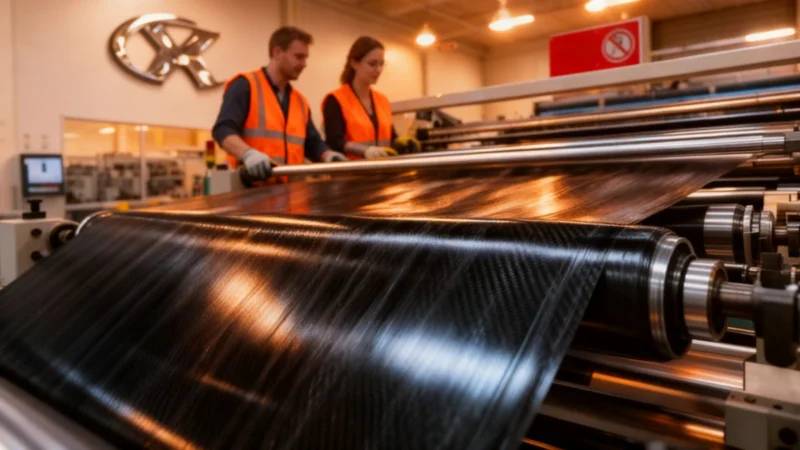
Chinese manufacturers have been mass producing T1100-grade carbon fiber, considered among the strongest in the world. Its tensile strength reportedly reaches about 7 gigapascals (GPa), compared to the roughly 5 GPa typical of standard aerospace-use fibers. In US terms, 7 GPa is about 1,015,000 psi, while 5 GPa is roughly 725,000 psi—a marked advancement.
Industrial and Strategic Impact
This shift opens new possibilities. With superior strength, manufacturers can make structures lighter without compromising safety. In energy- and fuel-conscious industries, this can mean significant efficiency gains.
The space industry has paid close attention to these developments. Lighter rockets need less fuel; lighter satellites cost less to launch. The same principle holds for commercial aviation, where cutting weight helps airlines save on jet fuel. Even minor improvements in strength-to-weight can deliver big savings over time.
China has worked for years to reduce its dependence on foreign-sourced advanced materials, particularly in strategic sectors. Until recently, Japan and the United States largely dominated the high-end carbon fiber market, with companies such as Toray of Japan controlling specific technical segments.
According to reports cited in the French press, the true breakthrough for China is not only technological but industrial. Producing limited quantities in a lab is one thing; reliably manufacturing large volumes at consistent quality is another. Achieving mass production has been the true hurdle, and China’s progress in scaling up sets it apart.
Energy Sector, Economics, and Global Shifts
The energy sector, especially wind power, stands to benefit as well. Offshore wind turbine blades already use large amounts of carbon fiber composites. With even stronger fibers, designers can create longer, lighter blades—potentially improving power output and efficiency.
This industry push also carries broader economic implications. The world market for carbon fiber is growing quickly, driven by soaring demand not only in transportation and energy, but in developing new infrastructure projects.
China has invested heavily for over a decade to develop its entire industrial chain for these strategic materials. The goal: securing access to the building blocks of tomorrow’s economy, with carbon fiber firmly in that category.
Geopolitics and Rising Competition
Recent global tensions have accelerated this trend. US trade restrictions on advanced technologies have encouraged Chinese manufacturers to focus on domestic innovation. As a result, several Chinese groups have narrowed the long-standing technology gap between China and the former industry leaders in Japan and the West.
Greater Chinese production capacity could begin to affect global prices, intensifying competition. This could put added pressure on US and European manufacturers, especially within specialized or high-end market segments.
The electric vehicle sector is one area likely to feel these effects. Lowering vehicle weight remains one of the most effective ways to extend battery range, so more advanced carbon fibers could be crucial for future EV designs.
Other areas—like infrastructure and rail transportation—are also searching for more durable, longer-lasting materials. Although costs for these advanced fibers remain high, large-scale production may gradually make them more accessible to manufacturers worldwide.
Ultimately, for China, this move is as much a strategic message as an industrial achievement. The country is no longer content with competing solely on price. It is seriously intent on taking a lead in ultra high-tech materials—a space long dominated by select Western and Japanese companies.


Could this be useful in the automotive industry?