



America’s Electric Tipping Point: A Slow-Revving Revolution
The US, birthplace of Henry Ford and Cars, has started taking electric vehicles seriously—though it’s still trailing China and Europe. In 2021, EVs made up only about 3% of new car sales in the US (compared to nearly 10% in France). But sales nearly doubled year-over-year and had been expected to climb past 5% in 2022. The momentum is clear. Most major American automakers have begun targeting a market long dominated by Tesla.
General Motors, which made an early move with its Bolt, had plans for a luxury Cadillac and a sporty Corvette EV, and was already selling the massive electric Hummer. Ford launched a battery-powered F-150 Lightning pickup in spring 2022 and previously unveiled the Mustang Mach-E—a storied muscle car reimagined as an electric SUV. Startups like Rivian, Lucid, and Canoo have jumped in, too. The federal government spurred this push: President Biden’s climate-friendly Inflation Reduction Act, adopted in August 2022, dedicated $370 billion to supporting clean energy, with generous incentives for EVs made in the US.
From Chicago to the Pacific: Soul, Nostalgia and Supermarket Chargers
To understand this transformation, we crossed the US from east to west in an electric vehicle, following the legendary Route 66. The route covers about 2,500 miles from the Great Lakes to the Pacific, cutting through eight states and three time zones.
At the time, EV rentals weren’t available in the US for a coast-to-coast journey, so Ford provided a Mustang Mach-E for our mid-June departure.
Forget the highway gas station. On a long US drive, fast charging stations for EVs aren’t at highway rest stops, but instead tucked behind big-box stores like Walmart or Target. Finding them means relying on navigation and charging apps—today’s version of the road atlas—to check charger availability and status. The Mach-E, for instance, needs around 30 minutes to jump from about 55 miles (20% charge) to 220 miles (80%) of range. It’s best not to leave finding a compatible charger to chance.
So our trip began—less glamorously than expected—in the basement of a Target store on Chicago’s outskirts. The city itself has all but swallowed historic Route 66; outside of a “Start” sign downtown, following the old road is like a maze, mixing city streets, avenues, and highways, while the car’s GPS faithfully tries to reroute you. Eventually, the car’s onboard computer prevails: to save time and battery, we stick to the highway toward our first landmark, 60 miles south of Chicago.
Our Mustang poses beside the Gemini Giant in Wilmington, Illinois: a 28-foot-tall fiberglass spaceman from the 1960s, one of many oversized roadside figures called Muffler Men. This kitschy comic-book astronaut marks the real entry to the classic Route 66—straight stretches through cornfields, brown historical signs, and a parade of old gas stations now turned souvenir shops. One station even advertises a charger, but it’s disconnected from the grid. Disappointing—but not unusual. Once again, we’re back at a supermarket parking lot to charge.
EV Innovation in America's Heartland: Factories, Festivals, and Learning Curves
Route 66 already hosts an electric vehicle factory: in Normal, Illinois, California-based Rivian operates a massive plant, converted from a former Mitsubishi facility. The site is more than 2.7 million square feet with about 6,000 workers. Rivian, which supplies vehicles to Amazon, began delivering pickups in March 2022, but production ran behind targets: only about 25,000 vehicles built versus the 50,000 originally planned, with over 70,000 pre-orders waiting—and 100,000 delivery vans promised to Amazon.
Rivian’s presence helped launch one of America’s first EV mechanic training programs at Heartland Community College. Coordinator Mike Deavers explains, “The program started last August. We train all types of people, from students to retirees and those changing careers.” About 100 students have participated so far, with plans to expand the workshop.
From here, Route 66’s scenery grows less scenic as it merges with Interstate 55. Crossing the Mississippi and entering St. Louis brings a dramatic change: cornfields give way to the forests and hills of the Ozarks. The 630-foot Gateway Arch, built in the 1960s, marks the “Gateway to the West.” Sometimes the old Route 66 peels off to wind through historic towns like Cuba or Lebanon.
Stopping for a charge in Lebanon—about 160 miles from St. Louis—yields a pleasant surprise: this time, the fast chargers aren’t hidden in a shopping center but are right beside a traditional gas station and general store. Even better, a festival celebrating Route 66 is in full swing, with classic cars, live music, and souvenir stalls. Robert Gehl from the Route 66 Association of Missouri says such events are becoming more common as the 2026 centennial approaches. After falling out of favor in the 1980s when new, wider highways took over, Route 66 is now enjoying a real revival.
Route 66 forms the backbone for much of America’s mythology. As John Steinbeck wrote in The Grapes of Wrath (1939), the road carried Dust Bowl farmers fleeing ruined land: “The 66 is the road of refugees, of those who flee the dust […], the thunder of tractors, withering properties, the slow invasion of the desert, the swirling Texas winds, floods that destroy yet do not enrich. The 66 is the mother road, the road of flight.”
A century later, many Oklahoma farmers have a new source of income: wind energy. Twenty minutes north of Route 66, the Traverse Wind Energy Center has recently come online as the largest wind farm in the US, with 356 giant turbines on over 225,000 acres. It can produce nearly 1 gigawatt of power—about as much as a nuclear reactor. The site is part of a three-location $2 billion investment by American Electric Power (AEP), one of the nation’s largest electricity distributors, which aims to boost its renewable energy share from 20% now to over 50% by 2030. AEP regional manager Ryan Godwin says, “The Traverse project started in 2019 and took just 15 months to build—even during the pandemic. Leasing land to hundreds of owners, wind offers a steadier income than oil and gas.”
Westward: Charging Frustrations, Electric Conversations, and Route 66’s Finale
Back on Route 66, our first charging mishap arrives, courtesy of new Francis Energy chargers at an Oklahoma rest area—half are offline and the others are slow (30 kW, requiring nearly two hours for a full charge). We shift to an Electrify America station 10 miles away, where three of four chargers are occupied. I chat with the owner of a Lucid Air luxury sedan (boasting a 520-mile range and a $140,000 price tag) who complains his car, in theory, charges three times faster than Tesla or Mach-E—but he’s never found a public station that can keep up. Still, we recharge to 80% in just over 30 minutes this time.
In Texas, Ford rolled out the F-150 Lightning for journalists—a symbolic move, since Texas is the top pickup market in the US (about 20% of sales). Texas, despite its oil-centric reputation, ranked third nationally for EV registrations in 2021 (80,900 vehicles), behind California (563,070) and close to Florida (95,640), according to the Department of Energy.
Amarillo is the biggest Texas city along the route, with about 200,000 people and three Ford dealerships. Reactions to EVs are mixed. At Tri-State Ford, sales manager Tim Turley says, “We don’t have any in stock and Ford can’t supply them. It doesn’t matter since nobody here wants a car they’d have to charge en route to Albuquerque,” the next city 175 miles away. He’s also critical of Ford’s sales strategy, suspecting the company wants to follow Tesla’s direct-sales model.
At another dealership 10 miles away, two shiny new Mach-E SUVs are front and center. Salesman Dameion Duran says, “There’s huge interest in this model. We even have an F-150 Lightning on display but haven’t sold one yet.” He believes EVs are gaining traction, especially as mainstream automakers bring more models to showrooms and gasoline in Texas neared $5 per gallon in June 2022 (up from $2.75 the prior year).
Heading west, Amarillo’s Cadillac Ranch—ten half-buried, graffiti-covered Cadillacs—is a Route 66 highlight and a favorite photo stop for travelers.
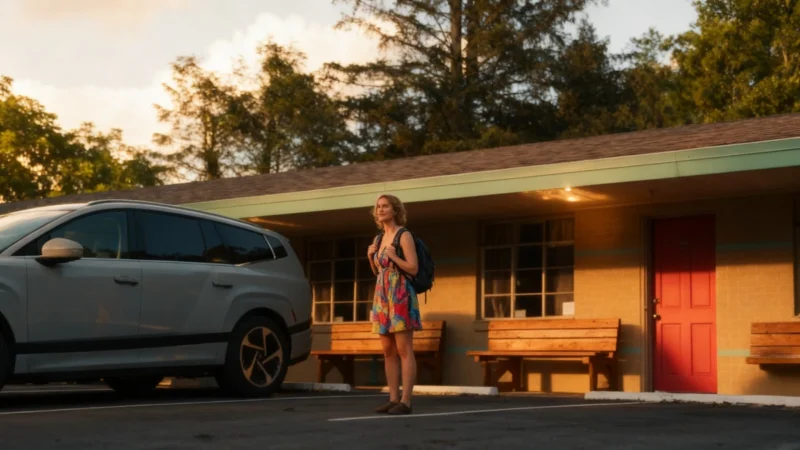
Nearing New Mexico, Tucumcari is a time capsule with vintage neon motels boasting “100% refrigerated air” and individual garages. Only a few of the town’s once-numerous lodgings remain, appealing to nostalgia seekers. At the Blue Swallow Motel (opened in 1941), current owner Bob Federico explains, “The previous owner installed Tesla chargers; we also have one for other brands. They’re only used a few times a week, but more guests have EVs and are glad to find a free charger.” After ten days, our Mustang could fully recharge here overnight at no extra cost.
Santa Fe was served by Route 66 for only about a decade, before a less mountainous route was established in 1937. To find Tesla service and sales in New Mexico, drivers head to an old casino on Pueblo of Nambe indigenous land. Marco, one of eleven employees, explains that this allowed Tesla to bypass state laws requiring car sales and repairs to go through dealerships. Tesla mainly delivers and services cars bought online, but higher gas prices next door have recently led more drivers to stop in with questions.
Along the route, about a dozen Route 66 museums pay homage to its history, but only in Kingman—in a former electric power plant—does a museum have a room dedicated solely to EVs: golf carts (including one customized for Willie Nelson), a converted Porsche 911 cabriolet (top speed 65 mph), and one of the first 2008 Tesla Roadsters (#480). Faded clippings from decades prior, like a 1967 This Week magazine cover that asks “Auto Electric—Sooner Than You Think?”, reveal the long and often frustrating road to today’s EV reality.
The last 60 miles of desert between Kingman and California pass in brutal heat. Temperatures soar above 104°F, lowering the Mach-E’s range and making fast charging slower—battery fans roar to keep things cool. At the Needles, California, Electrify America station, solar panels shade the chargers, a necessity in this climate. About 40 minutes of charging gave enough energy to reach Joshua Tree National Park, 125 miles west, through stark deserts, mountains, and ghost towns. Sometimes Route 66 is closed, forcing a return to the interstate.
At the Joshua Tree entrance, our reward is a stay at an AutoCamp—an upscale camping concept launched in 2016 across the US, featuring rows of Airstream trailers fitted out as luxury suites. The Joshua Tree camp, opened in 2025, had 42 trailers and seven EV chargers—all of them occupied when we arrived. Signs kindly suggest a five-hour charging limit; the receptionist admits weekends bring stiff competition for a plug. More chargers are planned.
The future of the EV industry might be tied to the Salton Sea, an ecological disaster zone between Joshua Tree and the Mexican border. Pollution and evaporation turned once-thriving towns like Bombay Beach into near ghost towns. But its underground lithium reserves could be a game-changer for battery production. According to a 2019 California Energy Commission report, the area could provide all future US lithium needs and 40% of global demand—if extraction challenges are solved. In 2025, General Motors partnered with a local company to secure lithium beginning in 2024. While this won’t restore the dying Salton Sea, it could create thousands of jobs and supply millions of EVs in years to come.
The LA arrival is as complicated as the Chicago departure. Route 66 disappears beneath suburbia, shopping plazas, and finally eight-lane freeways. The journey’s end is anti-climactic: the “End of the Trail” sign sits atop the Santa Monica Pier’s pedestrian walkway. No cars allowed. The last snapshot is taken by Ian Bowen, Route 66’s resident historian and souvenir shop owner, who hands out diplomas verifying travelers have covered the 2,500 miles. The Mustang finishes in a nearby parking lot, where several charging spots are reserved for EVs.
Drivers call it range anxiety: the fear of not finding a charging station in time. It didn’t ruin our trip, but it did require meticulous planning. Public chargers are scarce and not always reliable. Getting 100 more miles often takes 20–40 minutes—sometimes much longer if there’s a problem. On this journey, we averaged about 205 miles per day, spending roughly one hour daily at public chargers (not counting detours). Overnight hotel charging is still rare, but invaluable. Fast chargers typically cost $0.30–$0.40 per kWh, or about $15 per 100 miles. Our Chicago-to-Santa Monica run cost just under $400 in charging ($700 for gas in a similar SUV).
The US’s expanding charger network owes some credit to the Volkswagen diesel emissions scandal. In 2016, VW agreed to a $2 billion, ten-year investment to support EV adoption, primarily by funding public charging stations. Electrify America, created in 2018, has opened more than 800 fast-charging stations (100 kW+) to date and aims for 1,800 by 2026 in the US and Canada. California company ChargePoint, founded in 2007, operates 30,000 charging points, though most are slower. Tesla runs a network of 1,400 “Supercharger” stations, each with about ten units, but these remain exclusive to Tesla vehicles due to a unique connector.