



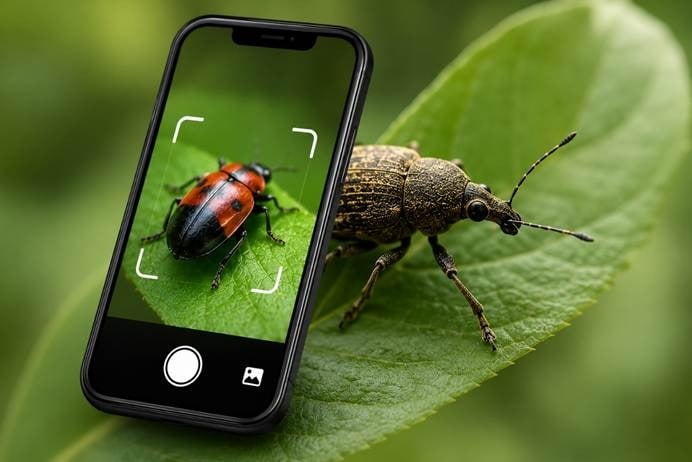
You found something crawling across your kitchen counter — or maybe something landed on your arm during a hike — and now you need answers. The good news is you don't need an entomology degree anymore. Today's apps let you identify a bug by picture in seconds, straight from your phone. We tested the most popular options to help you pick the right one. Here are our picks.
Quick Picks: Top Free Bug Identification Apps for Android
- BugKnow — Free and unlimited scanning, 260K+ species, built for everyday American households. Best all-around pick.
- Insectio — Feature-packed outdoor companion with hike forecasts, pet safety tools, and a discovery feed. Best for nature lovers.
- BugIdentifier.Org — No download, no signup. Open your browser and go. Best for one-time lookups.
- Google Lens — Already on your phone. Decent for common bugs, but not purpose-built for insects.
- iNaturalist — Community-powered citizen science platform with expert verification. Best for accuracy nerds.
- Picture Insect — Polished app with a large species database and bite reference. Good all-rounder with a subscription model.
1. BugKnow
Platform: Android & iOS
Why It's Our Top Pick
BugKnow does one thing and does it really well: it helps regular people figure out what's crawling around their house. You open the app, point your camera, and get a result. No complicated setup, no pressure to subscribe before you can even use the thing.
What sets BugKnow apart is breadth plus price — or rather, the lack of a price. The app covers over 260,000 species including insects, spiders, and other arthropods, and the core scanning feature is completely free with no daily limits. Most competitors either cap your free scans or lock the good stuff behind a paywall. BugKnow doesn't play that game.
Beyond the ID, you get full species profiles covering behavior, habitat, life cycle, and risk to you or your pets. The Bite Checker lets you upload a photo of a mysterious bite for a reference match, and the Pest Severity Assessment helps gauge whether that ant trail in your bathroom is a minor nuisance or something bigger. There's also a community feature for posting uncertain finds.
Pros & Cons
Pros: Genuinely free with unlimited scans. Massive species database (260K+). Bite checker and pest assessment are practical, everyday tools. Clean interface with zero learning curve.
Best for: Any American household that occasionally finds something with too many legs and wants a fast, free answer.
2. Insectio
Platform: Android & iOS
The Outdoor Explorer's Dream App
If BugKnow is the practical household tool, Insectio is the Swiss Army knife for anyone who enjoys spending time in nature. This app goes well beyond photo identification — it's built around the idea that bugs are part of your outdoor experience, and you should know what's out there before you lace up your boots.
The identification engine works the way you'd expect: snap a photo, get a species result along with a detailed, beautifully illustrated profile. Every find is automatically saved to your history. But where Insectio really separates itself is in the extras. The Hike Bug Forecast lets you pick a location and date to generate a full insect-risk report — what to expect, what to wear, what to watch for when you get back. Live activity alerts tell you which species are most active near you right now. And if you have a dog or cat, the dedicated pet section covers fleas, ticks, mosquitoes, and chiggers with clear advice on what to look for.
The Discover tab tailors itself to your location, surfacing what's active nearby along with daily insect facts. There's also a photo-first community space where users share their finds in a clean visual grid.
Pros & Cons
Pros: Deepest feature set of any insect app we tested. Hike forecast and pet safety tools are unique. Gorgeous species profiles with multiple angles and life stages. Strong community component.
Best for: Hikers, campers, nature enthusiasts, and pet owners who want more than just a name.
3. BugIdentifier.Org
Platform: Website, Android Web & iOS Web
Zero Friction, Instant Answers
Sometimes you don't want to download an app. You just Googled “what is this bug,” you're staring at a search result, and you want an answer right now. That's exactly the gap BugIdentifier.Org fills.
It's a web-based insect identification tool — no app to install, no account to create. You open the site, upload a photo, and get your result. The whole thing takes about thirty seconds. For the millions of people who encounter a mystery bug once or twice a year, this is all you need. The AI handles common species well, returning a species name along with basic information.
The tradeoff is depth. You won't find hike forecasts, community forums, or personal collections here. It's a single-purpose tool, and it owns that lane.
Pros & Cons
Pros: No download, no account, no friction. Works on any device with a browser. Fast results for common species. Perfect for casual, infrequent use.
Cons: Limited species information compared to dedicated apps. No collection or history features. Accuracy may dip for rare or unusual species. Not ideal for repeat use.
Best for: The person who sees a weird bug once a year and just wants to know what it is without installing anything.
4. Google Lens
Platform: Web, Android Web & iOS Web
The One You Already Have
There's a solid chance Google Lens is already on your phone. Open the Google app, tap the camera icon, and point it at whatever's bugging you (pun intended). Lens matches the image against Google's massive visual database and returns web results, species names, and related images.
For common household insects — think ants, cockroaches, common spiders — Lens does a respectable job. It's fast, it's free, and you don't need to install anything new. Results link directly to web pages with more information.
Where Lens falls short is specificity. It's a general-purpose visual search tool, not an entomology app. Independent testing has shown it struggles with closely related species, uncommon insects, and poor-quality photos. You might get pointed to the right family but miss the exact species. It also doesn't offer insect-specific features like bite checking, pest assessment, or species profiles.
Pros & Cons
Pros: Free and already installed on most Android devices. No setup required. Works for common, easy-to-identify species. Results link to broader web resources.
Cons: Not built for insect identification specifically. Accuracy drops significantly for uncommon species or lower-quality photos. No species profiles, collections, or community features. Can return vague or overly broad results.
Best for: A quick “is this a cockroach?” check when you don't have a dedicated bug app installed.
5. iNaturalist
Platform: Android & iOS
Citizen Science at Its Best
iNaturalist is a different kind of bug identifier. Instead of relying purely on AI, it combines machine learning with a global community of over 400,000 naturalists and scientists who actively verify identifications. When you upload a photo, the app's AI gives you an initial suggestion, and then real people weigh in. Once enough members agree, your observation becomes “Research Grade” — accurate enough to feed into actual scientific databases.
This crowdsourced approach makes iNaturalist arguably the most accurate option on this list for tricky identifications, but it comes with a tradeoff: speed. The AI suggestion is instant, but community verification can take hours or days. It's free, nonprofit, and completely open — no subscription, no ads.
The app goes beyond insects too. You can identify plants, fungi, birds, and pretty much any living thing. Every observation gets saved with photos, dates, and GPS coordinates, building a personal nature journal over time.
Pros & Cons
Pros: Community verification makes it the gold standard for accuracy. Completely free with no ads or paywalls. Contributes to real scientific research. Covers all living organisms, not just insects.
Cons: Community verification isn't instant — you might wait a while for a confirmed ID. The app can be buggy. Interface is functional but not as polished. Requires an account and internet connection.
Best for: Citizen scientists, educators, and anyone who values confirmed accuracy over instant gratification.
6. Picture Insect
Platform: Android & iOS
Polished and Practical
Picture Insect has quietly built a loyal following among gardeners, teachers, and casual bug enthusiasts. The app identifies over 4,000 species using AI photo recognition, and results come fast for well-known insects. Each identification opens into a profile with images, characteristics, and FAQs.
The app includes a bite reference feature for checking mysterious stings and bites, plus pest detection tips for home and garden use. You can save your identifications to a personal collection and share discoveries with friends. There's also a “Books” feature with curated articles about insect biology and seasonal activity.
The catch is the subscription model. While Picture Insect technically has a free version, the app pushes hard for its yearly premium plan — and some users report the onboarding flow makes it easy to accidentally start a paid trial. If you're comfortable subscribing, you get unlimited scans, expert entomologist Q&A, expanded information, and an ad-free experience.
Pros & Cons
Pros: Clean, intuitive interface. Solid accuracy on common species. Bite reference and pest tips are useful. Personal collection feature is well-designed.
Cons: Aggressive subscription prompts. Free version is limited. Species database (4,000+) is smaller than some competitors. Can struggle with less common or small insects.
Best for: Gardeners and hobbyists willing to pay for a polished, focused insect ID experience.
The Bottom Line
Your best pick depends on how you'll actually use it. For a free, no-nonsense household tool, BugKnow is the clear winner. For the deepest outdoor feature set, Insectio is worth the investment. And for a one-time answer without downloading anything, BugIdentifier.Org gets you there in seconds.
iNaturalist is unbeatable on accuracy if you're patient, Google Lens works in a pinch, and Picture Insect is solid if you don't mind subscribing. No matter which you pick, you're one photo away from knowing exactly what you're looking at.