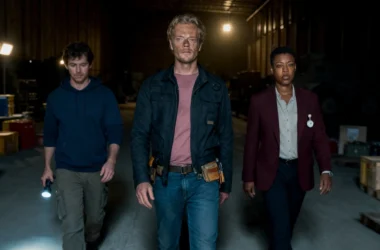



Curry Barker: From YouTube to International Acclaim
Curry Barker’s journey to the big screen rivals the drama of his own stories. Before landing international attention, Barker launched the YouTube channel That’s a Bad Idea, where he posted self-financed short films. Despite being self-taught and facing numerous challenges, Barker managed to steadily build his reputation. His debut film, Milk & Serial, already has close to 3 million views online. Obsession premiered on September 5, 2025, at the Toronto International Film Festival before screening at other festivals, and opened in French theaters on May 13, 2026. Shooting for just a month and on a modest budget reported between $750,000 and $1 million, Barker’s accomplishment stands out in today's film industry.
Not Your Average Love Story: The Plot of “Obsession”
On its surface, Obsession follows Bear Bailey (Michael Johnston), a timid, insecure young music store worker who quietly pines for his colleague Nikki Freeman (portrayed by India Navarrette). While it may seem at first like a straightforward love story, the narrative shifts into dark psychological territory as events progress.
Barker turns a tale of unspoken affection into a chilling psychological thriller where every detail counts. The screenplay has been noted for sparking debates on social media: is Bear the victim, or is Nikki? Unlike many horror films that tip into parody, Obsession distinguishes itself with meticulous direction, placing careful focus on wardrobe, lighting, and the detailed sets of Bear’s home and the music shop, all adding to the film’s immersive tension.
Blumhouse Productions backed Barker, providing him a team of engaged professionals. The film’s unsettling original score by Rock Burwell, Vivian Gray’s set design (including a memorable Burbank, California house), costumes by Blair James (notably Nikki’s signature outfits and Bear’s array of sweaters), and Taylor Clemons’ evocative cinematography all heighten the psychological unease.
A Wish with Catastrophic Consequences
The narrative centers on Baron “Bear” Bailey, deeply infatuated with his childhood friend and coworker Nikki Freeman, surrounded by their friends Ian and Sarah. When Nikki loses her necklace, Bear tries to win her favor by buying a mysterious “One Wish Willow” charm, said to grant one wish when its stick is snapped. Bear brings Nikki home and then, unable to voice his feelings directly, breaks the stick in frustration and wishes:
“I wish Nikki loves me more than anything in the world.”
What seems like a harmless desire quickly spirals into a nightmare with deadly results for Bear and their friends. Nikki’s demeanor dramatically shifts: her independence gives way to intense obsession. She pretends to feel sick, asks to stay over at Bear’s, and claims her father is terminally ill. While Bear initially doubts her stories, his wish is granted—turning his fantasy into a terrifying reality.
Bear and Nikki’s romance becomes seemingly perfect—until it warps into something deeply disturbing. The film begins with the painful death of Bear’s cat, Sandy, an event that leaves him devastated. Nikki tries to support him, but a call from Ian reveals Nikki had previously told him she wasn't interested in Bear, and that she’d been lying about her father’s illness. From there, Nikki’s behavior becomes increasingly bizarre. It’s clear she is no longer acting of her own will and is losing her true self.
One particularly unsettling sex scene shows Nikki’s vacant, mechanical stare—a moment that approaches pure horror and can be read as a metaphorical violation. Nikki’s obsession feeds off Bear’s detachment, and she becomes aggressive and possessive. At a restaurant, Nikki snaps during dinner after presenting Bear with a gemstone and professing her love.
The Steady Descent—and Its Implications
Nikki now seems to exist solely for Bear, though the film hints her real self is trapped underneath. Signs like the photo marked “Not Me,” her sleepwalking episodes, and Bear’s unnerving call to customer service where he hears Nikki scream, all allude to her underlying awareness. Nikki’s bursts of violence, self-harm, and a grisly retelling of “Hansel and Gretel” during a drunken night with friends emphasize her total loss of autonomy. Her reinterpretation of the fairy tale—focusing on her fraternal bond with Bear and its corruption—becomes a coded plea for rescue.
One of the film’s most haunting moments comes as Nikki, in a disjointed nighttime speech, begs Bear:
“Kill me. Don’t wake her up.”
At this point, Nikki realizes the horror of her situation. Bear, unable or unwilling to act, watches the nightmare he set in motion grow worse. As he tries to distance himself, Nikki threatens suicide. Meanwhile, Sarah, secretly in love with Bear, seeks to help—only to be murdered by Nikki, her face crushed with a brick. Later, Bear discovers Sarah’s bloodied letter confirming her admission to art school, intensifying his guilt and desperation. Bear buys more One Wish Willows, hoping to undo the wish, but the sticks cannot be broken.
In a panic, Bear rushes to Ian’s and explains what’s happened. Ian, doubting the whole story, jokingly wishes for a billion dollars—only for it to suddenly rain cash. Bear returns home to a grotesque scene: Nikki dressed in Sarah’s clothes and tattoos, Sarah’s corpse arranged on a chair amid a shrine dedicated to Nikki and Bear. Nikki threatens Bear with a gun stolen from work. Ian arrives and is immediately shot by Nikki.
Bear locks himself in the bathroom, takes oxycodone (the same drug that killed his cat), and attempts to make himself vomit as Nikki snaps the last willow stick. In the distance, a different tune plays—an unexplained but critical detail.
Now Bear finds himself under Nikki’s power. The film closes on their final embrace as Bear succumbs to an overdose. As predicted by the mysterious customer service rep, Bear’s death ends the spell. Nikki, regaining control, finds herself surrounded by the dead bodies of her friends in a pool of blood.
Deeper Themes: Possession, Power, and “Nice Guy” Horror
Bear’s negligence causes the death of his cat, foreshadowing his own fate. As the film unfolds, carefully placed details—Nikki’s “Not Me” photo, the Hansel and Gretel monologue, her self-harm, the altar to Sandy, and especially the devastating night-time dialogue—make clear that Bear is the true antagonist of the story.
Curry Barker purposefully blurs the line between obsession, madness, and consciousness. Nikki’s cryptic words in her sleep reveal her awareness of what she’s become and her inability to escape. This inversion says much about control and agency in toxic relationships. Bear, thinking he’s gained control, finds Nikki instead acting in ways he never expected, mirroring the loss of power. Ian, Bear’s friend, is presented as a hypocritical, toxic figure dispensing advice that only leads to disaster.
Nikki manipulates Bear’s fears, embodying, for a time, the “possessive” persona Bear thinks he wanted. But Bear’s wish traps him in a cycle of blame and violence, never acknowledging his own role in their downfall. By wanting Nikki for himself rather than wishing for her happiness, Bear sets the stage for tragedy—a pointed critique of love bound by control, not care.
When Nikki pleads for release and Bear responds,
“What’s so bad about being with me?”
his self-absorption is laid bare. The scene transforms into an allegory for psychological, romantic, and even social domination—how obsession can ultimately destroy the very people it claims to love.
Read through a feminist lens, the film warns of men who can only “love” by possessing women, echoing perennial fears: losing self-control, being responsible for someone else’s suffering, feeling trapped in someone else’s fantasy. Bear personifies the so-called “Nice Guy,” while Ian represents a figure akin to Andrew Tate. Some viewers—especially feminist commentators—see Nikki as the principal victim, a stand-in for women caught in the sights of controlling men.
Horror, as a genre, often serves as a social X-ray, probing fears and cultural dynamics that go unaddressed. As Olivia Chevalier-Chandaigne notes in The Philosophy of Horror Cinema, horror is a creative outlet for directors to sublimate private anxieties and societal dystopias. In turn, films like Obsession offer catharsis for audiences and spark reflection on our most painful social issues: young men dealing with love through the filter of misogynistic online worlds, and the dangers that follow.