



For compliance and operations leaders at RIAs and regional banks
You have already spent six figures hardening your CRM. Every client interaction is logged, every email archived, and every trade ticket time-stamped. Your audit trail is pristine until an SEC examiner asks a question you cannot answer: “Show us the contact record for the number the advisor sent a text message from at 8:47 p.m.”
That number is not in the CRM. It may not be in any system you control. And yet, it was used to confirm a wire transfer with a client in writing, via a personal device.
This is the compliance blind spot that operations and compliance leaders at RIAs and regional banks are only beginning to confront. Wealth management firms invest heavily in CRM compliance, audit trails, and supervisory review platforms. But the contact data sitting on advisors' phones, the actual numbers they dial, text, and save remains largely invisible to compliance teams. It is not a technology failure. It is not solely a technology problem either. It is a governance gap that technology must close. And regulators are already treating it as a recordkeeping violation.
The Off-Channel Enforcement Wave
The Securities and Exchange Commission has made one thing unmistakably clear: if business happens on a channel you cannot capture, you do not have a policy problem, you have a books-and-records problem.
In 2022, the SEC announced settled enforcement actions imposing $1.1 billion in penalties against broker-dealers and affiliated investment advisers including major wirehouse firms for violating recordkeeping provisions related to employees' use of unauthorized communication channels. (See: SEC Press Release 2022-174, September 27, 2022.) Firms had policies prohibiting personal text messaging and platforms like WhatsApp, but they lacked the capability to capture records of communications that actually occurred on those channels.
For standalone RIAs, the regulatory exposure is grounded in a different but equally important rule set. Under SEC Rule 204-2, investment advisers are required to retain written business
communications, including electronic messages related to investment advice, fund transfers, and trading activity.
Unlike FINRA-regulated broker-dealers, RIAs are not generally held to the same call-recording requirements for oral conversations. But written communications are treated broadly. A text confirming a wire transfer, a WhatsApp exchange discussing portfolio allocation, or an iMessage sent from a personal device can all fall within scope.
That distinction matters operationally. The 8:47 p.m. scenario is fundamentally a written-record problem because regulators will examine the communication trail first, and the evidentiary gap becomes immediately visible.
If the contact behind that message never existed in the firm's CRM or governed systems, the archive itself is incomplete, and the compliance gap becomes discoverable.
Regulators are no longer satisfied with policies written on paper. They expect evidence that supervision is actually occurring.
Why the Phone Contact List Is a Regulatory Asset
Most compliance frameworks treat the phone as a communication endpoint. The real vulnerability is upstream: the contact list itself. When an advisor adds, edits, or duplicates a client contact on their smartphone, they are creating a shadow record outside the firm's system
of record. That record can become stale when a client changes firms, inaccurate when a junior advisor copies a number from a business card, or unsanctioned when it includes a prospect the firm has not yet onboarded.
The risk compounds during organizational change. Mergers, acquisitions, and advisor transitions generate massive contact churn. Without centralized contact synchronization, each advisor's phone becomes a siloed repository of outdated or conflicting information. A number that was valid yesterday may belong to a different person today. If an advisor sends a message to that stale number and discusses sensitive financial information, the firm has inadvertently breached client confidentiality and triggered a data governance incident.
This is why contact data governance is not an IT hygiene issue. It is a supervisory control. The SEC's heightened scrutiny of off-channel communications has made clear that firms need written supervisory procedures covering all channels used for business communications
Effective supervision requires more than a policy. It requires that the underlying data and the contact identifiers themselves remain accurate, authorized, and auditable.
The Operational Reality for RIAs and Regional Banks
Unlike wirehouse platforms with rigid, centrally managed technology stacks, RIAs and regional banks often operate with a mix of CRMs, core banking systems, and Microsoft 365
environments. Advisors may use Outlook on their desktops but native iOS or Android contacts
on their phones. The result is fragmentation that compliance teams cannot easily see or govern. Microsoft 365 provides the compliance infrastructure audit logs, data loss prevention,
eDiscovery, and retention policies but that infrastructure only governs data that actually resides within the M365 tenant. When advisors manually maintain separate contact lists on their personal devices, they create data that sits outside the M365 compliance boundary. The firm loses the ability to apply retention policies, conduct eDiscovery, or enforce data residency requirements against those records.
It is also worth being precise about where client contacts actually live within Microsoft 365. For most firms, client contact records reside in the CRM, Salesforce Financial Services Cloud, Redtail, Wealthbox, or a similar platform not in the Global Address List (GAL), which primarily holds internal employee directories. Effective contact governance for advisors therefore requires a
two-step architecture: the CRM must push approved client contacts into the M365 tenant, and the M365 tenant must then synchronize those contacts to supervised devices. Both steps need to be in place for the chain of governance to hold.
The Gramm-Leach-Bliley Act Safeguards Rule and state-level privacy regulations add another layer. Financial institutions must protect non-public personal information and demonstrate that access controls are restricted to authorized personnel. A contact list stored on an unsecured device and synced to a personal iCloud or Google account directly undermines that control—which is precisely why endpoint governance cannot stop at the desktop.
Closing the Gap with Centralized Contact Synchronization
The solution is not to ban personal devices or add another layer of manual reporting. It is to eliminate the discrepancy between the firm's official contact directory and the data on the devices advisors actually use. Centralized contact synchronization ensures that the CRM remains the single source of truth, and that any update, an address change, a client termination, a new
onboarding propagates automatically to every supervised device.
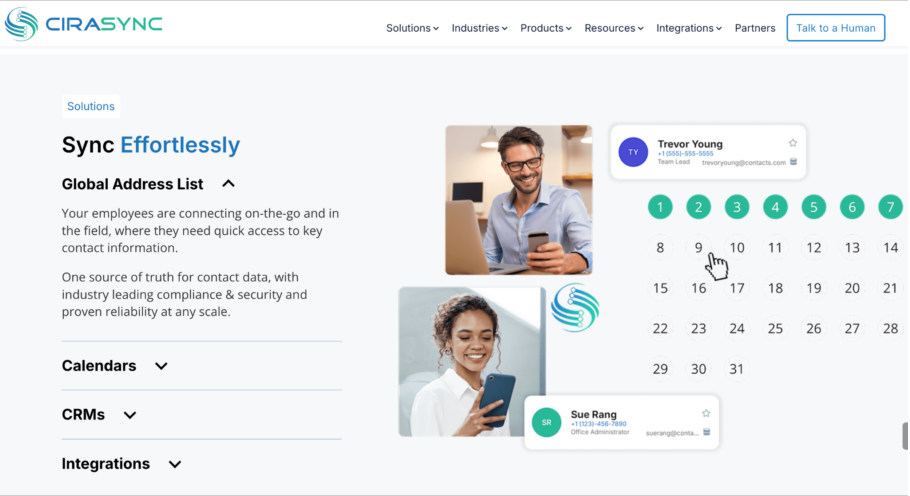
Platforms like CiraSync address this by acting as a bridge between the firm's CRM, its Microsoft 365 tenant, and employee smartphones pushing approved contacts into native iOS and Android contact apps without requiring end-user action or third-party mobile applications. Because the synchronization mechanism and the source data remain within the Microsoft 365 compliance boundary, the firm retains its existing audit, encryption, and access controls at the
infrastructure layer.
A practical note on endpoint governance: synchronized contacts pushed to a device do land in the device's native contact store. On iOS, that store can sync to iCloud; on Android, to a Google account. Full control of the endpoint contact store preventing personal cloud sync of firm contacts typically requires a Mobile Device Management (MDM) policy alongside CiraSync. Compliance and IT teams should evaluate their MDM configuration as part of any contact governance initiative, particularly for BYOD environments where advisors use personal devices for business communication.
Importantly, the CiraSync model is centrally administered by compliance and operations teams, not left to individual advisors. IT defines which contact sources sync, which users receive them,
and how frequently updates run. When an advisor departs, their access is revoked at the tenant level. When a contact is deactivated in the CRM, it disappears from every synced device. This transforms contact management from a reactive support ticket into a proactive supervisory control.
A Call to Compliance Leaders
The risk is not in your technology stack. It is in the gap between your stack and your advisors' pockets.
If your firm can produce every email but cannot verify the contact record behind a text message, your audit trail has a hole. If your advisors are messaging numbers that never passed through your CRM, your supervisory review is incomplete. And if your contact data governance strategy ends at the desktop, your mobile footprint is ungoverned.
Regulators are no longer asking whether you have a policy. They are asking whether you can prove it works in practice. For RIAs and regional banks, that proof starts with the contact list.
Centralized RIA contact management and wealth advisor CRM sync are not IT projects, they are compliance infrastructure. The firms that recognize this distinction first will be the ones that pass their next SEC examination without a finding.
Close that gap, and you close the blind spot