


A US company recently revealed a nuclear battery designed to last for more than a century without needing replacement. NRD, a manufacturer of advanced nuclear materials, announced its new NBV series power cells, which use the radioactive isotope Nickel-63 to generate electricity through a solid-state betavoltaic design.
Unlike conventional batteries that store energy chemically, the series continuously converts energy released by radioactive decay into a small but steady electrical output. Although it's irrelevant to the consumer market now, it’s potentially the key to a major innovation in the future.
It's not big enough for smartphones, but it's pretty cool
According to autoNotion, NRD’s NBV battery can operate for over 100 years while requiring no maintenance, which means it's suitable for devices deployed in remote or inaccessible locations. The battery delivers between 5 and 500 nanowatts of power in a compact 20 mm × 20 mm × 12 mm package.
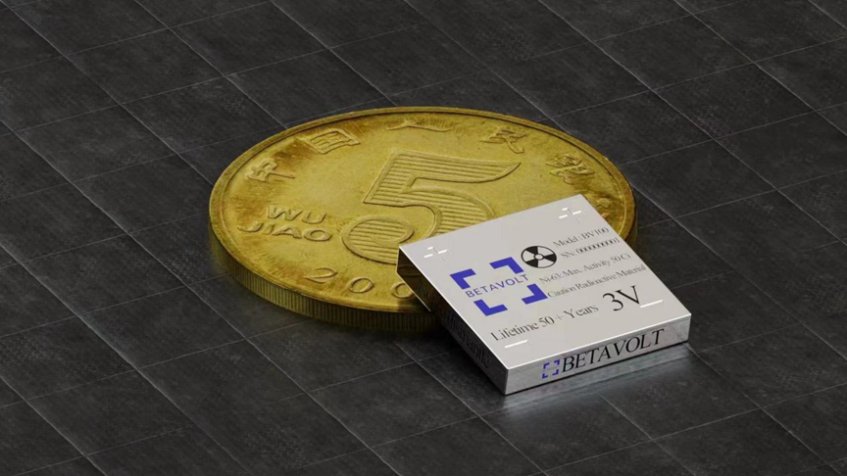
Its size is roughly a postage stamp, but much thicker. You could say it's a compact chip or sensor block you’d find inside a smartwatch or industrial tracker. Regardless, it's far too low for smartphones, laptops, or other consumer electronics.
An average modern smartphone consumes from a few hundred milliwatts while idle to several watts during active use. On the bright side, the battery could power specialized devices needing tiny amounts of electricity for years or even decades at a time.
Potential applications include environmental sensors, data loggers, security systems, and industrial monitoring equipment. Normally, these devices use lithium-ion batteries that eventually die and need quicker replacement. They're more expensive and mean facilities have to dissemble devices buried in concrete, implanted in the body, or navigate around other tricky situations.

With the nuclear battery, a sensor buried deep inside a bridge could continuously monitor structural stress and transmit occasional status updates without maintenance crews ever replacing its battery.
It's a long road from nanowatts to smartphone
NRD’s battery doesn't change anything for smartphone users in the near future. But at least, companies continue exploring alternatives to traditional lithium-ion batteries.
If betavoltaic technology improves dramatically in the future, a nuclear power cell might one day run ultra-low-power functions inside a phone even when the main battery is dead.
For example, the security chip that stores your passwords and fingerprint data or very basic “find my phone” tracking signals in rare cases. As for how long it would take before it's large enough to meaningfully power a phone, it's uncertain.

Even in optimistic predictions, we're likely talking many decades before it starts influencing mainstream electronics design, and longer before it has any role in powering user-facing phone functions.
Android phones are constantly powering a bright display, cellular radios, Wi-Fi, cameras, speakers, processors, sensors, and background apps. The amount of energy they consume in a fraction of a second would take NRD’s nuclear battery thousands of years to produce.
But battery progress in phones is already happening, though it's small. Manufacturers like Realme and Xiaomi now replace some graphite inside batteries with silicon to allow them to store more energy in the same space. It's why phones with 6,000mAh battery capacity or higher are becoming more common on the market.