


First Impressions and the “Primacy Effect”
On my first date with the woman who would eventually become my wife, we were both a ball of nerves, each trying to make the best possible impression. That’s the primacy effect at work: a cognitive bias where our brains cling to first impressions—sometimes at the expense of everything that follows. It’s a helpful shortcut in some situations but can also lead us to stubborn, often inaccurate conclusions, whether about people or, for example, films dismissed by the critics that are actually worth a look.
In our case, the breakthrough came when we realized we shared a common enemy—a cruel individual we’d worked with at separate jobs. That mutual recognition made our chemistry electric. As Henry Rollins once said:
“Nothing brings people together more than mutual hatred.”
Fear, Paranoia, and Satire in Suburbia
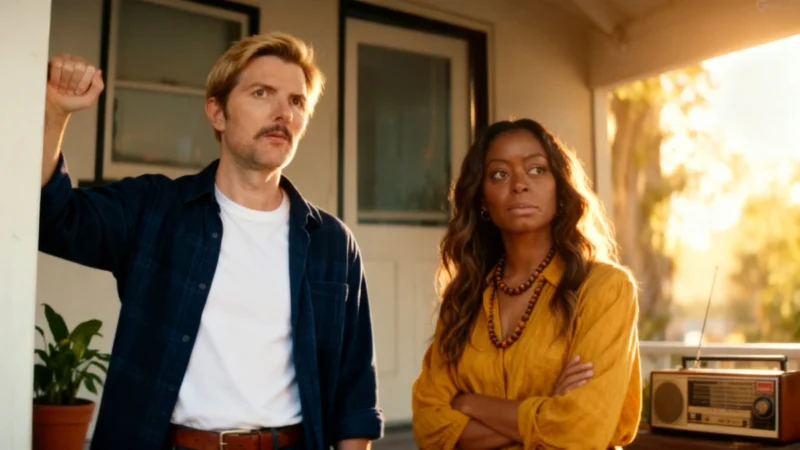
That strange energy of shared suspicion is at the heart of “The Saviors.” The story follows Sean and Kim Harrison (Adam Scott and Danielle Deadwyler), a suburban California couple teetering on the edge of divorce. They rent out their guesthouse to Amir and Jahan, Middle Eastern siblings played by Theo Rossi and Nazanin Boniadi. The film never names the siblings’ country, a deliberate choice.
Before long, Sean and Kim become convinced their tenants are plotting to assassinate the president. Clinging to their first impressions, they read even minor behaviors as evidence of a terrorist plot—an echo of the biases that have pervaded much of post-9/11 American society. Their growing paranoia and xenophobia, unsettling as it is, transforms into the very thing that unites their fractured marriage.
Marriage as Metaphor
Sean and Kim’s dysfunctional partnership can be read as a stand-in for the nation itself. They are caught in an endless cycle of instability, sometimes pulled further into hysteria by Sean’s conspiratorial, far-right parents (played by Ron Perlman and Colleen Camp). Instead of confronting their own flaws, they project their anxieties onto their Middle Eastern neighbors. The inspired casting of Scott and Deadwyler highlights that even self-identified liberals—or those with marginalized identities—aren’t immune to the pervasive social conditioning that fosters fear of the “other.”
Who Can You Trust? The Rorschach Test of Bias
Amir’s first words as he settles into the guesthouse say it all:
“What a great step for humanity. Letting strangers sleep in your home.”
Depending on your own lens, this might sound earnest or unsettling. The film builds tension on precisely that ambiguity. Amir and Jahan’s actions, while sometimes suspicious, are ambiguous enough to force the audience into its own Rorschach test: are the Harrisons responding rationally to real threats, or projecting their assumptions onto innocuous behavior?
This is no accident. By refusing to specify Amir and Jahan's homeland, the film critiques the American tendency to oversimplify and stereotype entire regions and peoples. Director Hamedani, an Iranian American, couldn’t have predicted how timely “The Saviors” would feel upon release. Just before its SXSW debut, real-world Iranian-US-Israeli hostilities reignited the same fears that have flickered in America for decades—and the film’s portrait of festering paranoia suddenly hit even closer to home.
Part of what makes “The Saviors” linger is its sense of inevitability. Hamedani and co-writer Travis Betz explore how suspicion and division have become fixtures of American life, suggesting that despite the traumas of recent history, little has truly changed.
As Sean’s obsession deepens, he ropes in his sister Cleo (played with wild energy by Kate Berlant) and an eccentric private investigator, played by Greg Kinnear in a memorable wig. Their farcical, makeshift surveillance spirals out of control, moving the film from grounded satire into surreal, genre-blending territory. Throughout, Scott and Deadwyler’s performances keep the film tethered to a recognizable emotional reality, using awkward humor to offset genuinely unsettling moments.
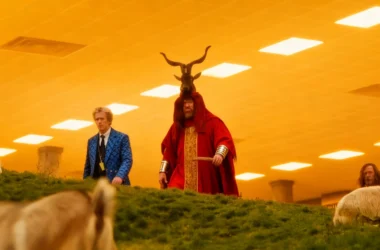
Sean’s recurring nightmares of apocalypse, which at first seem tied to Amir and Jahan’s secrecy, gradually reveal themselves as reflections of his own unraveling mind. The more he buys into his own paranoias, the stronger the self-reinforcing cycle of fear and projection becomes—mirroring the feedback loops that sow division in real life.
Combining incisive dark comedy with speculative sci-fi, Hamedani probes questions that rarely get comfortable answers: what risks are posed by letting outsiders into our most private spaces? Why do people avoid facing their own uncomfortable truths? “The Saviors” also questions whether good intentions—especially those tinged by ego or a desire to be a “savior”—can do much to confront deeper human flaws.
In the spirit of the best “Twilight Zone” tales, the film refuses to tie things up neatly. Instead, it leaves ambiguity and tension trailing into the credits—a challenge to our reflexes and assumptions, whether about neighbors, strangers, or ourselves.