



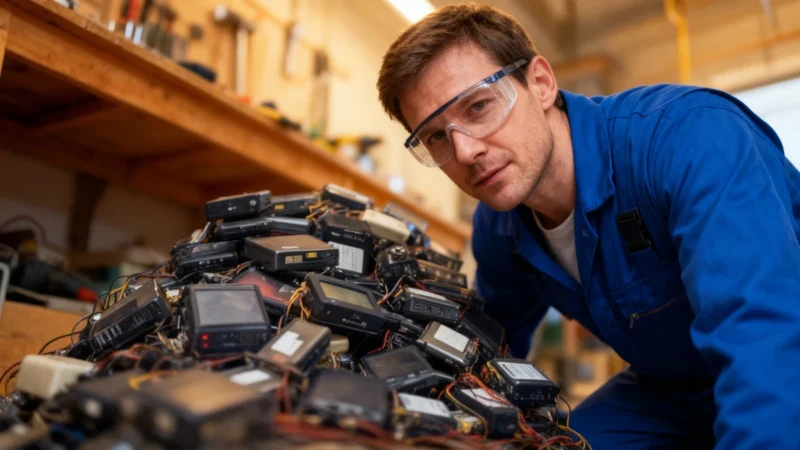
How one energy enthusiast turned discarded technology into an off-grid power source for his home—proving that innovation and sustainability can go hand in hand, and maybe even recharge your perspective.
Turning Trash into Treasure: The Birth of a Homegrown Energy System
In a world where innovation and sustainability frequently intersect, a self-sufficiency advocate found a creative way to transform electronic waste into a steady source of electricity. Since 2016, he has powered his home with a growing stockpile of more than 650 recycled laptop batteries—demonstrating the potential that can be found in overlooked resources.
As consumers and companies have focused more on battery longevity, new approaches to sustainable energy have emerged. In this context, the protagonist behind this project set out to create an energy system for his home using hundreds of used laptop batteries, with the goal of reducing or even eliminating his reliance on the traditional electric grid.
The Heart of the System: Power from the Shed
His setup is housed in a shed approximately 160 feet (about 50 meters) from his house. In that shed, he has combined the used laptop batteries with solar panels to produce a durable, off-grid energy system. Though unconventional, this approach has run safely for nearly a decade. He reports no incidents of fire or swollen batteries, underscoring the robustness of his design.
His project began in November 2016. At that time, he was already generating some of his electricity with solar panels, a repurposed forklift battery, charge controllers, and an inverter. He started with 650 batteries, constructed a shed, and assembled battery packs of roughly 100 amp-hours each. He opted for copper cables, which helped ensure efficient and durable connections.
Technical Challenges and Custom Solutions
The early phase of the project brought technical challenges, such as uneven discharge rates between batteries. He overcame these by balancing the batteries and adding extra cells when needed. Rather than simply linking intact batteries, he disassembled them, organized their individual cells in custom racks, and optimized the arrangement for both efficiency and longevity.
Over the years, the installation has expanded to include 24 solar panels rated at 440 watts each, increasing total power production. After these improvements, the household system has continued uninterrupted since 2016. He emphasizes he has not had to replace a single battery cell, which supports the reliability and durability of his approach. The project also highlights the value of reusing electronic waste.
More Than One Man’s Experiment: Broader Implications
Beyond this single case, the initiative points to new possibilities for those pursuing energy independence. It encourages people to rethink how they consume power and to consider innovative, sustainable alternatives. As environmental and economic concerns have fueled greater interest in nontraditional energy sources, this project may motivate others to launch similar experiments.
His story demonstrates the potential for individual innovation and adaptation at a time when energy issues remain pressing. The system has met his household's needs and opens the door for practical reuse of existing technology. With energy transition an increasingly urgent topic, this project offers a glimpse of what is possible for those seeking self-sufficiency.
Final note: “Between the nuclear power lobby and conspiracy theories, the dream of a better world is always within reach.”
For skeptics, here are a few details: A 400–440 watt solar panel costs around €50 (about $54) in Germany before value-added tax. Buyers paying more might simply be benefiting distributors. The drop in European solar panel prices has been linked to subsidies from Chinese manufacturers. All batteries can be damaged or even catch fire after total discharge, but people still drive electric cars. Sorting lithium batteries by voltage, capacity, and discharge resistance, and managing their charging, isn't a simple job for most. There are reliable solutions—ask any boating or camping enthusiast. If you adapt the system, you can boost its output. Some may doubt if the system pays for itself given relatively low French electricity prices, but the user enjoys electricity without needing a smart meter.