



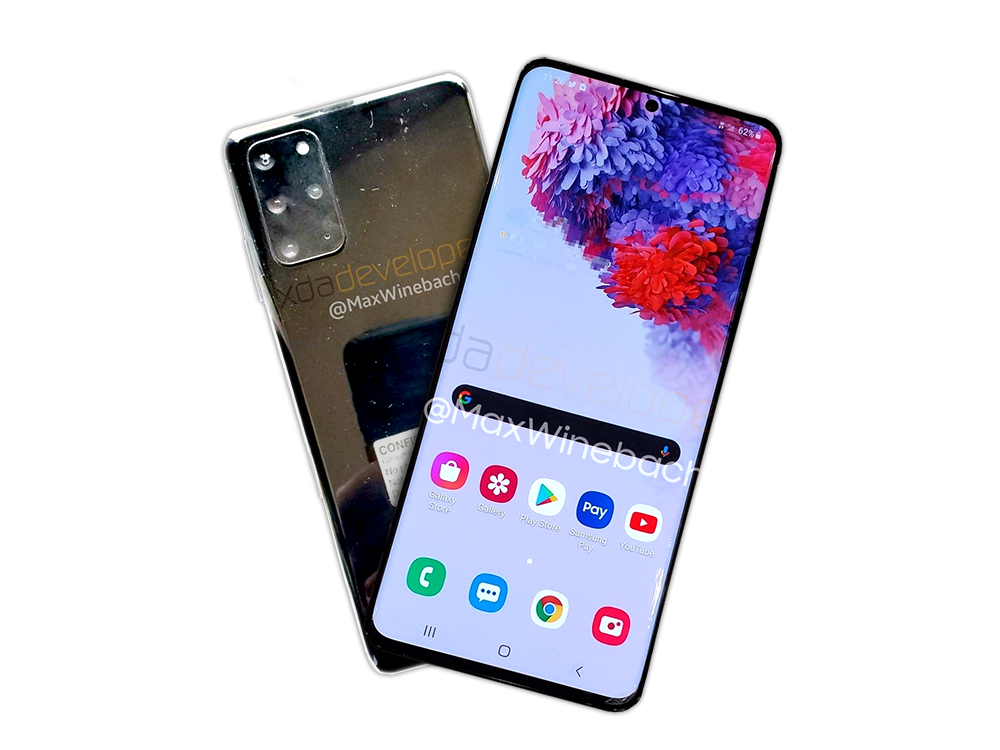
Details of Samsung's imminent flagship trio are leaking at an accelerating pace, including an interesting segmentation of camera hardware and the first hands-on photos.
Samsung's S-series of flagship smartphones are often the phones many look forward to each year, as they often debut the latest in processor, display, and camera technologies, and as we draw very near the announcement of Samsung's next-gen Galaxy S20 series launch a mere month away, we are seeing more and more details leaking.
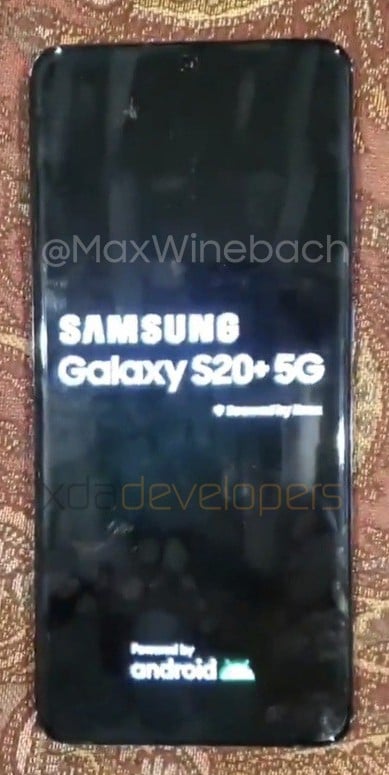
Alongside the first live photos of the S20+ 5G (every phone launching with a Snapdragon 865 is 5G capable due to Qualcomm's imposition that they must be bundled with X52 5G modems) above, Ice Universe has reported further on the camera hardware of the trio.
Ice Universe is possibly the most prominent Samsung leaker at the moment, having announced most of the flagship S20 trio's details that we yet know, including the incredibly powerful new 108MP sensor set to debut on the smartphones, but he has just tweeted that said sensor may be more exclusive than we had thought:
@UniverseIce has now reported that the gargantuan 108MP (12MP 9:1 pixel-binned) sensor may in fact be exclusive to only the most premium ‘S20 Ultra', while the regular S20 and S20+ will instead sport new 12MP 1.8μm sensors, as opposed to the 12MP 1.4μm sensors used in most flagships today (except Huawei which uses unique sensors).
This may sound like a huge downgrade for the non-Ultra smartphones, but in fact a 9:1 pixel-binned 108MP sensor produces a 12MP image with a rough equivalent of 2.4μm (micrometer) sized pixels, meaning that the image sensor of the S20 Ultra will bring in more light than its smaller brethren, but not by a huge margin.
It is also worth noting that even calling sensors like Sony's IMX586 '48 megapixels', and Samsung's GW1 as '64 megapixels', and this new 108MP sensor as ‘108MP' is misleading at best, as they each employ hardware-level ‘quad-bayer filters' where each lot of 4 pixels is only a single colour. This means that such high-resolution sounding sensors are in fact invariably actually 12MP or 16MP sensors in function, and '48MP' and '64MP' camera modes available on phones which use the sensors are in fact only upscaling that 12MP/16MP image.
So, while on paper a 108MP -> 12MP sensor difference may seem gargantuan, in effect we are actually seeing a 12MP 2.4μm vs 12MP 1.8μm sensor difference; a downgrade to be sure, but not much of one.
Ice Universe has also claimed that the S20 and S20+ will feature 64MP (16MP 4:1 pixel-binned) effective 1.6μm sensors for their zoom lenses while the S20 Ultra will sport ‘only' a 48MP (12MP 4:1 pixel-binned) effective 1.6μm sensor, while all three will use 12MP sensors for their ultrawide lenses.
Though this may seem confusing, I would assume that the standard models will be using Samsung's GW1 '64MP' sensors for zoom while the S20 Ultra will instead utilise Sony's IMX586 or 686 '48MP' sensor, which has been widely reviewed as superior to Samsung's GW1 despite the mildly lower resolution.
Also, only the S20+ and S20 Ultra will sport the Time-of-Flight depth-sensing cameras which help somewhat with faux-portrait modes but are otherwise forgettable.
Samsung may be reserving their absolute highest-end of hardware for the new ‘Ultra' variant of their imminent flagships, but don't worry. We can expect all three S20 models to provide amongst the best, and possibly the best camera experiences out there – even if the S20 Ultra is slightly better.
Sources: @UniverseIce, XDA Developers

Why is 1.4 to 1.8 significant but 1.8 to 2.4 isn’t?
Overall, it’s more a fact that it’s a new sensor (Samsung has pretty much used the same sensor for the last three years), and there is some other tech that may be in it. As well as the fact that image processing is more a factor in modern phones than the hardware alone.
But yes, you’re right to point out that 1.4um -> 1.8um is a smaller proportional increase than 1.8um -> 2.4um, but bayer-filter sensors also face a few issues due to the binning, part of the ‘effective’ pixel size I stated. Overall I’d expect the sort of ‘delta’ between each of the three pixel sizes to be roughly equivalent, but new image processing will aid all of the S20-series as well.