



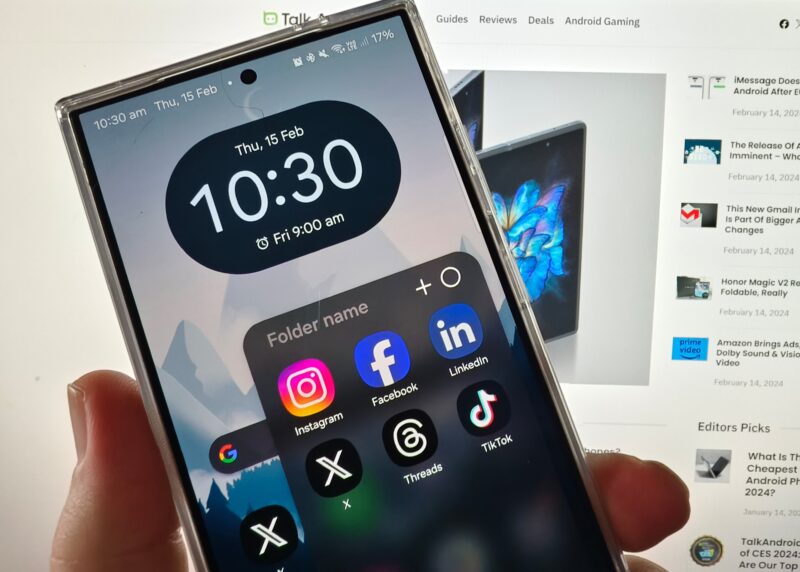
Google acquired Android Inc. in from Andy Rubin, Rich Miner, Nick Sears, and Chris White in 2005. It released the Android OS two years later and changed the system for the consumer mobile market. Recent Statista research indicates that Android is the dominant OS globally, with a market share of 70% in the fourth quarter of 2023 alone.
With a large user base, there's a strong incentive for Google and app developers to keep innovating on the platform. Already, we're witnessing Artificial Intelligence (AI), Augmented Reality (AR), and cloud computing domination among other key drivers. Here's how they impact Android devices, and what's to come.
AI becomes more prevalent
In 2022, The AI sector generated $7 billion and is estimated to reach $132.42 Billion by 2030. AI features are rising in Android apps, offering personalized experiences and advanced functions, from chatbots to image recognition. More and more apps learn your habits and preferences to recommend products. It almost feels like they know you. Below are some ways they shape our everyday lives.

Smart replies, translators & circle to search
In messaging apps, AI-driven smart replies understand the context and suggest quick responses. The latest Samsung Galaxy S24 line integrates Chat Assist with your keyboard, checking your message as you type. Your phone then offers suggestions to improve clarity, and grammar, or even propose witty replies. With Live Translate, you can break language barriers and speak to anyone.
Likewise, the Google Pixel 8 Pro can recommend relevant replies for received messages. If a friend texts “Let's go shopping,” Gboard may prompt you to respond with “I totally agree!”. Both phones leverage Circle to search to enable you to find web content faster.
Virtual assistance down to photo categorization
Most Android phones today have Google Assistant pre-installed. It provides real-time information, smart home control, and schedule management. In February, Google introduced Gemini, a new AI model, allowing you to choose between both. Gemini is supposed to be the better option, as it learns topics instead of browsing through articles and giving you generic answers, among other capabilities.

Flagships this year are also using automatic photo categorization. We've seen this in action within Google Photos. The app automatically groups your pictures by people, places, or objects. You can even search photos based on content, rather than the title you saved them with. For instance, type “birthday cake” into the search bar and you'll see every photo you've taken or downloaded with birthday cakes.
AR/VR Technologies alter reality
The United States leads in revenue generation, with the largest market segment being AR Software. The AR & VR market should reach $38.6 billion in revenue by 2024, with an annual growth rate of 11% projected until 2028. Android is well-positioned to capitalize on it and is offering the features to a large user base.
Google Maps' Live View is one example. You can point your phone camera at a street while walking or cycling. Then arrows overlaid on the real-world view guide you to your destination. There are also numerous AR and VR apps available on the Google Play Store for free download. Augment lets you place furniture and other equipment in your home to visualize how they look before you buy them.

Instant apps provide weightless experiences
Although Instant apps represent only 0.20% of all apps on the Play Store and 0.21% of total app downloads, they're useful. They offer free trials and eliminate full downloads. You may notice that some apps on the Google Play Store have “Try Now” buttons. Tap them, and you'll launch a preview. Play Store gives you access to specific features and their code modules. If you like what you see, you can get the full version afterward.
These innovations are only a few Android trends. In the coming months, expect to see foldable phones becoming more mainstream, solutions tailored to data privacy, and more cloud-based apps.