




With recent leaks and mentionings of the Samsung Galaxy S III one has to wonder what kind of CPU will we see under the hood? Recent rumors were that it's possible we could see a quad-core 2.0 GHz processor in the first half of 2012. And while that sounds a little far fetched, it may not be all that crazy after all. With the recent announcement of the upcoming 1.5 GHz dual-core Exynos 4212 system-on-a-chip (SoC) which can be found on several Galaxy S II's, it's only a matter of time. In slight contrast to the 4210, it will now be built with Samsung's advanced 32nm High-K Metal Gate (HKMG) low-power process touting 30 percent lower power levels. Subsequently, you can expect higher speeds on the GPU as well hence Sammy's boast that the chip will perform with “50 percent higher 3D graphics performance over the previous processor generation from Samsung.” Well, who in the world wouldn't want a device sporting 30 percent lower power output while simultaneously offering 50 percent higher 3D graphics?
Recently, at the ARM TechCon 2011, John Kalkman, VP LSI for Samsung made the following statement:
“I’m extremely excited to announce that Samsung will deliver a new Exynos processor in 2012 that leverages both the Cortex-A7 and big.Little technology to meet the crucial demands of always-on and always-connected computing.”
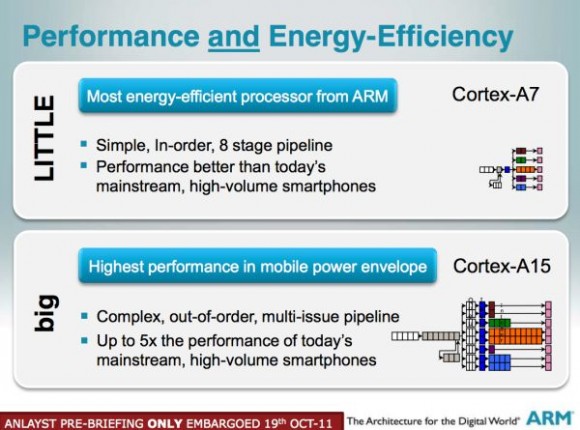
While I'm by no means an expert on ARM's big.Little processing process I can however point you in the right direction to get your learning on. However, from what I can gather, the technology is in part based on using a combination of high performance cores in conjunction with low-power ones to maximize the best possible experience in regards to performance and battery life. ARM is claiming that with this technology devices can extend battery life by up to a whopping 70%. That's extremely significant in this market. As for myself, combine this technology with the right hardware and software and it becomes an instant game changer. Most companies are speculating that Samsung will most likely go with the high-end Cortex-A15 CPU with a 1.8-2.0 GHz clock speed along side two low-end Cortex-A7 cores running around 1.2 GHz each on top of a 28nm process technology. However, can Samsung beat out the competition in this race? TI is looking to show off their OMAP 5 and Qualcomm, their Snapdragon S4 during the first half of 2012. These are definitely exciting times to be in and we can't wait for the day that battery life becomes a rare issue in the industry. Stay tuned as TA continues to gather details on the release of the technology and when we can expect to begin experiencing it for ourselves in the mobile device industry. Check out the video below of John Kalkman's announcement of ARM's and Samsung's intentions for the future of mobile devices.

