


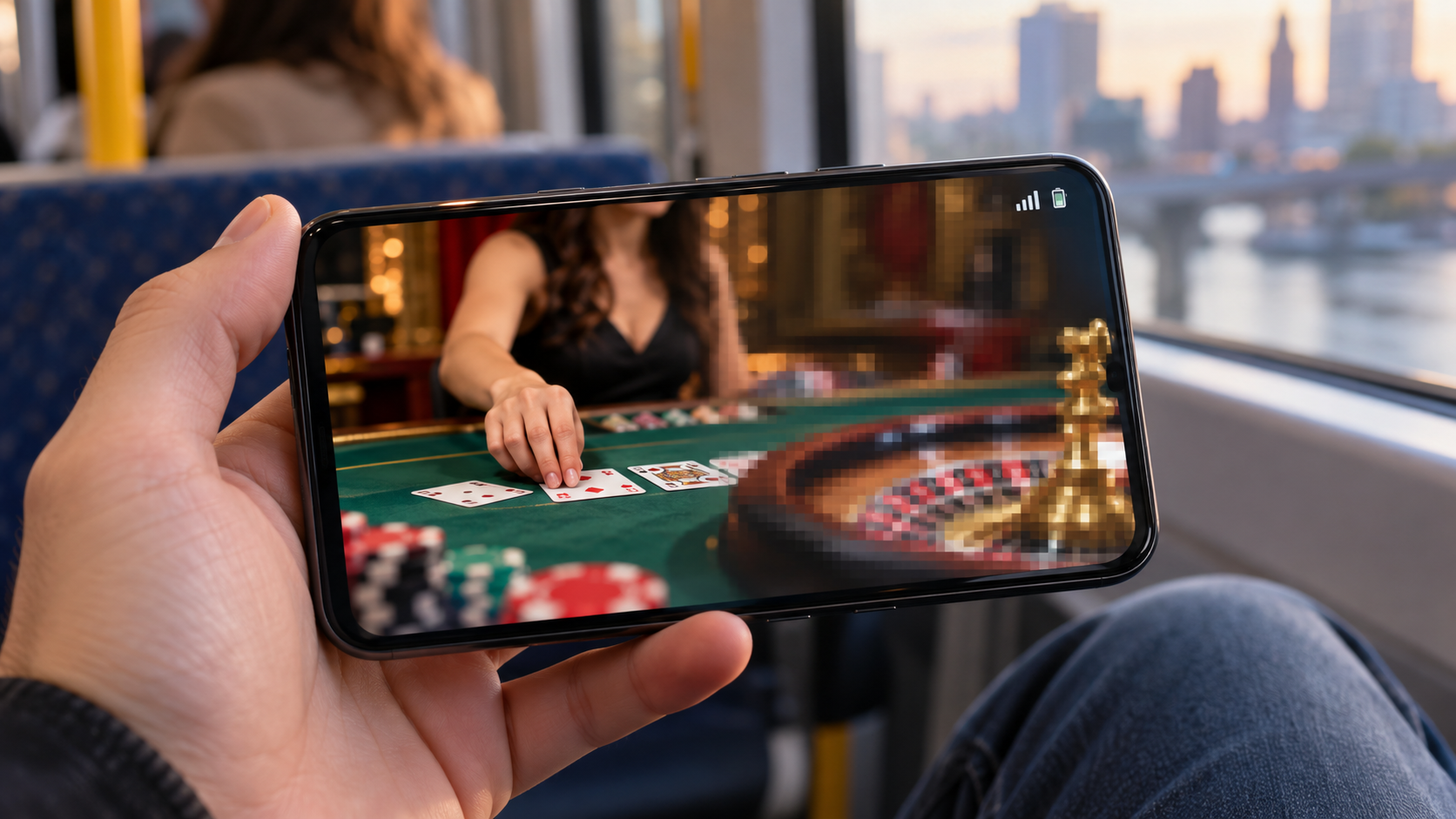
The dealer's hand is still moving, but the picture has become noticeably softer. An Android phone has switched from Wi-Fi to mobile data, leaving the video player with less bandwidth than it had seconds earlier. Rather than stopping the broadcast, the streaming system requests a smaller version of the next video segment.
This process, known as adaptive bitrate streaming (ABR), allows video quality to change while playback continues. In live casino broadcasting, though, uninterrupted footage is only one requirement. The dealer's actions must also correspond to the game information displayed on screen.
Why Android casino streams need multiple video versions
A fixed-resolution broadcast becomes difficult to sustain when network capacity falls below its data requirements. Adaptive streaming addresses this by encoding the same footage at several bitrates, typically with different resolutions.
The resulting bitrate ladder might contain 360p, 480p, 720p and 1080p versions. Each is divided into short, time-aligned segments. A player can therefore move between quality levels without jumping forward or backward in the dealer's sequence.
Device differences complicate delivery. Android browsers run across phones with different decoding capabilities, operating-system versions and network conditions.
ToonieBet, operated by Tobix Limited and aimed at Canadian customers outside Ontario, provides browser-based Android access to a live dealer lobby. The tooniebet login leads into that web environment rather than a conventional native Android application.
The calculation that prevents a video buffer from running dry
An adaptive player estimates network throughput and checks how much playable footage remains in memory before requesting another segment. The relationship between segment size and download time determines whether playback can continue.
Consider two seconds of video encoded at 3 megabits per second (Mbps). That segment contains roughly 6 megabits of video data. On a connection delivering 1.5 Mbps, downloading it takes approximately four seconds.
The player is consuming footage twice as quickly as the connection replenishes it.
Switching to a 0.8 Mbps rendition changes the calculation. Two seconds of footage now contain about 1.6 megabits, which the same connection can deliver in approximately 1.07 seconds.
The remaining bandwidth margin gives the player room to maintain its buffer. Actual performance also reflects audio, connection overhead, request delays and variations in encoded segment size.
ABR cannot improve network throughput. Its contribution is selecting media that can arrive before the available footage runs out. A sudden bandwidth collapse may still exhaust the buffer before the player completes its adjustment.
Why Android browser playback differs from native streaming
Android's Media3 ExoPlayer supports HTTP Live Streaming (HLS) and MPEG-DASH, two formats commonly used for segmented adaptive delivery. Their manifests identify the available representations and media segments.
ExoPlayer can select tracks according to bandwidth estimates and device capabilities. It also provides controls for live playback position and recovery after interruptions.
Those features describe a native Android playback library, not every website opened in Chrome or another mobile browser. Browser-based video depends on the site's player implementation, browser media support and the formats supplied by its streaming infrastructure.
Codec compatibility can restrict the available options. H.264, HEVC, VP9 and AV1 have different decoding requirements, and Android support varies by version and hardware.
Even when the network can accommodate a high-resolution rendition, the device may be unable to decode its underlying format. A functioning bitrate ladder must account for both bandwidth and playback compatibility.
Continuous playback does not guarantee a live picture
A stream can run without interruption while remaining several seconds behind the dealer. The distinction lies between buffering, which occurs when playable media runs out, and latency, the elapsed time between an action and its appearance on screen.
Keeping additional footage in the buffer protects against temporary connection problems. For a live broadcast, however, that reserve can increase the delay behind the source.
Casino interfaces introduce another timing dependency. Video may arrive through a media-delivery service while game-state updates, countdowns and betting deadlines travel through separate data connections.
AWS's betting-and-gaming architecture guidance describes approaches that coordinate video and metadata using timestamps. Without appropriate synchronization, the interface could display information belonging to a different moment from the dealer footage.
ExoPlayer's live-offset controls address playback distance from the live edge, independently of bitrate selection. Increasing video quality or eliminating visible pauses does not resolve a mismatch between media timestamps and game events.
How adaptive streaming behaves when a connection fails
When throughput recovers, the player can request larger segments and restore picture detail. The change carries a data cost: a constant 1 Mbps video stream consumes approximately 0.45 GB per hour, rising to 1.35 GB at 3 Mbps, before audio and networking overhead.
A complete disconnection defeats bitrate adaptation. Once buffered footage is exhausted, playback stops. Prolonged interruptions can also leave a player outside the available live window, requiring recovery to a valid playback position.
These technical safeguards are distinct from gambling protections. In Canada, legal gambling ages and applicable requirements vary between provinces and territories. Gambling participation must be restricted to legally eligible adults, with access to spending controls, self-exclusion measures and support for gambling-related harm.
For live dealer video, reliable delivery depends on more than keeping the image moving. The stream must remain decodable, recover from interruptions and maintain the timing relationship between recorded action and current game information.