



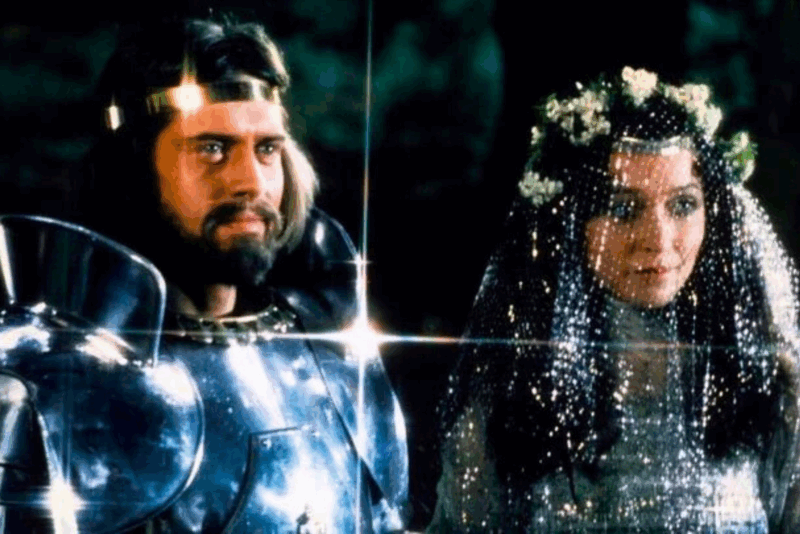
Long before Peter Jackson brought The Lord of the Rings to the big screen, a film inspired by one of the oldest legends in Western literature left a lasting mark on the fantasy genre. More than four decades after its release, John Boorman’s 1981 masterpiece Excalibur continues to be celebrated as a cornerstone of cinematic fantasy.
Excalibur, a legendary adaptation of the Arthurian myth
Excalibur is Boorman’s ambitious retelling of the Arthurian legend, charting the journey of the magical sword from Uther Pendragon to his illegitimate son, Arthur, who rises to unite the kingdom with the guidance of the enigmatic Merlin. The film follows Arthur as he assembles the Knights of the Round Table, faces betrayals, seeks the Holy Grail, and fights to protect his realm against both internal and external threats.
The production is distinguished by its meticulous art direction. Costumes were designed by Bob Ringwood, and Terry English crafted the film’s striking armour. Shot mainly in Ireland, including Wicklow and the iconic Cahir Castle in Tipperary, the film captures a misty, otherworldly atmosphere that perfectly complements its mythic tone. The cast blends veteran British talent with then-rising stars: Nigel Terry as King Arthur, Helen Mirren as Morgana, Nicol Williamson as Merlin, with early appearances by Liam Neeson as Gawain and Patrick Stewart as Leondegrance.
A critical and cult success
Upon release, Excalibur received broadly positive reviews, earning a 72% score on Rotten Tomatoes. Critics praised its “operatic and opulent” vision, with Pauline Kael describing Boorman as “a filmmaker intoxicated, driven by a marvellous form of zeal.” Some reviewers, such as The Boston Phoenix, noted that despite its striking visuals, the film lacked the “archetypal resonance” of a truly mythic tale. Others, like the St. Louis Post-Dispatch, hailed it as a “fascinating, richly detailed and highly enjoyable” film where the legendary figures are “larger than life, as they should be.”
Over time, Excalibur has cemented its place as a cult classic. Its bold, stylised approach to Arthurian myth, rich visual language, and thematic depth have influenced countless subsequent adaptations of medieval legends and fantasy cinema as a whole. For many fans, no film since has captured the raw, mystical essence of King Arthur’s saga quite as powerfully.