


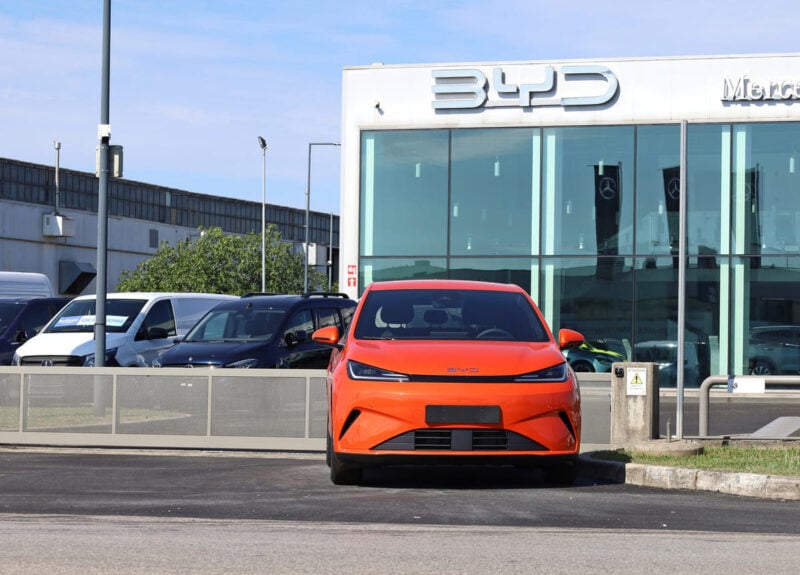
It’s not every day that a new electric car shakes up the industry, but BYD’s latest sedan might just pull it off. Meet the Qin Max: an electric sedan about the size of a Tesla Model 3, priced under $15,000, and capable of charging its battery nearly as fast as you can finish your coffee. On paper, the specs are stunning—and the details are sure to concern competitors.
What is the BYD Qin Max?
The Qin Max is the latest flagship in BYD’s Qin lineup, positioned just above the Qin L. This isn’t a compact city car: the sedan measures about 191.6 inches (4,866 mm) long—roughly 2.9 inches longer than a Mercedes-Benz C-Class and 5.7 inches longer than a Tesla Model 3. It’s a substantial B-segment sedan.
Affordable Pricing and Range
What really stands out is the price tag. The plug-in hybrid version starts at 99,900 yuan (about $13,700), while the fully electric model begins at 109,900 yuan (around $15,000), based on recent exchange rates. To put that in perspective, that’s about half the price of a Tesla Model 3 in China. There are nine variants in total, covering both DM-i (hybrid) and EV (electric) versions.
Incredibly Fast Charging
Thanks to its second-generation Blade battery and BYD’s proprietary Flash Charging technology, the Qin Max can go from 10% to 70% charge in just 5 minutes, and from 10% to 97% in about 9 minutes—close to a full charge in less time than a typical coffee break.
Even in frigid conditions—down to -22°F (-30°C)—charging time only increases by three minutes. The technology reportedly delivers up to 1,500 kW through a single connector, exceeding what’s currently available at most public charging stations. Here, BYD truly sets a new benchmark in charging speeds.
Performance and Features
For the electric Qin Max, buyers can choose between two single-motor setups: one rated at 120 kW (161 horsepower) and another at 240 kW (322 horsepower). The official range estimates are 329 miles and 391 miles, respectively, on China’s CLTC cycle—which tends to be optimistic compared to real-world numbers. All-electric models are rear-wheel drive.
For those preferring hybrid power, the Qin Max DM-i combines a 1.5-liter gasoline engine (74 kW) with a 175 kW (235 hp) electric motor, backed by an LFP battery.
BYD didn’t skimp on interior features. The cabin comes with a 15.6-inch central touchscreen, an augmented reality head-up display (AR-HUD), and, as a bonus, a built-in refrigerator that can heat or cool drinks.
Select versions can be equipped with the God’s Eye B driver assistance system, which includes LiDAR. This option costs 12,000 yuan (about $1,650). The system manages assisted navigation on both city streets and highways. Notably, BYD says it will take responsibility for accidents that occur during compliant use of this feature.
Caveats and the Bigger Picture
Now for the catch: as of August 2026, the Qin Max remains exclusive to China. There’s been no announcement about a launch in the US, Europe, or other international markets. If it ever does arrive overseas, customs duties and import taxes on Chinese electric vehicles could drive the price up substantially.
For now, the Qin Max is aimed at reinvigorating the Qin lineup, which has struggled recently—sales for the series fell by 45.62% in the first half of 2026. With a price tag this accessible and record-setting charging times, BYD clearly hopes to turn things around.