



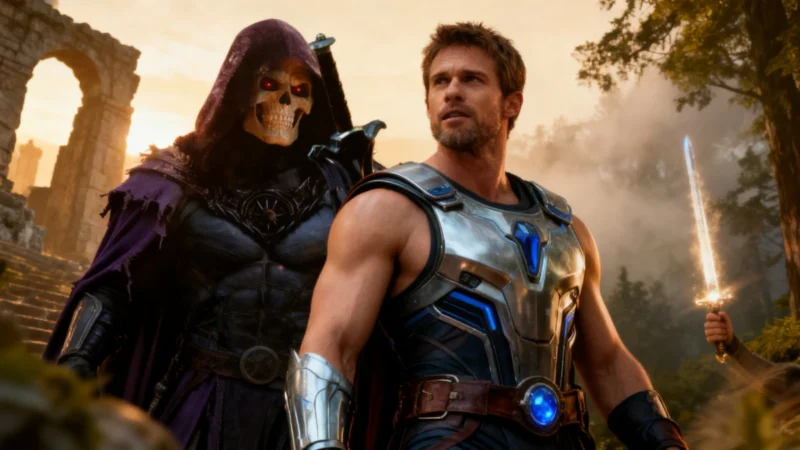
Nearly forty years after the cult-classic kitsch of Dolph Lundgren’s He-Man, Masters of the Universe has finally returned—emerging from a production hell worthy of Eternia. Yet after all that, does this big-budget reboot conquer new ground, or is it caught between past and present, nostalgia and modern spectacle?
The He-Man Project: From Development Hell to Streaming Setback
Since 2009, Masters of the Universe has passed through the hands of directors like John Woo, Rian Johnson, McG, and Andrés Muschietti. In 2022, Sony passed the film to Netflix, which then dropped the project; Amazon eventually picked it up. Directed by Travis Knight and starring Nicholas Galitzine as He-Man, the film debuted July 22 on Prime Video France after a disappointing theatrical run—reportedly pulling in just about $114 million at the box office against an estimated $200 million budget. That kind of crash was easy to see coming for a film split between vintage Mattel nostalgia and modern blockbuster ambitions.
The story introduces Adam Glenn, a thirty-something lost in an uninspired office job. But Adam is actually Eternia’s exiled crown prince, forced to Earth as a child after Skeletor (Jared Leto) seized power. When the Sword of Power finally calls across the cosmos, Adam reclaims it, returns home, and suits up for battle against the usurper. It’s classic sci-fantasy, but the film quickly slips into sprawling, fan-fiction territory.
Big Budget, Small Impact: Nostalgia and Marvel Imitation
Despite an estimated budget of $170–$200 million—roughly on par with Aquaman 2 or Inside Out 2—the film already feels cheap within its first fifteen minutes. The sets look plastic, the visual effects lack depth, and the fight scenes, rather than full of bravado, seem oddly flat and short on energy.
The music, assigned to Daniel Pemberton (Yesterday, Eddington, Spider-Man: Across the Spider-Verse), leans on retro synth stylings likely meant to appeal to longtime fans. Instead of invoking any real nostalgia or synthwave energy, the soundtrack feels flat and dated, further highlighting the film’s struggles to establish a distinct identity.
Adding to the confusion, the film tries to borrow shamelessly from the Guardians of the Galaxy playbook. Meta-humor and punchlines frequently fall flat given the lack of strong writing. Knight’s attempts at light, glossy fun end up stranding viewers for 2 hours and 20 minutes in a halfway space that doesn’t fully commit to any tone.
The Good: Costumes, Cameos, and Jared Leto Cutting Loose
It wouldn’t be fair to dismiss 2026’s Masters of the Universe entirely. The film features some genuine surprises and maintains real respect for its source material, especially in its costume design, which is faithful to the classic 1980s toys. The true standout, though, is Jared Leto’s Skeletor—a turn that could generously be called unhinged. Leto embraces the character’s meme-like reputation, delivering a performance that’s hilariously over the top and unpredictable in every scene.
Opposite him, Galitzine’s He-Man is a departure from the hyper-masculine, stoic hero of the 80s. Under Travis Knight, Galitzine injects humor and even vulnerability into the role. It’s a clever twist, but the script sometimes leans too far into parody, diluting the film’s stakes—most notably during a sluggish Eternia prison sequence.
Dolph Lundgren’s cameo, teased for months, is handled tastefully. The original 1987 He-Man pops up for a well-placed meta wink that doesn’t upstage the rest of the film, and the filmmakers wisely avoid stuffing this callback into a post-credits sequence.
Who Really Wants This He-Man?
This raises a question: Who is Masters of the Universe (2026) actually for? Die-hard fans will see heresy, blaming the reboot for tearing down their childhood icon without offering any new mythology in return. Newcomers are likely to see a generic, formulaic science-fantasy: predictable, uninspired, and visually inconsistent.
Yet if you’re just seeking that explosion of colorful, vintage toy style—or hoping to introduce the franchise to your kids—you might find a half-star more of enjoyment. Torn between excessive fan service and an urge to radically reimagine the brand, this Masters of the Universe lands awkwardly in the middle. It’s imperfect and forgettable but might win over a warmer legacy later on Prime Video.
Viewers Speak: Kitsch, Camp, and Confusion
Fans are deeply divided. Some call out the film’s excessive length (2 hours and 20 minutes) and silly tone, though they also find pleasure in the camp and knowing embrace of the franchise’s long-perceived queer-coding. Others say the true lack isn’t in biceps but in the soul-sapping monotony of Adam’s day job—a sly comment on how the film explores ideas of masculinity beyond brute strength. Daniel Pemberton’s score, while controversial, has its defenders for its wildness.
One viewer notes the film’s similarity to the 1980 camp cult classic Flash Gordon, down to a Queen-like musical homage; but while the comparison flatters, the film’s length undoes much of its potential for so-bad-it’s-good delight. Longtime fans reminisce about the original show as gloriously goofy, and see this reboot as pushing that goofiness so far that it’s more baffling than fun. Still, many agree that Skeletor—thanks to Leto—steals the show, as the only character fully liberated from nostalgia’s weight.
Some give high marks to Knight’s casting, and even prefer the film’s pulp stylings to recent superhero movies. Others find its Guardians of the Galaxy influence overwhelming but appreciate moments of heartfelt character dynamics, like the forest scene between Adam and Teela. There are complaints about inconsistent effects—top-grade work from Industrial Light & Magic sits beside obvious papier-mâché props—and about the missed opportunity in not having a stronger director at the helm.
Older viewers claim the film succeeds at reviving their earliest TV memories, even as it pokes fun at the datedness of the original cartoon, with some noting that deconstructing the old franchise was a necessary evolution.
Whether you’re here for the nostalgia, the costumes, or just to watch Jared Leto chew scenery, Masters of the Universe (2026) is a messy curiosity—torn, but not without flashes of charm. At the very least, it doesn’t pretend to be something it’s not, and every so often, its energy and commitment to camp make the trip worthwhile—if you have the stamina for the full two hours and twenty minutes.