




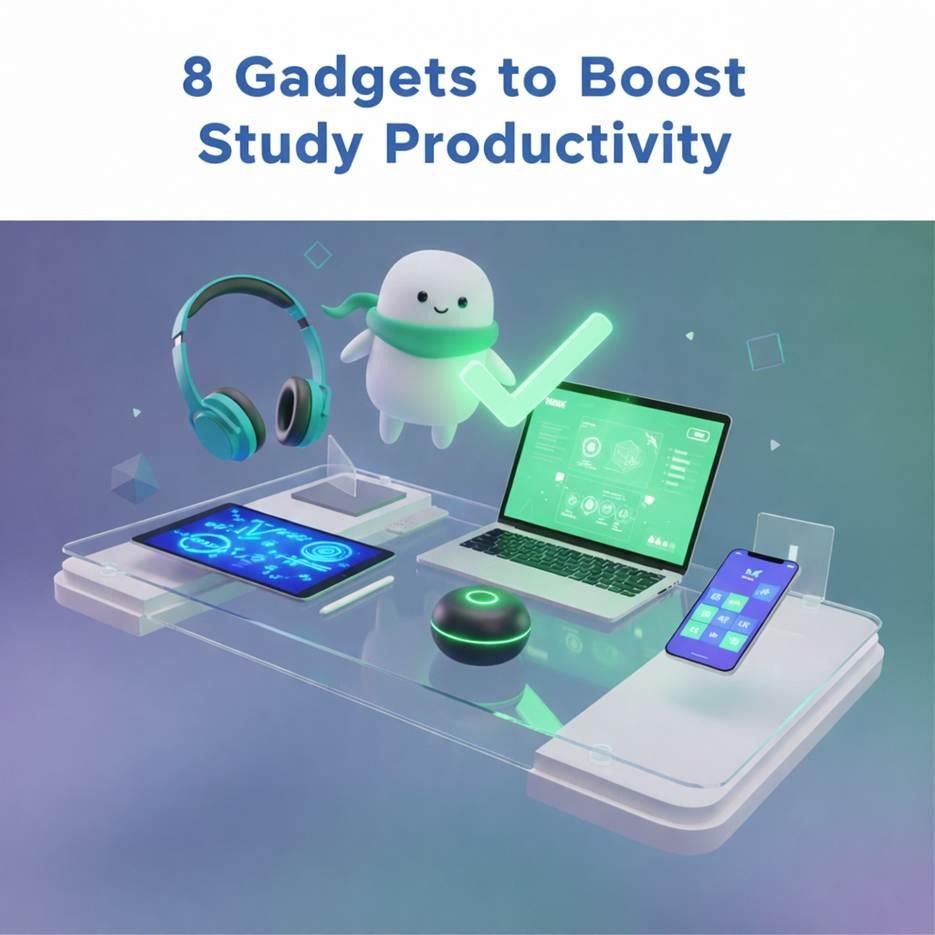
Hundreds of notebooks, printed worksheets, and late-night guesswork are no longer the main components of studying in 2026. These days, students work in a setting that is formed by sensitive devices, advanced technology, and tools made to make learning easier. When distractions decrease, ideas become clearer, and activities seem doable rather than overwhelming, productivity increases.
That is precisely what the newest study-focused devices accomplish. Modern study tools help students stay organized, pay attention, and digest material more quickly.
These tools range from AI-driven problem-solving machines to focus-boosting technology.
When used properly, these resources turn study sessions into productive, organized experiences that provide greater results with less time wasted. Eight devices that significantly increase study productivity in 2026 are listed below; each one offers useful advantages rather than superficial convenience.

1. Tablets Designed for Academic Workflows
For many pupils, paper-heavy setups have been replaced with learning-optimized tablets. These study gadgets retain everything digitally and allow for handwriting, sketching, annotation, and highlighting. The outcome is quite effective but feels natural. Cloud syncing, searchable handwritten notes, and organized folders that cut down on time spent organizing resources are all advantageous to students.
It becomes simpler to handle visual subjects, courses with a lot of formulas, and explanations based on diagrams in one location. Digital note-taking is supported by this configuration without compromising control or clarity. Additionally, contemporary tablets seamlessly combine with PDFs, video lectures, and textbooks to create a single study experience as opposed to dispersed materials.
2. AI Math Solvers That Work From Images
Because one misinterpreted step might completely impede development, mathematics frequently slows kids down. By letting students input images of handwritten or printed problems, AI-powered arithmetic solvers remove that friction. The system analyzes the equation, correctly answers it, and provides a systematic explanation of the logic.
Rather than taking shortcuts, this method promotes learning. Students evaluate logical steps, spot errors, and improve their problem-solving abilities rather than speculating on answers. Additionally, the instant response lessens frustration when studying on your own.
One effective example is this math AI solver, which functions as an AI homework helper by converting images into clear, step-by-step solutions. It supports algebra, geometry, calculus, and word problems, making it a practical tool during daily study sessions and exam preparation. Its early placement in the workflow facilitates student growth rather than their paralysis.
3. Noise-Canceling Headphones for Focus Control
When background noise disrupts one's thoughts, concentration rapidly breaks. Even in public places or shared living spaces, noise-canceling headphones offer a regulated sound environment that promotes deep focus. In order to avoid sensory fatigue, advanced versions in 2026 automatically modify cancellation levels dependent on the environment.
When watching instructional videos or recorded lectures, clear audio enhances comprehension. In order to keep their beat over extended sessions, many students also connect these headphones to background noise or white noise. The advantage is still straightforward: longer, more productive study sessions result from fewer disruptions.
4. Smart Digital Notebooks That Sync Instantly
Students who want to write by hand frequently have trouble remembering and storing information. By enabling handwritten content to automatically sync with cloud systems, smart digital notebooks address this issue. Pages become constantly organized, searchable, and shared when they are written.
Exam preparation is made easier and fewer notes are lost as a result. Content remains available across devices, in contrast to typical notebooks. These notebooks facilitate rapid reviews and long-term memory when used in conjunction with tablets or phones, particularly for heavy on concepts subjects.
5. Portable Monitors for Multi-Task Study Setups
Managing references, practice problems, and study material while working from a single screen reduces efficiency. Without confining pupils to fixed desks, portable monitors increase workspace. Side-by-side viewing of notes and assignments is made possible by lightweight designs that are simple to connect to laptops or tablets.
This configuration minimizes frequent tab flipping and preserves study flow. Portable screens provide flexibility without compromising productivity for students who study in different places. If you’re aiming for a seamless study experience where multitasking is more than supported, then a portable monitor is definitely what you need to increase your productivity as much as possible.
6. Digital Flashcard Devices and Apps
When examinations are organized rather than monotonous, recollection of knowledge increases. Digital flashcards track progress over time, adjust difficulty, and automate spacing. Students receive performance-based, focused prompts in place of haphazard repetition.
This approach lessens needless review while promoting long-term recall. Additionally, digital flashcards sync between devices, allowing for quick study sessions all day long. This method works best for topics that involve definitions, terminology, or formulas.

7. Ergonomic Input Devices for Long Sessions
Productivity is silently decreased by physical discomfort. Long study sessions can be less stressful with ergonomic keyboards and mice, particularly for typing tasks or programming. Longer sessions without weariness are the result of better posture.
Tension can be reduced by making minor changes to the wrist angle or hand placement, which keeps attention on learning instead of discomfort. Despite having a direct impact on consistency and endurance, this category is frequently disregarded.
8. Smart Time Management Tools
One of the most difficult things for students to do is manage their study time. Focus tools and smart timers organize meetings without requiring frequent decision-making. While planned breaks help students avoid burnout, visual timers encourage students to devote themselves entirely to work blocks.
Instead of depending just on motivation, this strategy increases consistency. These tools encourage realistic workloads and lessen procrastination when used in conjunction with planning software. Applying such tools and using them to your advantage, you surely won’t miss an important deadline, and you’ll be able to prepare for your exams on time.
How These Gadgets Work Together
Success cannot be guaranteed by a single gadget. When tools work well together instead of competing for users' attention, productivity increases. Timers organize effort, AI solvers solve obstacles, headphones control focus, and tablets manage content.
When used in tandem, these study tools foster a controlled and intentional learning environment. Students spend more time comprehending the content and less time looking for solutions or controlling distractions.
Final Thoughts
In 2026, smart assistance is more important for successful learning than hard work. The appropriate technology lowers friction, enhances clarity, and keeps kids interested without wearing them out. Learning becomes easier and more fulfilling when technology operates silently in the background.
Pupils who make deliberate investments in these resources benefit from more than just convenience. They acquire time, self-assurance, and mastery over their academic schedules.
Takeaways
● In 2026, employing intelligent technology that eliminates obstacles rather than adds complexity will be crucial to study productivity.
● Students can overcome learning obstacles and comprehend problem-solving procedures more quickly with the aid of AI-powered solvers that operate from visuals.
● Tablets and smart notebooks centralize academic materials, reducing time spent searching for notes and resources.
● Longer, more concentrated study periods are supported by the controlled study environments created by noise-canceling headphones.
● Ergonomic gadgets like portable monitors increase productivity and comfort when studying for extended periods of time.
● Digital time management and memory technologies encourage consistency rather than just fleeting motivation.
● Relying on a single productivity solution is not as effective as combining complementary devices.
● Students who use contemporary study tools thoughtfully gain greater control, clarity, and self-assurance in their study habits.

