




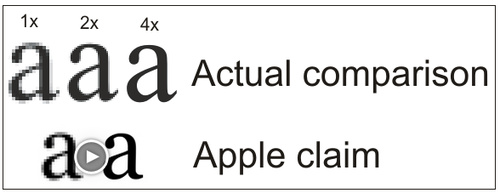
As consumers, we need to stand up for when a manufacturer or supplier makes a mistake describing a product, and when we're actually being misled. Former ZDNet technical director George Ou has used a series of pictures and renderings to convincingly establish that Jobs' team faked a pixel-density improvement of three to five times, versus the two times improvement actually delivered by the new iPhone and its retina display. (326px/in vs 163px/in before)
The image above shows what a 2x and 4x improvement actually looks like. Quite the difference.
[via digitalsociety]
Sadly, this isn't the first time Apple has done this, check it out: Gawker
Granted, the current Android community does not have a device that can match the iPhone 4's resolution or pixel density, but we all need to be aware of marketing departments trying to slip one by us.


Ou doesn’t know what he is talking about. Not only the basic difference between pixel density doubling and resolution quadrupling, but perception of “pixelation” is affected by screen technologies and quality — hell, any manner of representation including print and tv; any advertising, highlighting the display quality, would need to “simulate” the difference.
Did you notice how the difference was indiscernible at a distance, live at the keynote, but the first 10 rows were floored? Did you ever notice that some screens at the same resolution look more pixelated? That some books are printed poorly so rather than just perceive the words, you actually see the printing of the words?
A screen capture of an advertising video on a web site and a photograph by a decent quality DSLR at a considerable distance are “proof”?
God, how does Ou and the author and “consumers” feel about Sulu wearing a Sharp lab coat hawking quad-pixel televisions? Bigger “pixels” and more than likely blown out yellows because everyone else makes images for RGB, not RGB+Y — “Woah!”
If Google had presented this would you have cared? Not likely. Biased journalism is not helpful.
And 960×640 is 4x resolution. You’re counting pixel density, which is 2x. The example they brought up clearly demonstrated each pixel in the example before they zoomed out. How could they have demonstrated that in a more honest way for you?