



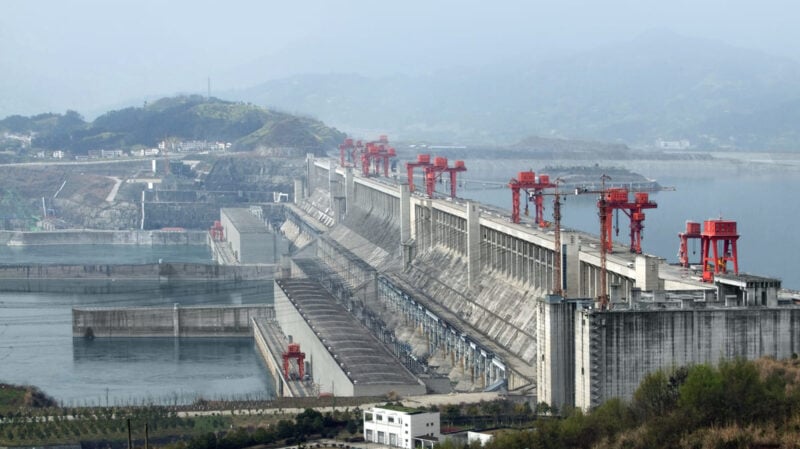
What if filling a single dam could make our days just a tiny bit longer? As incredible as it sounds, that's what NASA scientists once reported when discussing China's enormous Three Gorges Dam, which shows human activity can nudge even the basic rotation of our planet.
The Three Gorges Dam: Engineering Marvel with Subtle Planetary Reach
The Three Gorges Dam, stretching across the Yangtze River in Hubei Province, China, is the largest hydroelectric power station on Earth. Construction spanned nearly 18 years and finished in 2012. At more than 7,660 feet (2,335 meters) long and about 607 feet (185 meters) high, this vast structure can hold up to 10.6 trillion gallons (about 40 billion cubic meters) of water.
NASA noted that storing such a huge mass of water could subtly affect Earth’s rotation. It sounds far-fetched, but this theory is grounded in well-established physics and careful scientific study.
How Could a Dam Affect Earth's Spin?
This concept was explored in a 2005 NASA analysis. Researchers were then reviewing the impact of the 2004 Indian Ocean earthquake and tsunami. They found that massive earthquakes could shift the distribution of mass on Earth, changing what physicists call the moment of inertia—a measure of how resistant an object is to a change in its rotation.
A simple comparison helps: if an ice skater pulls their arms in, they spin faster; stretch out, and they slow down. Similarly, if large amounts of mass move farther from Earth's axis—even something as dramatic as filling a colossal dam—it could slow the planet's rotation ever so slightly.
NASA's scientists found that the 2004 quake shortened the day by about 2.68 microseconds. When the Three Gorges Dam filled, Dr. Benjamin Fong Chao, a geophysicist at NASA's Goddard Space Flight Center, explained that the shift in water could move Earth's pole by about 0.8 inches (2 centimeters) and slow the planet’s rotation just enough to make the day 0.06 microseconds longer.
The Human Footprint on a Spinning Globe
While changes measured in microseconds won’t affect daily life, NASA’s observations show that major human projects—however local they seem—can have global consequences.
Climate change also plays a part. As polar ice melts and sea levels rise, the redistribution of mass from the poles toward the equator continues to slow Earth's spin by an equally minuscule but measurable amount.
Earth’s rotation has always been influenced by natural factors too. Scientists had already observed a gradual slow-down of the planet’s rotation, mostly due to the gravitational pull of the Moon and geological factors. The Three Gorges Dam and other mega-structures are now, albeit at a tiny scale, thinly tipping those balances further.
Keeping Precise Time as Earth Slows
Some researchers have proposed introducing what’s called a “negative leap second” in the coming years to keep atomic clocks aligned with our planet's subtly changing pace. This would mean a minute with only 59 seconds to adjust our timekeeping systems to the slow shift in Earth’s spin.
Even though the effect of any single dam is minor, the collective impact of these grand structures worldwide might become more noticeable if such projects keep accumulating. Countries like the United States, Brazil, and India have also built giant hydroelectric dams. Each individual impact is marginal, but together they could contribute to larger trends.
The Big Picture: Tiny Shifts with Big Implications
NASA's findings about China's Three Gorges Dam are a fascinating example of how planetary systems and human activity intersect. Even minor effects on something as basic as Earth’s rotation remind us that our actions, however remote or monumental, have repercussions on a global scale. Recognizing these links is key to making more sustainable choices in the future.
And for anyone with a sense of humor about planetary physics:
“We just need to build a 24,854-mile (40,000-kilometer) running track around the equator and get a billion people to run non-stop in the direction of Earth's rotation.”
An imaginative idea that only highlights how enormous Earth truly is.